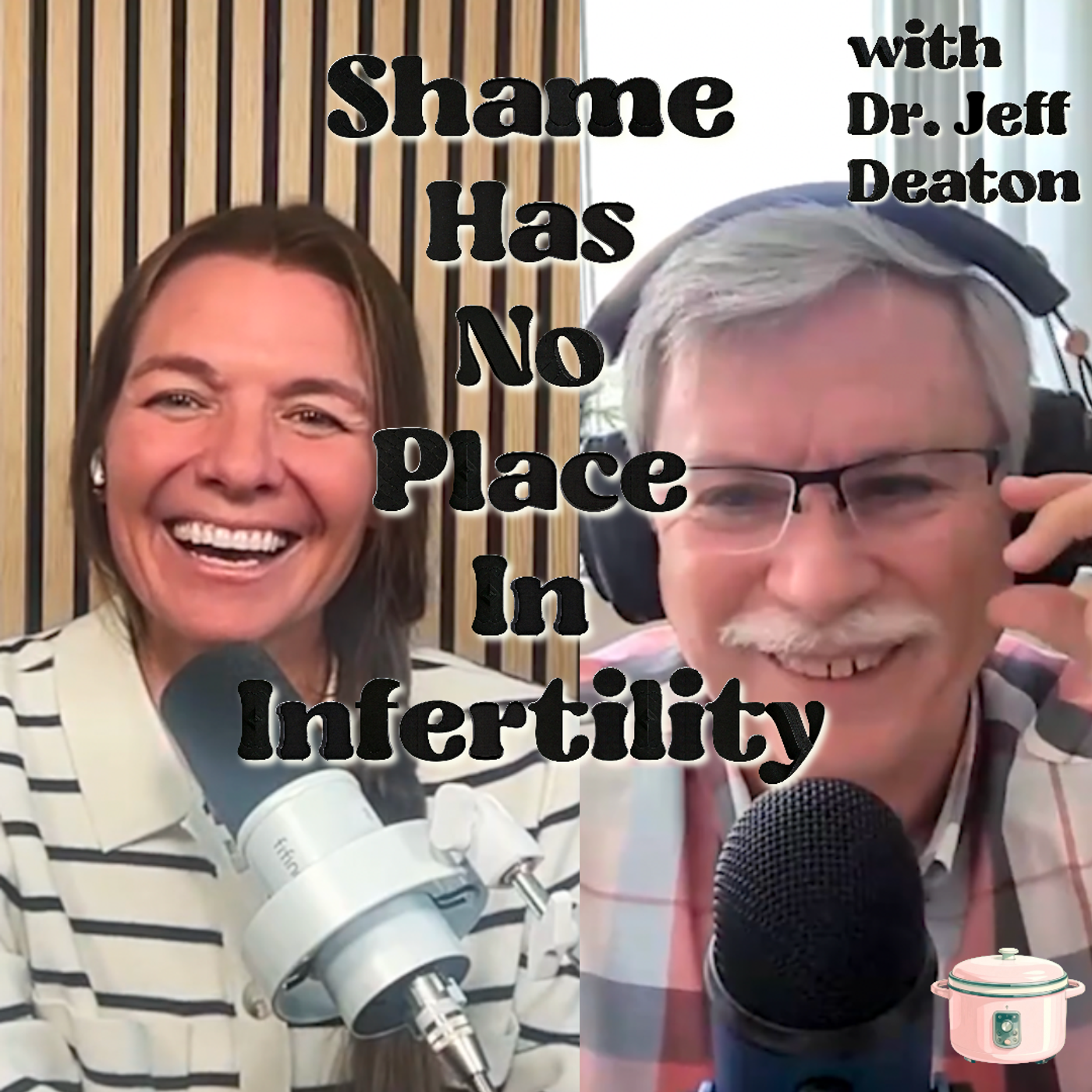
Episode 21: Shame Has No Place In Infertility with Dr. Jeff Deaton
Tonight's Episode
When you find out you may have to fertility issues of any kind a lot of emotions can come up: Frustration, worry, fear, feeling like you're going to be late to a party you assumed you'd be right on time to...and shame. Shame is the worst of these as it's a total liar and can complicate what is already hard to begin with.
Dr. Jeff Deaton knows this all to well in his work as a reproductive endocrinologist both in private practice and in his current role at the Wake Forest University School of Medicine. His medical expertise was certainly impressive, but what struck Ashlyne even more was his compassion for the people involved. She felt so comfortable with him that she inadvertently talked about a teenage trauma for the first time ever in public!
Dr. Deaton's Book: When Waiting Becomes Life
Website: http://jeffdeatonmd.com
Podcast: https://podcasts.apple.com/us/podcast/pod-ology/id1896900354
To get in touch with Ashlyne:
Instagram: https://instagram.com/ashlynehuffblue/
https://instagram.com/confessionsofaslowcooker
Email: [email protected]
https://confessionsofaslowcooker.com
This audio and video podcast was produced, edited, and distributed by Small Batch Sound. https://www.smallbactchsound.com
Small Batch Sound: Hey everyone, and welcome back to Confessions of a Slow Cooker. I'm Ashlyn Blue, and today I'm excited to welcome another practitioner to the podcast. Dr. Jeff Deaton is a medical doctor specializing in reproductive endocrinology and infertility, which is obviously great for us. He gets to see this whole fertility, or in many cases, infertility thing play out from a different perspective than the patient. And also there's like the whole went to medical school thing, which, ⁓ is really impressive to me, ⁓ not being a science girl. like at all. ⁓ on top of treating patients, though, Dr. Deaton has written a book called When Waiting Becomes Life. And it's a collection of honest, heartfelt stories from women and couples who've walked the difficult road of infertility. I will let him talk about all of that in detail, of course, but the reason I bring up the book Is that this podcast came from a similar idea? The idea to write a book filled with stories and context for other women and couples like myself and my husband who deal with this or have dealt with this hardship that I feel like a lot of us either didn't see calm or found to be ridiculously long feeling and sometimes hopeless feeling. So, Dr. Deaton, that's a long way of saying welcome to the show. Thank you for being here. Well, Ashlyn, thank you so much for having me. I really appreciate it. ⁓ me too. And we were talking before this and we have a little bit of a connection. ⁓ he was ⁓ in Nashville for eight years. I I beat you having been there from five to I don't know, I was thirty three when I left. I I left a couple times in between, but for the most part. And ⁓ I love that connection. That makes me feel right at home. It's a great city. It's a great city. It's a great city. Awesome. ⁓ okay, so why don't we start where well, first of all, we get to start wherever you want to start. But ⁓ you are in North Carolina at Wake Forest, right? That's correct. Yeah, I guess if you're looking at the video you can see my Christmas tree. We just like to leave it up. I don't know. We we love it so much and we we'll play Christmas songs in July and we just leave it up. It's just We like the mood. We like the mood. I love it. I love it. 'Cause the first thing I saw I was like, Wait, is that a Christmas tree or am I blind? And you are not at your office today because there is a power outage because of storms, which is Yeah, this happens like once every ten years. It's really, really, really rare and it causes chaos like you cannot imagine. I'm sure Well, actually, you can probably imagine it because you Yeah. I think you went through this journey, but imagine all the patients that were supposed be seen today can't get seen because there's no lights, no computer, no ultrasound, nothing. ⁓ the lab is the lab is okay because they have generator backup, obviously. Right. ⁓ but so, you know, to to try to tell these patients, you know, it's okay, we can get you work in tomorrow. But you know, we had a couple of inseminations that got had to get canceled. So it grieves me. That is stressful. That is stressful. Yeah, it's very stressful. And and luckily it doesn't happen very often. We ⁓ even even in snowstorms we tend to get in and take care of patients. But to have no power is rare. So yeah, it's been it's very c a very chaotic day. And that's why I'm at home doing this so you can see my Christmas. I c you can't really do much else, but ⁓ I appreciate you being here. And ⁓ I talked about your Christmas tree when you were saying what you did at Wake Forest, which is way more important than what I was talking about with the Christmas tree. So will you start that part over for me? I'm currently the medical director of the Wake Forest Center for Fertility and Reproductive Surgery. I've been at Wake Forest ⁓ for a long time. I've been there. ⁓ I came out of fellowship and went straight to Wake Forest. I started the program, was there for about sixteen years, kinda had a little bit of a journey where I went into private practice. I took the entire team, my nurses, my lab, into private practice for 10 years. Mm-hmm. And then due to the new chairman at Wake Forest who came, I decide to come back to Wake Forest to kind of work with her. And so I I'm kind of one of these bounce back. I I left academics and I went back to academics, which is a bit unusual. Like ⁓ yeah, but I also think it could be good for a patient, right? Like somebody who's seen it all. I feel like the ones I mean, I'm thinking of just like having gone to college a million years ago now, the best people and they were it was a music business kind of thing. So it was something that was constantly evolving. ⁓ just like And not just like medicine. But like medicine. It's something that's not just, you know, facts. It's it's a it's a move ⁓ breathing industry and technology has a lot to do with it. So the best people to take, and I always tell told people this and I I guess I still do what they ask, ⁓ take a you know, take the people who are great and have been there, but definitely take people who are still active and and ⁓ you know, adjuncts because those are the people who've been you know, they're not just in the academia. They're also out on the road and they're they're going to their job in real time. And so with something like that, you need somebody who has perspective. ⁓ and I feel like you just the perspective of being in private practice, I think would be ⁓ a really good thing as well for somebody who's going through something that is of such consequence. Yeah, ⁓ it's a very different world, academic infertility versus private practice. And I do think it is helpful that I've seen both. ⁓ I can talk eloquently about the differences in the two. But yeah, I think given I think having that private practice background does help me. ⁓ but sometimes when you're in a big medical center like I am and a big organization, ⁓ it's harder to get things done that that were easy in private practice. So I I've I also find that I'm a little frustrated at times. But I truly do love academics. Part of it's because I feel like I have a calling ⁓ to help train the next generation and and I really missed it when I was gone. I love private practice. I had a great team. We had fun. ⁓ but and I had a day off when I was in private practice. I didn't I don't have that anymore, but I had a day off which is when I actually wrote these stories, just so you know. There's a funny story about that. But ⁓ yeah, I I wanna hear it. Yeah, but ⁓ I do I do I did miss academics and I and I like being back. Well, that's great. I am not a numbers girl. I am not a science girl. I already said that. And ⁓ I used to be really ⁓ I used to I used to be more embarrassed by the fact that it just never appealed to me. I married into it. I feel good about it now. ⁓ we balance each other out. And ⁓ but that said, I had to look up endocrinology today. So and I I mean like I have I actually knew what it was. I just didn't know what it was called. And I and I told you earlier that my husband's a periodontist. I also had to look that up when I found out what he du what he did and my my ⁓ or does. And ⁓ actually my whole family had to be like, what? You know, so ⁓ I'm I'm okay with this now. But will you for all the other people like myself, especially because it does have so much to do with ⁓ reproductive issues, ⁓ will you talk about endocrinol well, you can just talk about the whole thing, but specifically that as well. Yeah, so endocrinology is a broad term meaning primarily the study and understanding of hormones. But there's All kinds of endocrinologists. There's medical endocrinologists which primarily do diabetes and thyroid. Then there are pediatric endocrinologists who do children stuff. And then there's re then there are reproductive endocrinologists like me that focus on reproduction. That's why it's called reproductive. There's a lot of overlap though. I s I I see a lot of patients that are that are ⁓ not a lot, I see some children. So we have overlap. And I see a lot of women that have thyroid disorders. And so I treat that on my own. But if it gets really complicated, I send to one of the medical people. So there's a lot of overlap. All endocrinologists though have a fellowship. It's not it's more than just the residency. So you have to do a residency, just so you understand, when you're if you want to be a fertility specialist like like me, you have to do course med school. And then you have to do a four year OBGYN residency where you do all OBGYN, you deliver babies, you take care of women with cancer, you do it all. And then you further specialize for three years into reproductive endocrinology and fertility. And so even though our field is broad, anything anything endocrinology we can f we can take care of, 95% of what I do is fertility. That's what people come to me for. But if someone has polycystic ovarian syndrome, ⁓ they can come and talk about that with me. They don't need to be getting pregnant. So we do that too. I take care of some women who menopause, menopause, and I take care of some young girls that have primary metarrhea. They don't have periods. And so it's a big feel, but the majority of what I do is fertility. Okay. Well, yeah. And sometimes that person with PCOS wants to eventually be that's right, you know, coming back to you, hopefully, or maybe not coming back to you for that because they took care of it. ⁓ well that's awesome. Okay, let me think. What was my next question? I'm just like, maybe I do like science. ⁓ let me tell you the story let me tell you this let me tell you the story about the book though, because ⁓ when I was in private practice, ⁓ I decided to take Thursdays off. Now I could never take ⁓ totally off because I was a solo provider, but we didn't schedule patients. I I had to do a little work. But I my son was w living in downtown Winston Salem and working. Okay. And so my day off I would I would come downtown, I would go to a special coffee shop I like, and I would ⁓ I would write. For about three or four hours. I just write stories speaking the language. I've always written stories. It's my way to process a little bit and deal with some of my grief and some of my issues. I like to write. So I've always written, but I decided about actually about 15, 20 years ago, I'm gonna write stories of my favorite infertility patients. And so I'd go downtown, I'd go to my coffee shop, I'd get a cup of coffee, I would ⁓ write. And I'd just write for three or four hours, never ever wanting to publish it, just to write. And then I'd go see my son. So it's kind of a special day. I'd I'd go ride then I'd go see my son. He worked at a high end audio play, so I'd go there and we'd listen to vinyls together. ⁓ day. And so I like your Thursdays thus far. I've lost those Thursdays though, but that's that's how the book came about. So I wrote all these stories long time ago and I just set ⁓ aside. I I didn't have people read ⁓ even my best friends. I th one of my one of my really close friends, I had to read a couple of stories, but I just didn't share ⁓ you know. Yeah. ⁓ and then I decided maybe there's something to it 'cause I 'cause people thought maybe I should think about getting it published. And so I had another guy saying, you know, every story has a life lesson. Why don't you put a Dr. Deaton's prescription after each story? And so every story there's a little short prescription about what do you do with the story. And then I just set it aside again for a few years. Didn't even think about it. And then ⁓ I sent it to a publisher about five years ago who said he would publish it, but then he chose not to. And he said, he said, some people like the emotions of a story and some people like the science of what you're doing. He said, give them both. And so I decided to do the story, do the Dr. D's prescription, and then have a little chapter on the infertility journey, kind of in a sequential way. So the book has both it has emotions of a story and then it has some real science about how to get through the infertility journey. Well and that's exactly that's exactly I feel like what is necessary for someone as someone who went through it ⁓ and also talks to a lot of people who are in the middle of it ⁓ offline, they will reach out to me ⁓ and or those who have, you know, come up here on the show to to talk about it in retrospect. But it is both. It is the emotional side and it is the scientific side. And the reason this podcast really started, besides me having the idea back during an acupuncture session of like we should pull these together, ⁓ because I I know more people who are I know more people are experiencing it than are talking about it. which leads me to a statistic that I want to bring up in just a second. But the podcast part of this, I'm not a doctor and I think that's okay. Like the side you like you out, you're out there. ⁓ I th I want to facilitate conversations that I have with other people who are not looking for the scientific part or they just want a little bit support. But those same people need the science of it as well. Those they have their their their their doctors. So having it in one book is like perfect. That's exactly right. That's why I think the book is helpful. And and like most doctors, at least doctors that are proceduralist like I am, because we do a lot of procedures in fertility, a lot of procedures. You know, we're trained in fellowship how to do all the procedures, how to get somebody get somebody pregnant. We're not trained in the emotional side. We're not. And ⁓ and I think it's often more important, you kind of alluded to it just now. I think I think the way you feel about yourself, the way you feel about your body is really important. And it it can make your journey it's gonna be a hard journey no matter what you do, but it can make the journey A hopeful one, one that you do grow, one that hopefully you get pregnant, but if you even if you don't, you still grow and you become a better person because of the journey, if your if your emotions are are correct. So the book is a lot about that, 'cause you know, you mentioned you don't know when people are going through it. Well, yeah. ⁓ I came across a friend of mine long time ago who kind of taught me about shame. he grew up in an alcoholic family. And If you grew up in an alcoholic family, you kind of know what shame is. Shame is basically I don't measure up. That's what shame is. I don't measure up. And so he taught me a lot about alcoholism and alcoholic families and shame. And I started to notice this is exactly the way the women in my fertility practice are are acting. It's the exact same way. And I and I began to learn about the shame of infertility. And it's why women don't often let you know what they're going through because If you don't feel like you measure up, you you want to hide. You want to go, you don't want people to know what you're going through. And so I really wanted to focus a lot of the book on that. So I think some of the stories touch on the shame of infertility. ⁓ because women should not feel shame about infertility. They should not at all. And yet they do. And so I I try to let the book focus on that. I d yes. I was hoping you were gonna say that your friend was Brene Brown. ⁓ tal talking about shame. Because that's the first when I think of shame and funny enough, I think of her and and I'm sure she's like, ⁓ but as a shame researcher, I I ⁓ she she ⁓ embraces it, you know. ⁓ I've read like everything of hers. She's the real deal. And I'll be honest, I got into shame before she hit the big stage, actually. Yeah. But Because back in that day back in that day nobody talked about shame. So Brene Brown, I I guess you're right. I give her all the credit for bringing it into the light. She did. She she's the one who made it something we can now talk about. And I sent her a copy of the book and a little note in it, hoping she would ⁓ respond and give me a call, but she hadn't yet. Yeah. ⁓ well there's time. There's time. Brene, if you're out there. ⁓ but seriously, ⁓ you talked about alcohol I did not grow up in an alcoholic family, but I did have a trauma happen to me. When I was 19, ⁓ a sexual trauma. And that the way you described it, I don't measure up is ⁓ exactly how I felt. And it really, really ⁓ it influenced the rest of my well, up until today, you know, I'm I'm still dealing with certain aspects of it. I have come a long way, but in the immediate aftermath, I I was getting a record deal and I didn't want to be seen. I didn't want you to know me. But I was actually gonna be my well, what is my maiden name now? I was going to be my name, my likeness, and there wasn't going to be a costume. ⁓ but I felt like I should because if you really knew me, if you really knew what I was going through, and that's the idea that I ⁓ my virginity had been taken from me, ⁓ on my nineteenth birthday without my consent, ⁓ that that you would think, ⁓ where did that girl we knew go? 'Cause now she's different. Now she's tainted. Now, you know, that's not what this podcast is about. And I've never actually talked about it on here, but ⁓ there's always a first time, literally and figuratively. Jeez. Anyway, but yeah. She killed me for the longest time. And and I didn't share it with anyone for I think a year and then five years for my parents because I felt it so deeply. Well, I'm so sorry you went through that, but I can tell you've had a lot of healing from it. But things still trigger it. I'm I'm sure things still trigger it at times 'cause that's the way shame is. You're healed of it and yet something'll trigger it. And so I first of all just I applaud you for sharing that. That just means you're pretty healed from it. I am, I am. I it took me a long time ⁓ to actually name it what it was because I was I think one of the best things that shame can do, and not best. Best is not the right word. One of the the craftiest things that shame can do is make you feel like your story is not like other people with the same thing. So for me, my lack, my freezing in the process, ⁓ versus fight or flight, I thought there were only two Fs there. ⁓ I didn't realize that there were actually four and f ⁓ freezing and fawning are other ways to respond. ⁓ because I just only heard those, you know, it's 2004. Who who I just I heard fight or flight. And ⁓ so I thought my freezing and my dissociation and just like not not moving, not participating, whatever was somehow making me at fault. And that's what I took from that experience. And until literally December of this past year when my Christmas tree was up, ⁓ I I graduated, if you will, from my w ⁓ a cognitive post traumatic ⁓ program with my psychiatrist. And I still see him for everything else under the sun. But last year there some of the stuff, like you said, was triggered. It had nothing to do, nothing to do with that. And yet it had like grown different branches and come into my 40s in a different way that made me feel like other things were my fault that I had d never actually dealt with. And so my husband, sweet husband, was like, please see somebody. ⁓ and again, it had nothing to do with ⁓ with with anything of what happened on my 19th birthday, but it it had found a way to come back and haunt me. And ⁓ yeah, Shane can do that. Shane can do a lot of things. ⁓ but what Shane can't do is stick around if you don't let it. And so I am ⁓ I am all in the business of bringing stories out, including my own, obviously, ⁓ to talk about what what ⁓ a lot of other people have gone through in a lot of different ways. And that's in for f infertility, it you said or read it when I was like doing your bio ⁓ for the beginning of this. Wha roughly one in six women experience. Yeah, we s we say one in seven roughly, but if you're over thirty five, it's one out of four. If you're over forty, it's one out of three. So it's very age related. but yeah, it's a it's a lot of women. And you don't know they're out there. If you think about a room with seven women in it. That's what I was thinking about. One or one or two of ⁓ will be struggling and you probably won't even know it. Your story so needs to be told. I don't wanna keep coming back to it. But your story so needs to be told because my eyes were open to shame with one thing that happened. I was at church and a woman shared that she was raped when she was a teenager, but she was afraid to tell anybody because she thought they would think less of her. Yeah. And I'm going What? You know, the the person that raped you should not want to share it, but you didn't do anything wrong. Why why would we think less of you for being the victim? Why is the then I then my eyes were just open to how diabolical shame is. Yeah. It it is. And you know, I actually came around to that idea that I should be okay with it even before I did all this therapy. But ⁓ the reason that I went back under my the proverbial rock a couple of times is that ⁓ if I was bold enough to say something had happened in any way, shape, or form, and I didn't even call it that. I didn't even use the R word. But if I got close to it, ⁓ somebody who knew that person, you know, because it was it was some it was my boyfriend. So it's people knew who it would have been if they did the math and ⁓ their response was not good. It was against me. You you need to be careful about how you talk about that. you need to be careful about, you know, he he's not here to talk ⁓ to to you know dispute as if it was disputable. ⁓ i in in my case. I wasn't telling everybody. I was telling somebody in confidence, ⁓ in a very specific conversation. And it only came up because I was finally ready to talk about it. So for that to be the response there, maybe be like, ⁓ maybe I ⁓ my growth is probably wrong. You know, I'm growing in the wrong way. I sh I should have gone the other direction. I should have been saying it ⁓ yeah, it really was my fault. ⁓ and and then later on I'd be mad because I'd be like, Okay, wait, you were not there. Yeah, you shouldn't You weren't there. And I guarantee you you haven't talked to this person about it in order to get his side of the story. So like why are you immediately questioning me? No wonder I had issues, you know? Yeah. And ⁓ it's still I'm a little warm right now thinking about that. Well, thank you for sharing it. Your story is important. And I tell every I try to I don't tell every woman this, don't get me wrong, but if I f feel like I need to say it, I will say to infertility patients, ⁓ if you have children, they will enrich your life. However, your inherent value, your inherent goodness, your inherent qualities are independent of children. You you fully measure up. Whether you have children or not, you fully measure up. ⁓ so I try to th if I could get one thing into these patients, that's why I get into all of ⁓ All of ⁓ Well, I'm tearing up, so cool. one thing that you talk about. ⁓ and actually let me go back to the one in seven or one in four or one in three. I was thinking about on my way here. ⁓ even more, even even further back, like just in a room, I was thinking about like when I was in first grade. ⁓ not specifically first grade for any reason. I'm just thinking of like a young class or like my child's class, my two year old child's class at preschool right now. Like if there are seven little girls in there, you know, like thinking about them as children, as little ones, ⁓ that they might have issues later, it just puts it in perspective, a different perspective to me. Yeah. adults are, yeah, definitely. But like, what can we be doing right now? I don't have a daughter, but I ⁓ I have friends with daughters and ⁓ I was one and ⁓ I am one. No, I am one. And I what can we be doing now to foster something and think about them as eventual potential reproductive ⁓ people because it's you know, and that that not only is an emotional thing, but also reproductive thing in terms of science. And like my sister has PCOS. And she didn't find out she had it or w that it existed until she started trying at twenty-seven with her husband of a couple years. So like she it just didn't even come up. And so, like, what can we be doing now? And I'm not this is rhetorical. I'm not literally asking you to answer. You can, but you don't have to. What can we be doing now as the emotional side, the parental side, the aunt side, the friend, ⁓ you know, ⁓ whatever you are to a to a a girl in your life? And also preparing them for the the scientific, the the physical part of the whole experience. Because both have they they're both A, they're there, but both are necessary to be as ⁓ front and center as possible. Like you said, the emotional side is so important because it's gonna be hard ⁓ if you experience infertility. It's hard to be just fertile, you know, but if you have a little bit of a ⁓ a hold up, you know, in your in your journey, it it does make you question, ⁓ like what not in this exact like I've never said this to myself, but growing up in the South or growing up around circles where ⁓ there's there's quite a lot of shame anyway, just just for for women, you know, and in in every in every sense. And in religion too. And this is not a religious or a politics, kind of or political podcast at all. ⁓ but they all exist in our lives, right? And so ⁓ I've heard recently, ⁓ it was just a news clip, but it was it was one that stuck with me. And someone said, ⁓ it was a man who said, ⁓ you know, basic basically, not quoting him, but something to the effect of what you're good for is pushing out a baby. Growing a baby, pushing out a baby. As if that's like no small feat, ⁓ or as as as if that is a small feat or no big deal. But reducing a woman to her role and then not getting to have that role potentially. Okay, so really what am I good for? If I can't even do the thing I was supposed to naturally be able to do. And ⁓ I feel like again, I've never said that to myself in in so many words, but I feel like that is kind of swirling around. Maybe not what the guy said, but Just that like you're supposed to be able to do this. What's wrong with you? Yeah, I think that's where shame kind of comes in because whether somebody says that to them or not, they often still believe that's kind of one of their main purposes here is and again, I would say, yeah, you you can have a pregnancy and deliver, but that's not your your worth is not tied to that. But yeah, you can do that, but your worth's not tied to it. It reminds me of a book I read recently about ⁓ manhood. And the person in the in the book made the comment that men one of the things men are supposed to do is procreate. And I was kind of offended by it. I mean, the same kind of a thing. Yes, we are able to pro we are able to get somebody pregnant, but that doesn't define my worth at all. At all. Why would you even why would you even attach that to being a man? So you asked a lot of questions in in your lead up to that. I would say that what we can do for children is to try our best to instill them amazing self worth. We should be You could have unconditional love. Every day telling them how special they are. ⁓ try not to use words that curse children, try to use words that bless children, which is not easy to do when you're in the middle of raising X number of children and they're acting out and you're at a restaurant. I mean it's not easy to do that. But the words are important. Children hang on your words. And so if we could try to instill self they do. If we could try to instill self worth into our children, then when they come to face some adversity, whether it's fertility, divorce, whatever it is, they don't tie their worth to that adversity. It's just something they gotta get through and deal with. Their worth is not tied to it. So for children, I think that's what our main job is. If you if you have someone in your life that is having infertility, I think you should resist every temptation you can every temptation to give them advice. ⁓ that's what the doctor's office is for. Don't don't don't give them advice about what they should or shouldn't do. Your job is to sit with them and listen to ⁓ And I always say your job is to sit with them in the waiting room. Because infertility is all about waiting. You're waiting for everything. You're waiting for your period. You're waiting for the treatment start. You're waiting for your pregnancy scan. You're waiting you're just waiting all the time. And so if you're trying to support a family member or a friend that's infertile, that's your job just to sit with them in the waiting room ⁓ and listen to ⁓ and ⁓ try not to make their shame worse. Try not to give them ⁓ advice. Because we all have advice you want to give and just try not to do it. Well, and that leads me to I do a segment on here sometimes. It just depends on the on the guest, about ⁓ called Hot Potato, and it's about those little things, the little tidbits of maybe, maybe it's coming from a great spot, maybe it's not. And it can be both, or maybe it's just ⁓ a cautionary tale of like, hey, this didn't land the way that I'm sure this person meant it. But you're point about giving advice, ⁓ and I like it wrapped up in a medical or a clinician side of things is that a lot of times when I got advice, they didn't realize that it wasn't my body that was having the moment of trouble. They didn't realize it it was actually my husband who who had a blockage, so we had to go in manually or I didn't, he did, had to go in. I was outside. he had to go in and get it removed manually and they were literally put on ice, you know, in in the Denver fertility clinic. And so when somebody took the time to give me their well thought out but not really sought out advice, usually it had something to do with my body or my relaxation methods or lack thereof, or ⁓ it kind of felt sometimes like ⁓ you're not very patient. ⁓ which is another thing that ⁓ I love being told. ⁓ ⁓ you know, and everyone loves being told that, especially when they're waiting. and the person who's telling you to wait or be patient in the waiting is maybe not waiting for anything in that realm, you know. Or I can say I can be that person right now. I can talk to somebody and and be on the other side saying, I know the waiting is hard. Even that yeah, great. Thank you so much for your help. There like it doesn't really help. You know, I I can I can try as hard as I can to to say I understand what you're going through. Like someone reached okay to bring it back to something else that is not what this podcast is about. I got divorced ten years ago. And somebody we're doing we're doing everything today. I know we're doing the whole thing. I have I have run the gamut. That's why this this whole pro this whole thing matters to me so much is I have gone through a quite a few things that I feel like a lot of people don't talk about. ⁓ because of For good reason. ⁓ a girl from 2016 who I knew on the periphery, not so much. ⁓ but I went to yoga a lot back then. And I was working through a lot. I had gone to yoga before the divorce, but during the divorce, I was there all the time, just physically trying to work through what was going on in my ⁓ personal life. And she reached out to me recently and said, I had no idea what you were going through, but now I do because I'm in the spot. And I thought, God, what can I tell her to help her? And I realized I can't. ⁓ and said as much in my message but back to her, but that I remember how I didn't think I would get here. And so if I can even just be that person, I won I thought I was the exception to the rule that I would be like any of the other women who were five, ten years ahead of me. with a new life, a new outlook, not in the trenches, not drowning, ⁓ and not trying to rebuild from the rubble ⁓ of what had just happened. ⁓ and so I just that's what I could give to say I did not think I had it coming for me and I did. And so if you feel that, just know that you are not alone, you know, in that. And because that was the thing that no one could fix from me. no matter who they were. They could tell me what happened. I just didn't know what to do in that moment. And I thought for sure I'm the exception here. And probably a lot of that came back because of what happened when I was nineteen, thinking something was probably my fault, right? So ⁓ yeah, those are the things that I try to give when I'm asked not for advice, but when I'm told something that I resonate with or that I've experienced in any shape or form. ⁓ but yeah And I think telling people not to give advice is like someone be like, Well, who are you to say that you can't? But your reasoning is that you I mean, and I'll go back to the scientific part of it, you just don't know all the things. That the the doctor will know what's going on inside the body or the husbands or partners. Yeah, you don't know what you don't know. Yeah. and ⁓ you know, it's what you said was so powerful because ⁓ you know, people don't understand how powerful it is just to say something very simple like, I'm sorry you're going through this. Anything I can do for you. Just that simple is powerful. Or I don't know what I can do for you. I'm not sure what to do here. Yeah. But we like to we like to we like to minimize pain. Nobody likes to deal with pain, right? And so we find ourselves saying things that even though it sounds good, it's actually more hurtful. For example Miscarriages are very traumatic. And a lot of women that are going through a miscarriage, they're grieving over it. And someone will say something like, Well, at least you got pregnant, you can get pregnant again. Well, you know, they think that's being helpful, but it's really not. It's minimizing the grief of what they're going through. They need to grieve that. And if you don't grieve something fully, you can get stuck in things. And so they need to grieve it. So if you don't don't rush them through their grief. ⁓ or just You can think it's if you're someone like me who never had been able to get pregnant before, ⁓ that would be my first internal thought. Like, I would I wouldn't love to have a miscarriage. No, but I would love to know if I could get even pregnant. Like that would be the first thing that that pops in my head, and I'd be a little, a little weirdly jealous of that moment. Now I know, but I've only done it once. So like ⁓ my sister had well, she got pregnant. three times and then she had two miscarriages and then she's has her fourth son they're thirty days apart. But I was always feeling that way, but I don't think I ever told her that. If I did, I'm sorry Maddie. But I I definitely know I'm ⁓ much more aware of like that internal thing should not be coming out because their grief has nothing to do with my personal journey either. Yeah I don't I don't want people to feel bad about saying something. They don't feel guilty. I'm just saying you think it's helpful and it may not be helpful. It's like when someone says, what At least you can adopt. Don't worry about getting pregnant. At least you can adopt. I mean, that's true. And there may be some value to say in that to get them thinking about it, but it actually doesn't help the person struggling to get pregnant to to have that said to them. So there are things on the alternative. The alternative I do have friend, and she's gonna come on here hopefully at some point. ⁓ she's had a ⁓ her journey is ha took a took a turn. ⁓ and so she was one of the first people I talked to about the book years ago. And yeah, so it eventually by the time hers hopefully comes out, it will be new to somebody else. But she was gonna have to go through surrogacy. ⁓ at least that's what her spine was telling her. And so she and then ⁓ somebody who she said is no longer her friend after this comment, which wow, but ⁓ okay. And ⁓ if you know her, like you're like actually, okay, that does make sense. But she said that this person who had had multiple children naturally and so far as she could tell, no major. infertility issues, you know, not not knowing the full story on her either. But ⁓ her first thought was to say, There are so many children out there you could adopt. Why would you basically go through the surrogacy process? And this girl, I won't name her because I just she'll come on here and and be frank herself, but she goes, Why didn't you? And the girl's like, ⁓ ⁓ you know, well, if that's the case, then why do you have so many children naturally that you could have adopted? Like why didn't you? And I thought that's the perfect response. I mean, I'm a little bit more like Southern in my style of delivery. But I thought, yeah, what are you thinking? Saying from your side of the fence that you understand how someone else is feeling and like the word prescription, it's a perfect thing here. You're prescribing what they should be doing and you don't have that. Wha I'm not a I'm not a friend doctor or a real one. And getting to tell somebody how they should go about their fertility, especially when I have my own way, ⁓ as if I'm like the all knowing person. I just thought that I mean the story like threw me off my my seat at the time. Well, you mentioned a while back that ⁓ you know just telling someone they're not alone, that can be actually helpful. That's why I think stories are so valuable because you we all think we're alone. No matter what we're going through, we think no one else has done this but us. And so that's why stories are so valuable because you quickly see that you're not alone. People go through this also. ⁓ that's why I think the stories are ⁓ helpful to people that are struggling. Even if they don't, you know, ⁓ follow the Dr. Deep prescription, the story itself can be emotionally helpful to them as they realize that, yeah, look at what she went through and so on. Because every story the idea of you if you see her, you can be her kind of thing. Like really does not like in a I'm not trying to go into ⁓ you know, all the the politics of the not literal politics, but just like the gender stuff. Like I'm not trying to go there, but there if you can see yourself in any spot in someone else's journey, that's light when you're in the dark feeling. Right. any, even if you don't because I I think that's another reason why people think, Well, no one has my story is because everyone's just so complicated and so many twists and turns. But if you can see yourself at all, that's like, okay, well, I sort of exist in this in this world, ⁓ not alone here. And then another person's story, a little aspect, a little sliver there, okay, here I am again. You know, and that's what songs do too. The best songs have nothing to do with you, but you see yourself in it. That's what's it, therefore they speak to you, you know. Like like a good speech or a good sermon. You think you're the you think they're talking to you. ⁓ I I actually have an adopted son, so I don't bring this a lot into my practice, but I do bring it at times when a couple's really struggling with what they do next and they're looking at adoption, they're looking at spend a lot of money on whatever. I'll often talk about the adoption process. I think it's an important part of my job actually. I th I love that. And that's not something obviously that you would like like bring in on your resume and being like, this is why I'm qualified to go to medical school because I have this like what a bonus though for your patients to know that you have ⁓ you have just that that not offhand, but like just that experience alone and that you can you might not you know be in their specific place, but that you have been there in one way or another. Yeah. That's just how how lovely. Yeah. What's his name? ⁓ well he he's from ⁓ Guatemala. His name was Eduardo but but we have his in fact is now Edward. We made his name Edward when he came to this country. So we call him Eddie. Eddie Eddie. And he's and he's the one at the the audio place at the No. Is that the one ⁓ okay. Dang All right. Well we're just gonna bring everybody. I have a biologic son whose name is Taylor, who ⁓ lives in San Francisco. Hey Taylor. ⁓ and he and he works at the museum complex in San Francisco. Then I have ⁓ my My second son is Eddie, who ⁓ we brought we brought from Guatemala ⁓ when he was three. That's awesome. And he lives down in Mooresville on the lake. ⁓ so. ⁓ I love it. I love it. And and I have never been ⁓ opposed to it. I just got a little old for me to think about another one at at least at at forty right now. I'm just like, no, I'm I'm drowning in two year olds. And it's not right for everybody. I mean, everybody has their own journey. You gotta figure what's right for yourself. I can't tell y a couple whether they should spend, you know, eighteen, twenty thousand dollars on in vitro or they should look at adoption or they should just enjoy life as a couple and go take a nice cruise somewhere. You don't again, you don't have to have children. ⁓ I mean that's my job to help people have children. But I also understand that that no, people can be very happy. In fact, one of the most amazing changes in our society going on right now Is this issue of couples choosing to be child free. So when if you go back twenty years, you'd find that ⁓ only about zero percent, I mean there weren't many people who chose to be child free. Right. Those who couldn't get pregnant. Well at least they didn't mention it. They didn't talk about it. They th if they didn't couldn't get pregnant, they often adopted. Now over ten percent of the women in this country are choosing not to have children. And I think it's a it's a wonderful thing that's happening because now young women have role models for women who decide not to have children. Because again, like I said at the start, your children will enrich your life. They're great, but they don't define who you are and they don't necessarily ⁓ speak to your worth per se. So well, we need a lot of people to have children for this thing to keep going, you know, this this world to keep going, however like just in every single aspect of life Not everyone's going to medical school. Not everyone's gonna become a musician. Right. Like like professionally. Not everyone's gonna be like that's the spice. That's everything. So why would it be different for fertility? W why does everyone have to be a certain thing when they get to a certain age? You don't. You if you don't wanna get married, you don't have to. And ⁓ if you don't wanna have like that that doesn't mean something's wrong with you or that you I saw I've seen a lot lately about feminism and it being like a a a bad word and And I'm like, I don't I don't see it as a good or a bad thing. I think it's like it just is. You you you decide what you want in your life and you go for it and you don't apologize for it and you don't degrad you know, denigrate the other side for it either. Like it's just like it can be neutral. I think you define what femin feminism is, and I shouldn't say 'cause I'm a guy. I'm gonna leave it up to people like you to tell me that's Well, I know, but I feel bad doing it. But academic To me, feminism is That women have total freedom to do what they want to do. Right. If you wanna have if you wanna have, you know, ten kids and and stay at home, good for you. There's no higher calling than p being a parent. If you want to have a career and have children when you're fifty, good for you. If you wanna have ⁓ a child free life and and not have children, good for you. You should it's your choice. And that choice yeah, that's the thing. The choice is not a conservative or liberal. It is not a ⁓ Better or worse. It is not a acceptable, unacceptable or an an unacceptable thing. It is what you it's in the eye of the beholder. It's it's what you deem it to be. The choice that you're making should not be ⁓ well, it shouldn't be filtered by anyone's ⁓ anyone else. Right. We all have the freedom to make our own choices. We should all have the freedom. Because and feminism, which is funny, 'cause like we're saying like women should have a choice. ⁓ guys do. They do all the time and we never we don't we don't call it something that's c potentially negative or against whatever. ⁓ I mean maybe there are there there's some of that ⁓ out there that people are like, you know, against women, but it it's just it's su it's not really as much of a hot topic. And I think that that i it probably does have something to do with how women tend to feel about certain things and and that their role is one thing and then of course you can get find yourself not fulfilling said role. ⁓ Later on in life. Let's move on to a little bit more practicality. ⁓ a little less about some of the ⁓ stuff you feel, but like just logistics. ⁓ sure. Where do you start? Like if you're if you're someone who I know where I started, you know, and everyone starts in different spot at different age and all that. But if you are like, I guess you could be of of two avenues. You could be someone who is fully aware that you're gonna have issues, or you could you're someone who's assuming that all your plumbing is working and all the things with your body ⁓ work at your partners, etc., ⁓ and you are going down this path, like planning, you know, to have a child and you wanna you want to go to the next step, what would you say? for either side of the that either route, you know, either either path, I guess, for patients. Yes. Yeah. So if you're ⁓ older, like over thirty-five, or you know for a fact you're going to need the specialty care of a fertility specialist, then just go straight to one of us. You don't have to go through your OBGYN. You can call a fertility clinic, an IVF center, and they'll see anybody. They don't require referrals usually. ⁓ so you can always go straight there. It's also okay if you're young and ⁓ especially if you haven't been trying for too long, you know, maybe you've been trying for eight months to a year and you're young. It's fine to start with your Obi Gen too. They can do some early testing, ⁓ but they don't have an office set up for fertility. And that's a misconception I feel like, at least for me. Yeah. I thought they were kind of the thing, you know. No, they're not set up for it. If you go to an ob gen office, a few things will happen that'll be very frustrating. I'm just I'm not trying to talk bad about the LB Jen offices because I work with them all the time. They're great people. But their office isn't set up for it. So you will often sit in the waiting room with a bunch of pregnant women. Mm-hmm. I mean you can't avoid seeing pregnant women, don't get me wrong, but when you're sitting there and it's kind of in your face, it can be a little painful. ⁓ number two, they're not gonna have a dedicated they're not gonna have a dedicated staff. that focus only on fertility. They'll have nurses that do everything and they'll they'll call you back with results. But if you press them about what do we do now or what do you do with that low sperm count, they're not going to be able to go down that road with you. And so you may find that you don't have a a point person to talk to about the things in the OBEN office. Fertility all and you and I can also almost guarantee you won't have a person that financially understands fertility. And so that could be frustrating. This is not what they do. This is not again, it's not disparaging someone. It's just not what they do. And you're not gonna go see my husband for any for ⁓ reproductive stuff. You're gonna go because you need an implant in your mouth. Like he's not gonna touch anything else. So like if you just ask him a c he could have an opinion on it, but it's not gonna be his his ⁓ what you know, what he does on a regular basis. So it makes sense. It's just not something I feel like is so obvious because when you think of somebody in terms of ⁓ The parts that they're looking at, you know, since you're a certain age, when you start going to see them, you kind of must assume it's like this is that their area, literally and figuratively their area. And it's good to know, and that's why I think it's important to talk about, that it's it is, but it's not. And there are more people that you could see. So if you're listening and having trouble getting pregnant, don't be afraid to go straight to fertility office. ⁓ but if you feel comfortable with the OBGN, start there. There's nothing wrong with that unless again you're older and time is not on your side. If you have appointment with someone like me, often the first visit is done by video. ⁓ COVID kind of forced that on us and it's actually wonderful. So patients love it. They love being at work and doing a video visit with me. It's often it's about a thirty to forty five minute video visit. Often the office will send you a form to fill out about your your past, your reproductive history, so on and so forth. Just makes the visit go a little bit smoother. If you can have your partner on the visit, that's great. ⁓ and video visits are nice because you can actually hook them in from two different places. And so get your partner there if you can. ⁓ make sure you write down questions you have because ⁓ you know you get you you know, you may not remember them at the moment, but if you write them down, that way they can address them. Often after the first visit though, there's a a bunch of tests that are initially ordered to find out why can't you get pregnant. Most couples have a reason. Only about ten percent fall into an unexplained category where we don't know why they're not getting pregnant, but 90% there'll be a defined reason for it. And some reasons are very simple and cheap to fix. And some reasons are not very cheap to fix. But that's the first step. Find out why is the couple having trouble. ⁓ and then once that happens, often there's a follow-up visit with the doctor to kind of lay out a plan. Once we know the diagnosis, then we can lay out a plan, talk about financial issues in our office ⁓ our financial expert has notes in every chart about their insurance coverage, which is really helpful. 'Cause if someone's forty one years old with a low egg quality test and they've got coverage for in vitro fertilization, they should go straight to it. If they're twenty five years old and don't have coverage, well, we can often try other things. So it's really nice to know that insurance part first and that's what one thing we're good at. We help couples with that too. And that's a big part of it. And ⁓ talk about emotional. ⁓ it's emotional to know you have trouble or are having trouble. It's emotional from the female side, not knowing if it's your body or maybe it's your partner. So emotional I had my husband on and he was ⁓ you know, a little bit more hesitant at the beginning, not when we were talking about IBF, but pre getting to that point. Cause I was I was almost 35 when we started trying. ⁓ so I'm sitting there thinking my clock is ticking a little bit more loudly. And he's like, be patient, be patient. You wait it'll happen. It'll happen. And yeah, I run a little bit impatient when it comes to that kind of thing. But after a while, I'd be like, Hey, can you can you go see somebody too? Just to see that everything's all right. Like you said, some of it's really cheap to fix, some of it's not. But like I'm spinning my wheels here and I'm getting really sad every month. And it's taking it's almost taking the entire month every month for me, because like, you know, there's a halfway through point where you're like, all right. Let's like all right, let's let's do this. And then it's like, okay, now I'm waiting. And and then it's like, ⁓ shoot, it didn't work out. And so it's it's kind of a a an another job to to do to deal with. And if you feel like you're the only one that's really doing all the checking, ⁓ that can be frustrating and not great for your relationship. ⁓ and so he's come out on the other side of it, obviously. He did go get checked. He was hesitant, but he wasn't a averse to it. And ⁓ through that, we were able to find out more information. And that took, you know, that actually really put us into the same like boat. Like, all right, we are literally doing this together. He's not just holding me up, I'm holding him up too. And ⁓ and yeah, I think that's I think also to what you were saying about both of them showing up on ⁓ if if possible. ⁓ we happen to be physically together, but 'cause it was during COVID. ⁓ but and he was seeing patients in an emergency capacity, but that's about it. And ⁓ anyway. seeing them seeing together is also helpful not only for the questions you want to ask but for all the information you do get on the back end. It's really hard to relay it after the fact. I did my ⁓ initial consult with Marcus with us, with me rather and the and the doctor. ⁓ but then we did our workups in Denver separately because of our work schedules and it took a full day for us to go do whatever they suggested. And ⁓ and it was based on my cycle obviously so I had to go at a certain time of the month. He did not he has patience I do not And ⁓ I couldn't remember half the things by the time 'cause I was overwhelmed by all the information scientifically, but also just the emotional side of stuff and the financial side of stuff. So just having having a a support system and as well as ⁓ the the practitioner side of things, ⁓ having the infrastructure to address the components that have to be addressed at one time or another, whether it's financial, ⁓ emotional Or otherwise. Yeah, I think it's really helpful to have your partner there. Now, not all women have partners. So we have a lot of single women, then they gotta, you know, deal with on their own. But if you have somebody you can have with you, ⁓ that's really, really ideal. And you know, if you get the men, you know, we we often focus on the female, right? But ⁓ I'd say half the couples we do in vitro on is because of a male factor. ⁓ it's It's about the most common thing we're doing now, male factor infertility and vitro fertilization in the malefactor group. And if you get the men on the visits and you have a way to talk to them, they'll often open up and and share their struggles with this. They're they're different struggles than the women have. They're very different. But ⁓ they have struggles too. And that's the psychology of it's different too. ⁓ yeah. Totally different. That's why I like these ⁓ groups where they, you know, you'll go with your partner to a group for like six weeks. Cause then the guys kind of feel like they can do that. ⁓ and they may make some friends in the group and be able to talk to somebody 'cause men have the same needs that women have in terms of having relationships and friendships and people they can talk to about things. And shame. They s they have shame as well. And Marcus is saying on the ⁓ podcast he was saying it, you know, it feels it feels like it's tied to your virility. You know, it feels Inextricably tied to your worth as a man. Like you said, like you're you were meant to procreate, like and ⁓ or you didn't say it, you read it. I read it. Let me attribute correctly. Sorry, sorry. But but yeah, like the and so if if there's an ego, and that's what again, I'm using the ego part 'cause that's what Margaret said. It was like if that's the thing, like and you want to get out of the way of that. you need a mechanism to do so. And I think what you are saying you provide on your end is to make feel make ⁓ both people, both ⁓ if there are two people involved, ⁓ feel comfortable, but then also ⁓ addressing the psych the psychology of it and also just the physical science of it ⁓ and dispelling all those those feelings around it, which could involve shame. Yeah, one of the stories in the book is about actually two men. I hadn't had too many couples like this, but I had a two men come to have a child and one of the guys was the driver of the situation. He was in charge. You could tell he knew what he was doing. He lined up the surrogate. He lined up the egg donor. The other guy was kinda qu the other guy was kinda quiet. He was there, but he didn't say much. And when I did the embryo transfer on the surrogate, I walked out to the waiting room and the other guy, the quiet one, was sitting out there. And he looked up at me and I said, went great. ⁓ Easy transfer, sh should have a good chance. And he looks up at me and he says, All I've ever wanted was to be a dad. It just kind of pierced me a little bit. Yeah. Yeah, I know. Cause he he chose a career he chose a life path that made that hard. So he had a dream that he may never see fulfilled because he was too gay two men. And so I was I was so proud of him when he said that. And I realized that a lot of men would say the same thing. He just voiced it and it it was it was one of the one of the stories is called All I've Ever Wanted. So Do you have any stories either either in the book or just anecdotally about w to women? Yeah. So there's another story in the book called It Never Hurts to Ask. Mm-hmm. This is a I don't I don't know how much time we have, but this is a this is a a a woman I've kind of kept up with over the years. And ⁓ the two men don't did not want to be anonymous. So their names are in the book. The two women want to be anonymous. So I I can't say too much, but ⁓ when I first got to Wake Forest, they would they did not allow inseminations of single women. Okay. And it made me crazy. And yet I wasn't in charge. I was just one of the worker bees. And I kinda okay, whatever. But I I felt guilt I felt bad the whole time I was taking care. I just felt bad. And so this woman came to my office one day. She was very, very, very successful and very much in charge. And she just asked me. Could I inseminate? I I'm sorry, then she shouldn't allow it. And so she was very pleasant. She didn't she wasn't trying to be an activist. She just wanted to live her life. And she said, Can you go ask and see if you can get permission? And so I went to ⁓ the chief of staff and he was a very kind of scary man. He I loved him. I loved him dearly. I loved him dearly, but he was large and in charge. He was a surgeon. And and ⁓ ⁓ we talked it out and he finally said, Do whatever you think is right. And that day I went back to the office and I said, We're n we're now doing it. We're gonna inseminate all women. And I felt this just, you know, load come off my shoulders, to be honest with you. And so, ⁓ and so there the the story's in the book and ⁓ it there's more to the story than that. But that yeah, there's a story that two women too. That's kind of a a good microcosm ⁓ of Of ⁓ the how it feels sometimes to be on a fertility journey, you don't know what hiccups you're gonna run into. Right. And talk what about just even getting someone to say, Yeah, you are you are ⁓ eligible to do this? Like not like scientifically, like this is this this might help you. Like we're allowing you to do something th what? You know. I yeah. I do think fathers are important actually. So I was never conflicted about though. I never had conflict about should we be treating single women ⁓ and or For ⁓ same sex couples. I never had a conflict about it. I always thought we should. And at the same time, I think fathers are important. So I think it's okay to hold these two things that seem in conflict t together. But I've also realized that that I've been given a special role in society to take care of these people. And it's not my job to judge who's gonna be a good parent who it's not it's not my job at all. And so one again, once we opened that policy up, it just felt so good. I li yeah. And and you know, we have we have a couple ⁓ married couple women who live in our neighborhood and I'll say my husband he's he's you know he's involved with the the with ⁓ one of the boys, you know, that like you know, wants to be he c he'll say, Hey, come on over and ⁓ help me with this yard work. and that sa that boy will come over and be like, Do you need help? You know, like just randomly when he sees him, he's What are we gonna do today? You know, and so yeah, the the roles are good and and vice versa, you know, I I I know the alternative and ⁓ I think I think a lot of those ⁓ couples, they're they're fully aware that they're both the same side of the equation and they seek it out, you know, they want that for their children. They're not saying, No, no, no, we're good. We're better. You know, it's better this way. Like I think they are more receptive than you know, a lot of people give credit. Well that's that's the prescription at the end of that story is that we all are designed to kind of be fathers, not in a gender way, but just we're all designed to mentor something, whether it's your own child, somebody else's child like your husband's doing, an organization. We're kind of made to do that. And so go go do that. That's kind of the prescription. When it takes a village story that's that's what I see is a village. Because, you know, and and not just in gender roles, but like also I had people who poured into me as a young girl who ⁓ did other things like a dance teacher. My my mom could dance, but like she wasn't a dancer, so I needed someone else to do that. You have teachers who teach you stuff that you don't get at home. Like we don't come ⁓ like the millionth gazillion time you hear somebody say, We don't come with a manual. You know, like you also just don't come with all the gifts and all the talents and all the know how. Like I'm so thankful I marry someone who knows science because I don't want to be doing that homework with my child or the math. Like, but if I didn't, then I'd be calling somebody I knew I could trust with a multiplication pr question. You know, like I'm actually pretty good at because I do a lot of crocheting at my multiplication tables now at forty, but but I, you know, you find people to fill those gaps. And so I think the same thing for the the more maternal like how many women do I know who are not as maternal as yeah as the other side, you know, so it's just like we all have different things we can offer. I think it is our job ⁓ as parents and as friends and as, you know, people people in society to fill those roles ⁓ and understand what we can't give and yeah, fill them ⁓ fill them with people we trust. Yeah, and there are people out there who would love to help you and and it takes courage to put your story out there to get help. But one of the stories I love i is about a woman who ⁓ made seven embryos and she had two children and they they decided to keep their name in the story too, so it's not anonymous, but they had two children and they decided they didn't want to ⁓ they didn't want more children and yet they didn't want to discard the embryos and yet they didn't want to have a couple raise their their embryos and not know who they not so they They came to us about could we match ⁓ to a couple. And I at the time they brought it to my nurse, I told my nurse she was crazy. But but then we we came we did it. We've actually found a couple that did not have children that were done. They were finished. And we got the two couples together. They became actually best friends. And she gave her five embryos to this other woman, had two children and and then they had three more left over. The second woman didn't want any more. They actually have Passed them on to another couple. So Yeah, it's just a great story. It's kind of like a different form of adoption at that point. Yeah, it is. And so this the first woman is actually getting to see her embryos being raised, but she's not the mother. It's kind of a fascinating story. It was a long time ago. A, she knows they're out there, you know? And B, ⁓ she was able to have a conversation. ⁓ Or at least ⁓ have a some sort of process, whatever that is, with these people. And she sees them all the time. They're they're they're friends. So she's seeing these children be raised by this other by this friend of hers now. It's just a great story. That is such a great story. And that's and that's the beauty of of ⁓ of science ⁓ like mixing with impossibility mixing with a heart and a soul and someone saying, I I I'm looking at all these things and this is what I can do here, and then someone else being in the in the place of need and getting that yeah that gives me Yeah she she was in a place of need and she had the courage to reach out and have somebody help her. Yeah. Everybody everybody won. Everybody won. The embryos won too. Everybody won. And yay for your nurse for putting it in your in your periphery you know, in your field of vision. Yeah. Good for her. Yeah. She was a strong she was a strong woman and ⁓ I tended to do what she asked me to do all the time. But I love that. I love that. You have been so wonderful. I have loved this hour. My cheeks hurt. ⁓ I could keep talking, but I do need to kind of think about seeing a patient. So Wait, yeah. Yeah. I I I yeah, I'm I am not your patient. ⁓ we have I have taken enough time of yours. And so Dr. Deaton, y thank you. Thank you, thank you. I will put all of your information in the show notes. Anything you want me to share with anyone, ⁓ especially I mean, I definitely will put a link to the book because it sounds like a very Very good resource, ⁓ especially for someone who's who's kind of in that quiet time, you know, of like just doing research and wanting to learn. ⁓ and I think we all, you know, some people like movies, some people like books, some people like podcasts, some like everybody likes a different ⁓ way to ⁓ get the information. So ⁓ thank you for doing both, for being up here, ⁓ and willing be willing being willing rather to come on and talk about it, but also ⁓ being a resource in your community. ⁓ it sounds like you are a beacon of light. and I all the way from Colorado, I thank you on behalf of the people who come see you out in ⁓ in North Carolina. Well Ashley, this really has been fun. I could I could talk all day about this stuff. But I really appreciate your invitation. I really appreciate your getting me on. And ⁓ I look forward to continuing the conversation at some point. We ought to do this again. We ought to do this again. Definitely anything you come wanna come back on and talk about more, I'm happy to have you on. and so thank you to to Dr. Deaton and also thank you to everyone listening or and or watching. ⁓ if you know of anybody who's going through something difficult ⁓ based on this episode, it could be a lot of things that you're you're feeling shame about, as I outlined in my own life. ⁓ but y just know that you're not alone. ⁓ but also share it with that person if you're have an inkling about that i in their lives because sometimes it does take someone else pointing it out and saying, I see something. I don't know what it is just yet. But I'm here when you're ready to talk about it. And that could be fertility, that could be ⁓ a relationship issue, that could be something else. But whatever that is, the goal of this show is really to take the stigma out of feeling the shame that Dr. Dayton so eloquently spoke about today. So ⁓ I hope everyone has a great rest of their week. And we will see you again. Until then, take care.
 Apple Podcasts
 Spotify
 YouTube
 Castbox
 Castro
 Goodpods
 Podcast Addict
 Moon FM
 Overcast
 Pocket Casts
 Podbean
 Podcast Republic