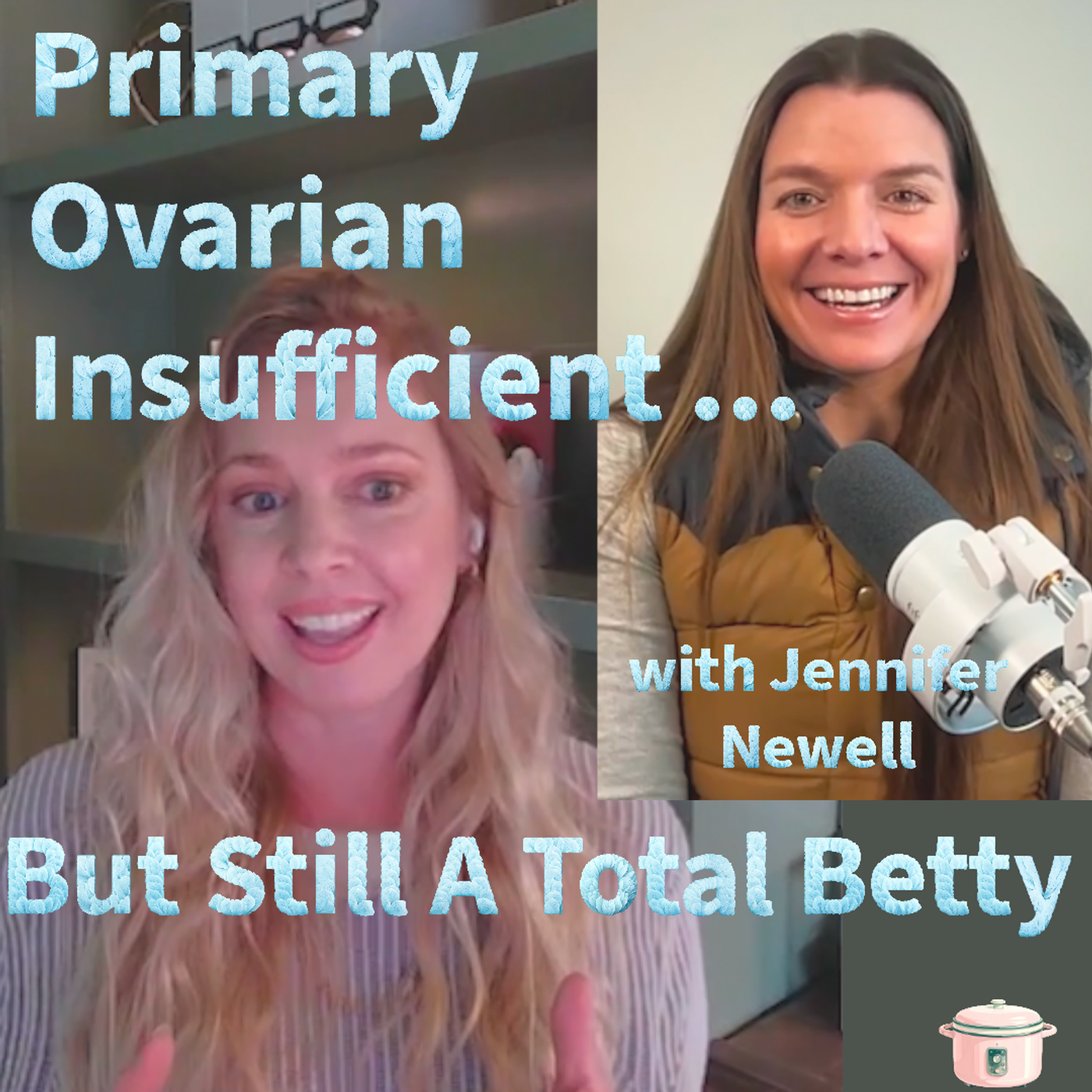
Episode 6: Primary Ovarian Insufficient But Still A Total Betty with Jennifer Newell
Tonight's Episode
Jennifer Newell (and Ashlyne’s best friend of over twenty years) was diagnosed Premature Ovarian Failure (now known as Primary Ovarian Insufficiency) at sixteen. In the Wild West that women’s healthcare during that time, she was left to do a lot of self-advocacy and navigation on her own. Infertility is not a fun subject for anyone. Not for the one who is unable to get pregnant (if she wanted to), not for her partner, not for those who love her and know she’d be the absolute best mother out there. But it has to be talked about. And there isn’t a more perfect person to talk infertility with than Jennifer—or women’s healthcare.
For more from Jennifer: https://bettysco.com
Instagram: @jenn_newell & @bettsyco
Have a question or have a fertility story to share?
Email [email protected]
Instagram: @confessionsofaslowcooker | @ashlynehuffblue
This audio and video podcast was produced, edited, and distributed by Small Batch Sound. https://www.smallbactchsound.com
speaker-0: and welcome back to Confessions of a Slow Cooker. I'm Ashlyn Blue and today we're going to take it all the way back to middle school. I met Jennifer Newell at our dance studio when we were on the competition squads together. We both went to Belmont after high school, ended up living together for a few years. She met her husband, Justin, when he was our guide going down the Ocoee for my 22nd birthday. You're welcome. She's been my best friend for over 20 years. And ⁓ I call her Farmer by the way, which is her maiden name.
speaker-1: We.
speaker-0: Our dance teacher, Ms. Kathy, didn't call her by her real name, so I only learned what she called her, which was Farmer. And I didn't, I don't know how long it took me to learn your actual name. Anyway, Jennifer, which sounds weird in my ears, hi.
speaker-1: I'm so excited to be here. Thank you.
speaker-0: Jennifer has a unique story regarding her fertility, which led to forming her company. And I'll stop talking and let her tell it. So, go.
speaker-1: All right. ⁓ First, thank you really for having me on. I love talking about this and it's really ⁓ exciting to be able to talk to you about it, knowing what we've both been through. ⁓ And that, we've been friends for 20 years and we've been on this journey together for 20 years too, because you were right there with me during my fertility management, I guess. So I'm just gonna take it back to the beginning. And it really starts when I was a teenager. I never started a period. And so when I was 15, my mom took me to our pediatrician and I went to see a female pediatrician and she said, you know, you're really active, right? We were dancers. I was a competitive dancer. was thin. She's like, you're athletic. You know, you're really active. It could just be a delayed start. So come back when you're 16. I don't know why that was the magic number. So like most teenagers and busy parents, we waited until I was 17 and I went to see my mom's OBGYN and it was a simple blood test. Nothing invasive from the jump. ⁓ And I was diagnosed with what's called ⁓ primary ovarian insufficiency. At the time, it was called premature ovarian failure, which basically means my ovaries don't work. Something happened along the way of my development and my ovaries don't function.
speaker-0: The former term was more explanatory, premature.
speaker-1: I It's hard to understand. And the reason that I've read ⁓ the reason for the change was related to the ⁓ name premature ovarian failure just sounds really dramatic. That's true. It feels like overly catastrophized, which I don't know. And it's different for different women, right? It's really uncommon for a woman to have premature ovarian failure. as early as I did. So it's often a term used for women who aren't considered paramenopausal, know, maybe before the age of 35 or around the age of 35. That can still be considered primary ovarian insufficiency, meaning your ovaries aren't functioning as well as they should for a person of your age, but we're not calling it paramenopause yet.
speaker-0: So there's like a, a pre-peri?
speaker-1: Right, yeah. It's like, hey, something has happened here. And sometimes there's a known cause for it, right? Something has happened in the body and you know. For me, we don't know. did genetic testing. I've done other tests that are available. The best thing that I've been told is like, it's likely autoimmune and your body attacked your ovaries and your ovaries don't function.
speaker-0: I say the way it showed up for me, not my body, like as your friend. ⁓ and you know this because I, this, you were like, we were on the same dance, dance team for years. And I remember being like, she seems really lazy when we first met. And it because you were having all these body things that people don't get until years and years later. And I remember.
speaker-1: When I first
speaker-0: when you first told me about what was actually going on, don't even remember when this was, but I was like, whoops. I considered her lazy, but her body was like rejecting ⁓ what should be happening during Cupid years.
speaker-1: I'm sorry. my ⁓ first year as a Cadillac, so that's the highest level of the dance team that we had. ⁓ So anyway, once I got on that team, like the senior team, my first year there, I was a junior in high school. That was the year that I started taking hormone replacement therapy. I was diagnosed in October. I was sent to a reproductive endocrinologist. ⁓ specialist who could care for my hormones. ⁓ And I started taking a combo pill. was called Primarin, was the estradiol, and Provera was the progesterone. It was terrible. It was awful. It's no longer recommended to be in use. ⁓ What was terrible about it? The side effects. So the side effects for me were severe mood swings, ⁓ specifically quick to anger. I found myself just being angry all the time, ⁓ tired, bloated. It changed my appetite. So I'm not going to say that it didn't cause me to gain weight, but it changed my appetite preferences where I felt like I just was not getting enough food. So, and then the bloating associated with it, I think I jumped, you know, about a size or two. I was still pretty small. I was really small before, but I a size or two. I don't remember this. Yeah, well that led to some other future issues that I had, other dance related issues. ⁓
speaker-0: I thought that would
speaker-1: And so there's just a series of like traumatic things happening, but it's all the stuff that you don't talk about, right? It's really hush-hush. So it's not like, you know, hey, so and so I wasn't sick per se, but I was on these meds for six months. I had all of these negative experiences associated with the meds. And then I took myself off of them. was like, I'm not doing this. This is not helpful. don't, I'm not, my relationships are being negatively impacted by this. My... overall just sense of kind of feeling is not good. It's not what I'm just going to take myself off of it. Not only that, but I was also engaging with a healthcare system that did not know how to serve me as a young woman who could not become pregnant or had no focus on pregnancy. And so I had several, you know, appointments with a specialist. I had to wait two and a half to three hours in the waiting room before she would even pull me in for her point for my appointment. And she didn't. remember me, right? She had no, I would go in and she just, you know, I'd get maybe five minutes with her and she'd be like, okay, so what are we seeing you today for? I'm like, I've seen you three times already and you still don't know who I am.
speaker-0: Now you'd probably say something or like change doctors because you know. But when you're in high school and you're dealing with something like that, that's an adult, you're a child.
speaker-1: Yeah. And you know, you're at that age too, where my mom was really involved. Thank goodness I had an involved parent who did understand healthcare. She worked the front desk at an OB-GYN office early in her career. And so she had some knowledge of it, but it's just, there's something about the way that we as patients ⁓ interact with medicine that makes you feel like you're in a submissive state. ⁓ And so questioning, you know, trying to change the experience that you have to get the information that you need, I think is really difficult because you already feel like you're walking into this situation with limited knowledge and understanding and you're talking to the expert and it kind of puts you in this submissive position. And yeah, as a young woman, even, you know, I didn't know how to talk about my symptoms. I didn't know what was and wasn't normal. They didn't ask me the right questions so that I could express what I was experiencing so that they could find better treatment. And to be honest, you know, 20 years ago, more than 20 years ago, The treatment options were shit. Like they were not good for women. They're just now getting better. And so I love that you mentioned the cream. I used to cream in college. okay. Now, and feel free to interrupt me, but let's fast forward a little bit. I was off of my meds for a couple of years. So by the time I, yeah, the pills. didn't go and I didn't go back to the doctor until my freshman year at Belmont. So when I went to Belmont, I was like, okay, I need to get this. to going, get this organized. My mother sent me a book about bioidentical hormones that my grandmother had read that was written by Suzanne Summers for me. And I am a 19-year-old girl reading this book about bioidentical hormones and how much better she feels on them. And it's so much better for post-menopausal women. And this is novel and no one's talking about menopause at this time. Now we're starting to see more conversation. So then I was like, OK. I'm going to see if I can find a doc that can do this. And so I went to a primary care doctor, 45 minutes out into rural Tennessee, which is crazy, White House, ⁓ to find a PCP that would actually be able to prescribe bioidentical hormones. And we worked together for a couple of years. He was great, ⁓ really helpful. He ran some initial tests that weren't done on me before, like a bone density scan. And I found out I was in, it's called osteopenia, which is... the pre-stage of osteoporosis, not nearly as severe as osteoporosis, but I was in kind of the stage one of osteopenia, so my density was not good. 19. 19 years old. All of my, I also had an MRI, a previous traumatic experience was when I was 17, I had a transvaginal ultrasound, my first one. The device, the wand was too big to fit past my pelvic bone.
speaker-0: This is in college.
speaker-1: And I was a virgin. My mom told the tech that I hadn't had sex and apparently the tech gave her a look like, mom. My mom told me later. And so anyway, they proceeded with it and it didn't go in. I'm just like laying there, tears just streaming from my eyes and this tech looks at me and she realizes, oh my gosh, this is incredibly painful. Yeah, it's like excruciatingly painful. So that was a traumatic experience. So I go to this other doctor who, you know, listens to me and asks me questions, which is amazing. And he doesn't, instead he does an MRI and we find that all of my ⁓ reproductive organs had atrophy so severely that you couldn't even see that I had two ovaries. We could just find one ovary. I do have two now. ⁓ But I do, I do have two ovaries.
speaker-0: That later. Continue.
speaker-1: So it took time on the bioidentical hormones for my body to basically regenerate. So I on these hormones. I felt a lot better on these hormones. I found a regimen that worked for me. It took several years. It took actually on these hormones, I think I was 22 when I had my first bleed.
speaker-0: I Longhorn when you told.
speaker-1: Yes, I believe it because we were working at Longhorn together. And I'm like, ⁓ I'm what's happening? What's going on here? Welcome to the club. Right. And so it's like everything had regenerated enough. Like my organs had, you know, come back from the brink and ⁓ and was now I was I didn't have a functioning reproductive system. Right. I could if I got off the meds, it wasn't a period in the sense like I didn't ovulate. Right. So I didn't ovulate. didn't have a typical menstrual cycle. All of it was just being produced by the hormones. But I did have enough of a uterus to develop a lining to be able to shed, which is, of course, a period. yeah, so that's kind of a progression there. And I've been, you know, I was managing that for 20 years. ⁓ And of course, that led to one of the things that I haven't said yet is, if your ovaries don't work and you don't ovulate, you don't become pregnant, you are infertile, right? And so I knew that I was not going to have biological kids ⁓ unless I could carry a baby. I could use egg donors and I could have in vitro. That was an option. ⁓ But I would not be able to have, I didn't have any eggs, right? My eggs did not survive ⁓ the ovarian failure. because I didn't have the environment to be able to survive. Right. Yeah, exactly.
speaker-0: I can regenerate, right? But I feel like the single thing they've said is like, you come with the amount you're going to have. Like when you're...
speaker-1: Right, you're exactly you're born with all of the eggs that you're going to have for the rest of your life. One of the challenges that I faced was I still had eggs. I still have follicles. So it's follicle before it matures. I had follicles. You could see them in my ovaries. You could see them with an ultrasound. And, you know, I saw several fertility specialists. And when I would tell them, you know, like, hey, you know, heads up, I do have follicles. And they would be like, really? And they would give me this such a surprised look like I thought they'd all be gone. And then like, no. They're not, they're still there. They're not healthy enough to be able to, and I haven't had them tested. I probably could. That's a conversation we can have a little bit later, but I think what was really interesting to me is I knew before the diagnosis I would not be able to have biological kids. I think I was probably 13, 14 when I realized like something's wrong here. Something's wrong. And my brother, my brother's a year older than me. He was, I was 14, so he would have been 15-ish. And it was before I was diagnosed. And I remember him asking me, do you think you're going to be able to have kids? And I said, no. said, no. He asked that, like that he would have, you know, the understanding to be able to ask that question. And that I would also have the immediate response of, no, I don't. It was just kind of like, part of the story of this.
speaker-0: you feel about that then? Like was it a matter of fact at that point or was it something you had to like really process?
speaker-1: It was a matter of fact. Yeah, because I had lived with that for a while.
speaker-0: kind of always happen. So that does not surprise me. But I imagine someone else may have had a response or grieving period of that.
speaker-1: Right. think part of it, you know, I'm grateful that I knew so young because it's helped me develop plans for life and thoughts about life. So I don't feel, I didn't feel the disappointment that I think a lot of women do when they feel hopeful that they're going to have this opportunity in the future. Right. And so I, you know, kind of always looked at marriage and family.
speaker-0: that you're going to.
speaker-1: building a little bit, I think, differently as a result of knowing so young that I wasn't going to be able to have biological kids. But yeah, yeah, It's been interesting.
speaker-0: We never talked about it when we were young, I don't think. We were always like dancing, because we didn't go to the same high school. So when we weren't at dance, we hung out more later on in those years, like outside of dance. But I feel like everything was, you know, we were just super focused or high.
speaker-1: Yeah, I agree. We're focused. And we didn't really become close friends until like, think my senior year of high school. Yeah. And then of course we went to Belmont together and became besties.
speaker-0: We did. We did. I wish that said, I wish we would have, I wish I would have known enough because I don't know who besides Philip, your brother, you're having conversations with obviously your mom too, but I would have loved to have been a help there if I could have, but it sounds like you you had pretty much processed that information by then.
speaker-1: Yeah, you know, I think one of the interesting things that as I was getting into my second wave of treatment and kind of figuring things out, you know, when I was in college, ⁓ I got the medical records back from my original doc, the one who diagnosed me. And it's so funny that you asked about me being matter of fact, she wrote in her notes, I don't think she gets it yet, but mom gets it. What she didn't realize was that I know. Actually, really, this doctor I loved. This is not the specialist. And I think she was just my matter of fact approach about it. like, in my mind, it's like, you're not telling me anything I don't already know. I know that that's fine. Let's move on and talk about treatment and how you care for me and all of that stuff. What are next steps?
speaker-0: Acting you to be like, wait, what? know, telling you news that you already know, but she doesn't know you already know.
speaker-1: Yeah, exactly. Exactly.
speaker-0: So I feel like I do remember a conversation that we had after you met Justin. Or maybe right after.
speaker-1: ⁓ yes. Yes.
speaker-0: Like, because it wasn't like you would come to this conclusion early, you had time for it to settle in your system. But what what does that mean for a partner? How does that like, think telling him was something we talked about, like how or or maybe it wasn't it was maybe it was pre Justin and we were saying, whoever it will be, how do you break that news? Do you do it right away? I mean, you kind of have to if it's something that's You know, don't have to necessarily say it on your first date, but it's important because you don't know how you feel about the idea that you've had all these years to come to terms
speaker-1: ⁓ it's, ⁓ goodness. I mean, to think about the impact that all of this has had on dating and getting into relationships, it's such an interesting nuance that I think that a lot of people don't experience. so, ⁓ yeah, having that knowledge going into a dating situation is like, how much, how important is it to them to have biological kids or traditional family building? And so, you know, I think whenever you have that in the back of your mind, You're always trying to put little feelers out to try to test, engage, you know, if they would be receptive to it. And that's just weird, right? Because then it feels like it's not a natural, you know, interaction. ⁓
speaker-0: How soon do you do it to where they won't be right? ⁓
speaker-1: I don't know about kids right now. It's always in the back of your mind, right? As the infertile person, it's always there. And so, you know, I think when I met Justin, I mean, falling in love with Justin was so easy, right? It's just the easiest thing I've ever done. And I do remember, I think we had been together. I was still working at Longhorn. It was a summer. So probably not quite a year, but close, maybe eight or nine months. I remember a table coming in and this little boy was so freaking cute. He was like 18 months to two years old, brown hair, brown eyes. He looked like a little mini Justin. And he was so precious. And I cried because I was like, we're not going to do that. I get that. that was, and I, you know, and I think that's the interesting thing about infertility, especially, and I'm not going to say especially, but for me having a really long experience with it is, it's like grief. The waves come at weird times and you don't expect it. And right when you think you're fine with it, it's like, ⁓ well, maybe I'm not fine with it. Maybe this is, you know, maybe I do want this, even though you're like, okay, no, I've settled into my like, joy filled phase, you know, very happy being child free, or maybe we can adopt or we can do this or we can do that. But ⁓ But yeah, that was one of the first instances that I had where I actually was sad about not being able to have biological kids.
speaker-0: And had he been told at this point or no?
speaker-1: Yeah, he knew. Yeah, he knew.
speaker-0: And how did that conversation, I don't think we ever talked about this necessarily, but if we did, I don't remember it. ⁓ I obviously know he's all right, because you guys have been married for how long now? Forever?
speaker-1: 17 years this year.
speaker-0: Yeah. Crazy. ⁓ and I... What? Yeah. It's you guys were doing your 10th during our wedding and we're going to be seven years in May. That's easy. Plus 10. Okay. Yeah. how did that conversation go? Obviously well enough for you guys to get married, stay married and be the most delightful couple ever. ⁓
speaker-1: I...
speaker-0: And something I really aspired to when I was in my post-divorce time, I was like, that's what I want. I want their relationship. I want my mom and dad's relationship. I want Maddie and Jordan's relationship. But like you guys were, well, we'll just go ahead and tell everyone. We refer to me as their love child. I'm not, but I mean, obviously.
speaker-1: I've always loved well-being.
speaker-0: And so anyway, how did that go? If you were called.
speaker-1: Yeah, I remember he was immediately on board with the prospect of adoption and that we were both really comfortable. It's something he had thought a lot about. ⁓ He definitely wanted to adopt and I think he was quickly okay with, okay, if that's the only path we do, that's fine. ⁓ And at least he made me feel that way. And that's been a, and that's, that also I think is another benefit of having this knowledge before getting married. ⁓ is yes, he's certainly had some grieving processes. He's had to deal with that on his own, but ⁓ for us to be able to have those conversations really early on, exactly. We know this is gonna be a challenge. Here are the different ways we can build a family if we do decide to have children. And just to go ahead and for the record, we don't have any children. I can talk a little bit about that process. But if we're going to have children, these are the different ways that we can do that. And I think for him, especially knowing how his mind works now, having those options laid out early on was just very much like a, okay, we know what the plan is and we can figure that out when we get there. And yeah, I knew early on that he was open to adopting as a way to grow a family. ⁓ I will say over the course of just our lives together, there have been several times where I've just pulled him aside and I'm like, thank you for choosing me. Because he did, he chose me over the very likelihood or possible scenario that he was going to biological kids. know, that he, you know, obviously...
speaker-0: So I'm not like, hmm, good for you, Justin. I'm just glad he could see it. I'm just proud of him for noticing so soon that something so big was not worth moving on and like not trying to get too, you know, too in love with you. Once you go farmer, you never go back.
speaker-1: Right. That's true. Love you. Love you. you know, but I do think, you know, it's recognizing the sacrifice. You know, yes, ⁓ it's a grieving process. It's sacrifice for, you know, both couples, depending on what, or both individuals in a couple, what they decide to ultimately do. ⁓ But yeah, was, that's a sacrifice for him to be able to be with me and not have, you know, this family that he might have also dreamt of having. ⁓ And a lot ⁓ of guys do, a lot of men, when they're boys and they're growing up and they think about what they want in their future life, that includes kids for them too. And they're grieving in the infertility journeys with their partners and need some support around them as well.
speaker-0: You had mentioned though that you could be a carrier. So it might be his kid, but maybe not yours, right? Like that was a potential thing that I don't know when you saw this, it wouldn't be just, it wouldn't be both of yours. It would have to be just some of them. And actually have a friend right now who eventually she just found out it's going to be a girl. It's not her egg, it's her husband's egg though. And they literally just found out like two days ago that it was gonna be a girl. So we're in that process, is another option at some point. So anyway, continue.
speaker-1: Yeah. So that's really fascinating. So to talk a little bit about our decision-making process when it came to, we going to have children? What does this look like? You know, we did, we met with a fertility specialist, actually, we live in San Antonio. We met with one in Austin that was recommended to us. Really, really liked him. ⁓ He's one of the ones that, ⁓ gosh, Ash, let me tell you the story first, because it's so funny. we are, Justin's going with me to this consult. You know, and we knew it's just, let's just explore options. At the time, I think I was like 27, we had just moved to San Antonio. And like, let's explore some options. Let's just go figure out what, so that when we're ready, we can know what we're going to do. So on our way up, you know, I'm talking to Justin and I'm like getting ready to tease him because he had just talked to a friend. We had a friend, she was pregnant. The husband was talking to Justin and he was talking about how big the ultrasound bond is. He's like, how does that thing fit in there? And I'm like, bro. Bro, don't even. I mean, seriously, you should feel a little insecure about the one. The one's big. So Justin has this in his mind, and I know he does. I know he's thinking about it. So I was like, hey, babe, I just want to let you know, I want to prepare you that they might want to do an ultrasound when we're there. And so you'll be there, and it's fine. It's no big deal. I've had several at this point. But I just remember so-and-so was telling you about that. So I wanted you to be prepared for this experience. And then I think I also told him, you know, they might also have you like, you know, go in a cup. You know, we don't, don't know what's going to happen here. I am lying to him because I just want to make him a little nervous. I want to see him squirm a bit. And so I knew it was just going to be a conversation. So by the time we I'm like, babe, I'm joking. I tell them, I tell them, I'm joking. They're not going to do an ultrasound. They're not going to have you do that. This is just a conversation. We get in there. talking to the doc. He's a really interesting character. tell him like, I've got follicles. I have premature ovarian failure, but I have follicles and this is what my stuff looks like. And he's like, really? He's like, can I? Yes. He asks me, can he see? He has an ultrasound room next door. So what happens? I go in there, stripped down, get the ultrasound, Justin's there, he sees the whole thing. I'm like.
speaker-0: See? Maybe I wasn't lying at all.
speaker-1: I know. It was amazing. I loved it. So, what did they say? So, we explored that option. Yes, and I knew from the jump that I would be able to carry a baby. I have a uterus. It's perfectly normal and healthy. I mean, now post hormones. So, we could have used a Justin sperm and then an egg donor and I could have carried. And that was a possibility we looked at through in vitro. And we talked to this doc and we were going back and forth thinking, okay, this might be
speaker-0: No, anyway, okay, so.
speaker-1: the best option for us. And then it was just a couple of weeks later, we had been thinking about it. We're both faithful people. We've been praying a lot about it. We went to our church service and it was kind of a special church service. ⁓ And they had an organization there that helped support adoptions. They had just started a new ministry to help families in the church adopt. And so we're seeing this, we're getting introduced to these people praying about it and just really felt like... this is the path we need to take. This is the right path for us. I was not particularly excited about the in vitro component, having an egg donor, just because a pregnancy experience wasn't something that was important to me, which I also think could have just been a result of my early diagnosis and getting more and more comfortable with the fact that I would probably not experience a pregnancy. ⁓ So that wasn't necessarily something that I personally really desired. ⁓ So we were open to numerous ways to think about, you know, having a family. And ultimately, Justin wasn't particularly, it wasn't important to him to have a biological child either. ⁓ It just, you know, for both of us, for whatever reason, that just wasn't something that we prioritized. I understand that some people do, and that's great. ⁓ So for us, we're like, okay, let's look at adoption. We started working with this group. We ⁓ ended up pursuing an adoption out of Nicaragua. We were in the adoption process for two years. We had done the home study. I wrote a reference letter. A recommendation reference, yeah, a character letter. ⁓ And so we had everything ready to submit to the country, our dossier, as they call it when they have like, this is the family that wants to adopt. We chose Nicaragua for a number of reasons. ⁓ We have my brother-in-law, my husband, sister's husband.
speaker-0: foundation.
speaker-1: is from Nicaragua. had ⁓ at this point, think, nephew and a niece. ⁓ And we were really excited about the possibility of them being able to share some of their culture. We also live in San Antonio, so we were really excited about ⁓ really thinking about, you know, just the cultural aspects of living in a ⁓ place that is, you know, focused on Mexican and Latin American heritage. So we were like, let's, and for a number of reasons, we kept coming back to Nicaragua. ⁓
speaker-0: Correct me if I'm wrong. I feel like you said, started dreaming of a child that looked not like you.
speaker-1: is I think I did, you're right. I forgot about that. I remember having, yeah.
speaker-0: You were saying... So I just, I thought that was a lovely thing at the time, obviously. In my head.
speaker-1: Yeah, you're exactly right. ⁓ That was the vision that we had. Absolutely. Goodness, I forgot about that. ⁓ Also an interesting thing about Nicaragua, at the time they required the adoptive parents to live in country for, I think it was a minimum of 12 weeks, which felt impossible. So we kept coming, going away from it coming back to it. But all of the research and the testimonials from other adoptive parents who had adopted from other countries are in from the states as well. They talked about how important that experience was both for the child and the parents for the attachment. ⁓ And I was like, that makes a ton of sense. And I really liked that they focused on the child in that process. So that was another reason we liked Nicaragua. Well, Nicaragua had a couple of changes internally. They had ⁓ changed their process. They had a new director over their adoption stuff. And then they also had some like political unrest that happened. And anyway, needless to say, we were a week out from submitting our dossier. It was completed. It just needed to hit go and they paused it. They paused international adoptions completely. they did not come back around for two years. So we were in the process for four years and we kept thinking, okay, are we going to transition and like take our stuff to another country? But it just never felt, it just never felt right to us. For whatever reason, we just did not feel compelled. to pursue adopting in a different place, from a different place. And so we let our home study lapse, that adoption process failed. ⁓ And so in that time, I also was getting ready to start Bettys. So I have a women's health company that I built and I'll talk about that a little bit, but in starting Bettys, it was like, okay, some of the focus has shifted and let's get this going. And then maybe we revisit. Yeah, Bettys became the baby. That's exactly right.
speaker-0: Where were you showing me that too? On the couch at my parents house. I was divorced and you came over and you told us about it. yeah. I have a great memory. Just kidding.
speaker-1: Cheers. Do I remember this conversation?
speaker-0: I remember the couch, like where it situated. And I had said, okay, so like update. Cause you know, I had gone through so much in the year before that and whatever that time of the marriage crumbling and everything that we didn't have those kinds of conversations. Cause I just wasn't up to, I was up to my eyeballs in just all the things that happen when your life is falling apart. And so that was the first time I remember asking, wait, hold on. I remember doing that reference or the, you know, the recommendation, whatever it is called. And, and you saying, this is kind of my baby now. And I thought, you seem to be good with it. I, have to.
speaker-1: You see. Work. It has been such. ⁓ I'll say just a blessing, because I don't think there's anything I did for this, but I think. Justin and I throughout this process, we've always been on the same page. We've always been at the same place. Do we want to have children? Do we? Do we not want to have children? ⁓ Luckily, there hasn't been tension between the two of us around that at any point, really. ⁓ That's one. And then the second thing is. Just the, I know that I am fortunate to have felt basically peace with all of the different changes and decisions. Yeah. And, you know, don't have a lot of regrets necessarily around, I wish I would have done that, or disappointment, severe disappointment around, I wish this would have worked out differently. I'm okay that the adoption didn't go through. And I'm okay that we are a childless home, right? We're... We're actually really good with that. And I don't think that's not true for a lot of people that I talk to that have, you know, experiences with infertility, right? They really feel that sense of loss. And I think that's because I, again, I knew young and I had a lot of time in my formative years to develop a different frame of mind for having children biologically or not, or having children or not having children. You don't think you can even grade.
speaker-0: Like, you'd be the last one to get married of our friend group and you were the host.
speaker-1: That's the first story.
speaker-0: You had, think you were like, I'm gonna be an old maid or a spinster. I think you called yourself a spinster. Yeah. You watched a lot of Sex and the City. I did. I love Sex I'm with it. I'm okay with it. I feel like you knocked your brain around so much of what you weren't gonna get that, it's like you prepared your whole life for the actual, half of the life you have. You got married 17 years ago.
speaker-1: like that. I know. It's so funny. read or I saw a video. It was an influencer posted something on Instagram and she did this comparison of ⁓ kind of a white woman's experience with feminism and marriage and a black woman's experience with feminism and marriage and how they're different. When she describes the way that a lot of white women experience, how they look at feminism and think about kind of rebutting the patriarchy, right? Like how we work against the patriarchy. ⁓ It resonated with me so much. And I just kept thinking back to even then when I was young, I was so scared of having someone come into my life who was going to try to control the direction of my life and influence me in a way that I didn't want to be influenced. And that's what I thought marriage was. I thought marriage was going to be attaching myself to someone and then my ability to choose and be free and do the things that I wanted to do and prioritize my life the way I wanted to that that would kind of go out the window. Because that's what I saw a lot of.
speaker-0: parents weren't together and you had a void there or did you just say, sorry, I cut you off? That you saw a lot of that around you.
speaker-1: Yeah, I think I just saw a lot of it around me in different ways. I saw it in existing marriages that people would look at and say were successful marriages, but her needs were never as important. I saw it in the bad marriages that ended in divorce or even just relationships that I saw through family marriage and relationship scenarios as I was growing up that just felt like I did not see a healthy, good relationship where both parties' needs were. seem to be appropriately handled. And so, yeah, you did.
speaker-0: Marriage, marriage, marriage, bring it on.
speaker-1: Yeah, whoop. Isn't that interesting? mean, just the way it turned out, I was so averse to marriage, and I think I was so averse to marriage that I actually didn't date until college, until later in college. And even dating for me was uncomfortable. I really had a hard time opening up and being vulnerable enough just to be authentic in a dating situation because it just, I don't know, it just made me so uncomfortable. And of course there's childhood stuff that plays into all of that.
speaker-0: First time did not work.
speaker-1: But then to, yeah, meet Justin and it just was like, ⁓ God's like, here you go. You don't know what you're talking about. Here's this person and it's going to work out incredibly well for you. And y'all are going to be ridiculously in love for the rest of your lives. Okay, okay, back to Betty's. got to get back on track with my story. ⁓ So at this time, you know, the adoption failed. We...
speaker-0: It's like
speaker-1: I had been thinking a lot about my experiences in healthcare and also my career was in healthcare. I worked for a healthcare consulting company for about 10 years and then I ended up managing marketing for the consulting firm. And so we were developing new products to offer around patient access was a key term, like how people enter the healthcare world. I won't say health system, essentially. And then also patient experience. What is their experience like and how do we... pull from different industries to create a better experience for them. And I just kept going back to my experiences as a young woman, right? Going and waiting for three hours to see the doc for five minutes who didn't know me and I got passed around and there was no conversation or understanding or really consideration for me as the person who was actually being treated. And I looked at women's healthcare, I did a bunch of research and found that, you know, A, women's health hadn't changed in the past 20 years and B, we don't have a mechanism to transition our girls from pediatrics into women's healthcare. There's no handoff. There's no ⁓ place for women in this kind of transitional age to go and get care. And they desperately need care, right? The first period is on average at the age of 12, like 11 and a half now. So 11 year olds. And we are really not caring for them as it relates to their reproductive system until they're in their 20s and they start thinking about fertility, right? And as a person who, again, can't become pregnant, but is a high utilizer of women's healthcare, my whole message and my whole thinking was we really need to look at women's healthcare outside of pregnancy. Like take some of the focus on pregnancy because that's a message that we give to lot of, to women really, is that women's health is only if you want to prevent, achieve or manage a pregnancy. And if you're not doing those things, you don't need to go get women's healthcare. which then if you live in the Bible Belt like we did, I'm in Texas, we're from Tennessee, it's like, well, then you don't need women's healthcare unless you're sexually active. And then there's a lot of stigma around anyone who is unmarried and in her teens and twenties who is sexually active. And that's frustrating because again, that does not, your sexual activity does not determine if you have endometriosis, if you have polycystic ovary syndrome, if you have premenstrual dysphoric disorder, if you have primary ovarian insufficiency. If you have all of these other things, if you have really painful periods and heavy periods that can be addressed, maybe it's not an underlying condition that we've defined, but you have problems that we can actually help with. ⁓ That has nothing to do with sexual activity. And so I wanted to create a place that was unique, just uniquely designed for women in this stage of life, that from period until pregnancy or until pregnancy planning and real family planning is needed. And so that's, that's Betty's. So I decided to build Betty's.
speaker-0: I love the concept of Bettys from the moment you told me about it because it did. And I loved that you had your personal journey to fall back on, to think about it. had everything converging in the right way. You have your own experience when you were young and thinking, okay, no, you didn't start your period, but that's enough reason to go to that person, to go to that.
speaker-1: Like.
speaker-0: whoever will be a handoff, okay, you're not starting, let's figure that out. It shouldn't be, I feel like it, there are so many things that we, like before you, well, you might not know this because you haven't had a child yet in the hospital, but one of the things that you have to have is the name of your pediatrician. Before you leave your child, like they go ahead and make you choose that and you have to contact them and.
speaker-1: you
speaker-0: all these things. So you have to have that handoff from the hospital to the pediatrician. You go ahead and you're on that schedule and you start with that baby on a regimen and that is way it is. And so there should be something to catch the girl going through like the hardest time of your life anyway, like, you're, you're an adolescent and everything. And there should be some sort of mechanism. I'm so proud of you for thinking about that. And then also with your healthcare ⁓ background, those two things just came ⁓ perfectly naturally at the right time. There's one other thing I wanted to mention is that Maddie has, I was talking to her on the podcast and she has PCOS. And earlier you said, the reason they said come back in a year is that you were athletic and you were thin. And there was no, you know, they just chalked it up to the activity. Yeah. And Maddie had, she was different. She had started, but it would be ⁓ a six month gap, no period. And then it would all of sudden be every two weeks, like constant period. said the same thing. You're very fit and you're very athletic. And it's probably just that. She didn't get diagnosed with PCOS until she started trying. And that's only because her period stopped for three months and she thought she was pregnant, but she clearly wasn't. And so she was 27 when she finally found out that she had PCOS. And what they did was put her on birth control to regular. So that masked anything because she was regular birth control. And it wasn't until the child part that she learned this and she could have been taking care of it all along.
speaker-1: Yeah, so, and that's a big reason that Bettys exists. And we, I've heard that story so many times, especially with PCOS, because what you might have is even in her case where she, you know, knew and went to see a doctor about her periods, you have a lot of girls who will, you know, maybe for acne go to a dermatologist and they'll get on birth control, which is perfectly fine, right? Birth control is totally fine.
speaker-0: They put me on spironolactone. I don't know that's how you say it. But they also said you also need to get on birth control because if you were to get pregnant, then there's a strong deformity ratio or tendency for someone on that. So that's why I got on it was because I was on another med that would give a child a body. And so it wasn't... the birth control for acne, was the spironolactone for acne. So there was like lot going on there. continue.
speaker-1: Oh, interesting. Yeah, and there are a lot of reasons that people get on birth control. And if you don't have that diagnosis, and again, we see this especially with PCOS. I have a few friends who have had this happen where, you know, they're on birth control while they're sexually active and, you know, when they're ready to come off of it and start trying, then they get their diagnosis. And what a lot of people have done, especially people on Instagram, there's some pretty big campaigns that happen around While it was the birth control's fault, but it's not you're right though. It masks the symptoms It's used as a treatment for these symptoms so that you feel better day in and day out but then if you get off of them because you want to have a biological child and then you realize oh that's gonna be really hard and I think that's something that we don't do enough of us when we talk to women especially teens, right? It's like we're so trying to prevent an unwanted pregnancy, which is good. Yes, when you really double down on that it makes it sound like it's gonna be easy and to become pregnant. And so when you then get off of it and you're like, okay, well, I'm gonna get pregnant, then it's like, you you need to go through a full year of trying before, you know, a doc is gonna say, all right, I'm gonna send you to a fertility specialist. I'm gonna refer you out to help with this because for a lot of women, just, takes time. It's not easy. It's not always easy or necessarily easy to become pregnant. And we just, we don't talk enough about that so that people are prepared. And then even in your visits with your providers, right, if you're getting on birth control, you know, the conversation should be, this is what this is going to do to your periods and to your cycle, just so you fully understand. If there are any issues that you have with your reproductive system, then, you know, this is going to treat those. So we're not going to be able to identify those because the way that a lot of these are conditions are diagnosed is based on a myriad of symptoms. ⁓ And it's, you know, it's complicated.
speaker-0: Moving on, I don't know if you have any of these, but I feel like over the course of years, you probably have something that you would put into this category. This is a little segment I call Hot Potato. Everyone's a little different here, and so I don't know what you will have, but if there's some unsolicited advice you got along the way with your fertility journey or something that someone said that was like, what? Or. ⁓ I mean, I know I had a few where people would say to me when I was struggling to get pregnant just to relax, it'll happen. That's what happened with my blah, whoever, fill in the blank. And I was like, ⁓ you don't know what's going on. And you really didn't ask. You just assumed that I needed to chill out. So thanks. ⁓ Maddie, my sister, had some really egregious ones. So. If there's anything that you wanna share, this is really to air it out, but also, I don't know, kind of a cautionary tale.
speaker-1: I love this. love this. I'm going to start with the one that is the most memorable, even though it didn't happen to me. It happened to my husband. Okay. Yep. he had several people throughout conversations, you know, when they asked if we had kids and he would say no, like in networking events and stuff. ⁓ He'd say no. And they looked at him and said, ⁓ are there problems? Like, there, basically are there problems with your wife? Is your wife infertile? And Justin would just get so upset. He's like, how dare they assume and how dare they ask a personal question like that? So that, that's his soapbox.
speaker-0: What did he You ever know?
speaker-1: I don't remember. don't remember. you? No. No, he didn't. didn't. Maybe he should have. I think he probably said no just because he wanted them to feel bad. Like, no, son of your business. But he was at a lunch, and I don't even remember with whom. I will say another category of bad is. even people within the church community who mean well, who are like, I just believe God's gonna bless you with this. ⁓ I just have that feeling, you know? And I just kind of look at them and I'm like, we've been having unprotected sex for 15 years. It hasn't happened yet, it's not gonna happen, baby. That's just science. And God created science, like it's just not. And so, although I have something else about that, but. For the egregious one, Justin's at a lunch or something with, I can't even remember with whom, and a man that he's having lunch with, they start talking about it, and he basically starts to prophesy over our pregnancy, our lack of children in pregnancy. He doesn't know me, and I don't know how well he knows Justin. I don't know if it's someone that he worked with not well. They're not a friend, right? And so it would be, I can't remember if it was somebody from the church that he was meeting with randomly or if it was someone in his network, his professional network that they were meeting and had also talked about being Christians. But he ⁓ basically said, it's going to happen. It's going to happen. Like God told me, it's going to happen for you. it's like, I too am a believer. ⁓ Just I'm really frustrated that you feel so compelled to say that ⁓ when it hasn't happened, it's not going to happen. I just, the way that it came across was just egotistical. Yeah. And insensitive. Exactly. And insensitive, ⁓ not compassionate. It was frustrating. It's stuff like that that's really frustrating. ⁓ and so it's like.
speaker-0: So with Justin receiving these comments, it's just like, what do do with that? How am I supposed to thank you? Thank you for giving me news that you can't corroborate and I can't corroborate that you had a vision or, you know, it can't do any of that. like, we're still at launch. Cool. Check please.
speaker-1: Alright. Exactly. That's right. Yeah. There's also a piece of it that is giving false hope. Right? If you're talking to a person of faith that shares this faith, and I think that some people may have that spiritual gift in specific times as it relates to glorifying God. But in this instance, and the way that that comes across, and what it does to the family, the impact on the family is, are you giving this person false hope? Yeah. Are we tired of hearing that? Yes. Like, cool. If it happens, great. But also, it's totally fine if it doesn't. We're not over here suffering. And I have some friends who, you know, they've had severe health care issues with ⁓ their children, one child specifically. And they get stuff like that all the time. And it's like, maybe you think you mean well, but It's just not helpful. ⁓
speaker-0: You didn't believe it. Justin didn't believe it. You guys have information. You're adults. are, you know, you have a lot of stuff under the hood that this dude doesn't know about. Him spouting that off. What if you had been different? What if you had been me when I was struggling and someone said that to me, it would make me feel if someone said, it's gonna happen. I know it. I saw a vision, whatever. In those really, really tough moments when I thought maybe this isn't something that God wants for me, hearing that when I was on shaky ground, I would have felt...
speaker-1: Hey.
speaker-0: like a bad person for not believing someone who's also a believer. Like I would have felt that like weird, like you must believe in because if you don't, then maybe you're not believing in God. Like I would have felt so conflicted. And then what if, what if you a hundred percent believe this guy just based on you need the hope, you need, there's like, there's like a hole that needs to be filled by hope. And this is the guy who gives it to you. What do you do with that when it doesn't work out?
speaker-1: Right. Right. It's tough. It's tough because we were a little bit in that place of we were OK with not having children. had, you know, kind of come to terms with that. But, you know, there is that little bit of hope never goes away. It's always the what if is always there. I took a pregnancy test six months ago. Really? Because, yeah, I have done that throughout. I mean, just throughout my adult life of just like, ⁓ these symptoms are a little weird. It's never a complete. Yeah.
speaker-0: That's insane.
speaker-1: Like for me, I don't have a 100 % guarantee that I won't get pregnant. So there's always that teeny tiny kernel of hope. And when someone stokes that fire, it creates, it's almost like it brings back the grief, right? Then you go through that same process, that same cycle of grief that you did before where it's like, ⁓ well, maybe it could. Do I want it to? Do you get hopeful that it's gonna be a yes? Like I've taken pregnancy tests that I hoped were positive. one that I took, was really hoping it was negative. was like, please, I can't, I just have too much on my plate. I don't want to be pregnant. ⁓ But you know, some, you know, it's just, it's, I think people need to be careful with their words when they are stoking ⁓ that fire of hope in women and their partners who are experiencing infertility, because again, all you're doing is you're just creating this like new wave of grief for them if it doesn't work out. And No one who says those things has a guarantee. ⁓ It's fine if you say, like, I'll pray for the best outcome for you for what you want, you know?
speaker-0: You might have a different view on this, I feel like people, when something is awkward, ⁓ like I remember post-divorce, people would say things to me and I'm like, why would you say that? ⁓ And which was ironically one of the things, well, at least you didn't have children, ⁓ but.
speaker-1: Anyway, you told me that and I remember thinking, yeah. Sure.
speaker-0: Yeah, you know, ⁓ sure, Ron Burgundy. ⁓ But I feel like that when something is awkward or uncomfortable, people feel that the need to fill the space with something positive, even if it's not really thought out. And so I wonder if this guy was like, ⁓ this is weird. Like inside his little brain or stomach, he's like, ⁓ this is weird. I thought that he was going to say something else. ⁓ I think it's going to work for you. It's actually, know it is, you know, because it's like, well, this will, this will help. This will cheer them up. Like when you don't really understand the implications of what you're saying, when someone's going through something rough or hard or something you don't understand because you're not in that. I think the best thing to say is I'm really sorry you're going through that. I can't imagine if you can't because you've not been there or like you said, I'll be praying for the best outcome.
speaker-1: Yeah.
speaker-0: It's to be positive for someone without giving them lots more to think about than they actually needed. And I just think it's people's feeling that they can't just say, I'm sorry, because they don't want to feel uncomfortable. They want to like try to fix it for you. And that is kind. And that is admirable. However, I think, and that's one of the reasons why this segment exists, is that I feel like there are a lot of things that people say with good intentions. they... Right. don't realize how it's landing or when I was talking to my mom, how something like is now put on someone's shoulders. Now you're actually giving them something else to deal with as opposed to just comforting them and saying, I'm here if you need it. know? Yeah. All right, well, we'll get a rate that. ⁓ What do you think?
speaker-1: Yeah, exactly. Gosh.
speaker-0: Five. Five being the most egregious.
speaker-1: think that's a four. Okay, I'd rate it a four.
speaker-0: And I think that is in the eye of beholder. Because you were the one, I mean, Justin was the one who was hearing it, but you were the one in this position. I think it might be different, might be more egregious or less depending on, you know, if someone doesn't believe in God, then this would have been a one. It's like, but if you really do and you really needed it, you know, where you were in your journey, think it makes, that's why I normally rate them, but I wanted to give you this opportunity.
speaker-1: Shut up. Well, I feel like compared to the other comments that we've gotten throughout the years, I'm just like, ⁓ you know, the simple that, ⁓ don't worry, it'll happen. I think it'll happen for you. ⁓ That kind of comment is just like a one. So I think this one to like active prophesying it is like I can't even describe the full context of it, but that is what the conversation was around. God gave me this vision of you with a family. Your wife will be pregnant by the end of next year. Like that level of crazy.
speaker-0: Yeah, that's some specific thing. Easily disproven come time when it doesn't come to fruition. But what happens during that time if you are hanging your hat on it? just, I, for me it's a five. I'll say. Because having been in like that really, I know you've always been somewhat hopeful.
speaker-1: That's Yeah, there is some. Okay.
speaker-0: but like I was in that big time. And that would have been something that would have just messed with me for all that period until this deadline that this person gave of I can see it, I can envision it and it'll happen on this date or whatever. If it was very specific like that, that would have messed with me the whole time. I would have thought about it, not constantly, but in the back of my mind and it would have ⁓ stolen.
speaker-1: Yeah.
speaker-0: a little bit of my piece that I had really worked to get.
speaker-1: Yeah. And I think also because of the faith aspect in it, am, ⁓ you know, maybe I should change it to a five, but I am pretty critical now and of how the church preaches about fertility because I remember listening to sermons when I was in church in high school and then in college too, where you know, you would kind of look at scripture and there were scriptures that were being used to talk about childbearing as a blessing and infertility as a punishment. And that can be devastating to someone's faith and self-image and all of these things that I've had to grapple with. And I think a person of faith has to grapple with, does my faith say and does God, am I being punished for something? What could I be punished for? And then you go through in the list of your head of like all of the things that you could possibly be being punished for. I don't believe that, you know, as a person of faith, I don't believe that scripture supports that narrative. I think it's poorly taught, but it's, it's, that's a journey in and of itself to figure out, you know, how do I take in this information that relates to me having a reproductive health issue? and translating that into the reflection of my faith. so, you know, I struggle with how the church takes some of these really sensitive topics and tries to use them for lessons around the theology. And it's like, I really think you're missing the point here and you're doing a really bad job of it.
speaker-0: Lastly, there anything, if there's someone out there going through infertility or they have an inkling or just kind of a suspicion, ⁓ is there anything you would tell them that you would tell your younger self now? Not because you said you didn't have any regrets and all of that, and I'm so glad about that. Or maybe not your younger self, maybe someone else going through it. Would there be anything that you would say to them? that would help them navigate it or ⁓ a piece of advice that would be helpful in this time of their lives.
speaker-1: I think a couple of things. The first is maybe just a little bit more practical. Try your best to maintain a posture that as a patient engaging with healthcare, you are the one in control. It is... ⁓ Be your own advocate. You're the responsible party. If you don't, know, jive with the doc, go find a new one. ⁓ If your insurance is covering something, call them. Be active. Be an active participant in leading how your healthcare is managed because the healthcare system actually puts that pressure on the patient. But again, because the patient is often seems to be in a submissive role because the insurance tells them what they can do. You know, the doctor tells them what they can and can't do. You feel like you don't have control, but you have a lot more influence and control than what you're led to believe. So make those phone calls, do those follow ups, be very, very active in how your healthcare is being managed. And that goes for anything. It really goes for anything. But it's the healthcare system is so... ⁓ segmented and siloed that, you know, you are the only one that's able to look at everything. And so anyway, I would say I would say that from just a practical perspective, be ready, like be ready to be an active leader in your health care management. ⁓ The other thing I would say, which is much harder to do is, and I I struggled with this, and then I think it's helped me ultimately is ⁓ Try to identify when you have set an expectation and ⁓ try to let that go. Try to let go of the expectations that you've set for yourself of how your family might come to be, of how a process is going to go. And it takes some self-awareness to say, is, I'm thinking it's gonna be about this time. You can be hopeful, you can get information. But I think there's one thing of having ⁓ a hope around it and then actually it implanting in your brain as an expectation because when you have unmet expectations that leads to disappointment. If you can let that go and it's just there floating as a possibility, it's possible it will go this way. I feel like ⁓ as you navigate that and that doesn't, you don't achieve that milestone, then it's, you can better let it go. and kind of move on and figure out to problem solve and figure out what you need to do next.
speaker-0: Yeah. So. Didn't have as many like, I like the idea of floating, where it's not tethered. You know, it's not like every piece is tethered to everything. It's able to kind of go along with the other things in your life. And therefore, yeah, the impact isn't so severe when or if it does not, it doesn't come to fruition as, I mean, you know me from, I had a plan for everything and not one thing went right, or accordingly. It just didn't go right in my head.
speaker-1: Yeah. Right, it didn't go according to plan.
speaker-0: Yeah, and therefore, it felt like I got sucker punched constantly because it was like, I thought if I write it in my head, you know, and I like play it out that it's going to be helpful. Not for visualization reasons or anything like that, but like, I just have a great imagination. And I like to think about those kinds of things in the future. And it turns out it gave me a lot more pain than it had to. I feel like it's a practice and it may be the way to practice that would be to talk to somebody who understands that you're needing to let go of that. Like you would be one of those people for me, you've always been that person for me. And like you challenge, like I trust you enough with my deepest, darkest stuff for you to be like.
speaker-1: Okay. Ash.
speaker-0: Really? You know, I remember a couple things with Boy Choices and you were like, ⁓ I don't really think this is good for you. And most people would never have told me that, you know, because it's uncomfortable. you and I had enough of a relationship and a trust where you could tell me that and I'd know you're not trying to hurt me. You're trying to help me. Right. Maybe that would be a way to someone to challenge your expectations and say, tell me why, you know, and then kind of like try to unhook. I'm visualizing something that's like literally tethered and like unhooking all the things so that it can be deserved.
speaker-1: Yeah, absolutely. An accountability partner. And someone to walk through this with, But yes, your partner to do that with for sure. But yeah, also someone who's not your partner because at some point they're going to go through their own aspect of family building and need somebody to talk to as well. So yeah.
speaker-0: farm that leaves me to okay Jennifer sorry this is Jennifer Newell just to make it clear. it. ⁓ But farm for real. ⁓ Thank you for being on this this show today I when I first thought about this actually writing a book about it I was still going to call on you because I feel like your story is not told enough it's ⁓ it is in a lot of silos and And infertility can become fertility too. Like for some people, had experienced what they thought was infertility and all of a sudden they had their parent, whether that be via adoption, surrogate, ⁓ donor, or they find out what's wrong and all of a sudden they have their own. so even if there's someone out there who doesn't have it as their entire experience, I feel like that particular one would probably not be one they talk about the most. And so I'm so thankful for you to come on here and be so open and honest about your journey, the highs and lows of everything, because I do think that is something that's missing in our discourse today. So I thank you, thank you, thank you for being on. Thanks, bye. Also, we to hang out. We haven't hung out in a long time. We live in different I know, it's been two weeks. Right. And thank you.
speaker-1: Like we're just gonna chat.
speaker-0: To everyone listening, if you have any questions for me or for a farmer, I'm going to go ahead and just offer her up. If you have questions, please send an email or comment or something. And I'll put Jennifer's Instagram link and Betty's because I do think you should check that out, especially if you're in Texas. And yeah, I'm an open book about my fertility challenges because it's the only way. that I got through it is to be honest. And I heard other people who were doing the same. So I'm going to pay that forward. Obviously Farmer or Jennifer is going to do that too. And so if you have any questions or comments, know, leave them. We want to hear from you. I so thank you for spending this time with us today and until next time, take care.
 Apple Podcasts
 Spotify
 YouTube
 Castbox
 Castro
 Goodpods
 Podcast Addict
 Moon FM
 Overcast
 Pocket Casts
 Podbean
 Podcast Republic