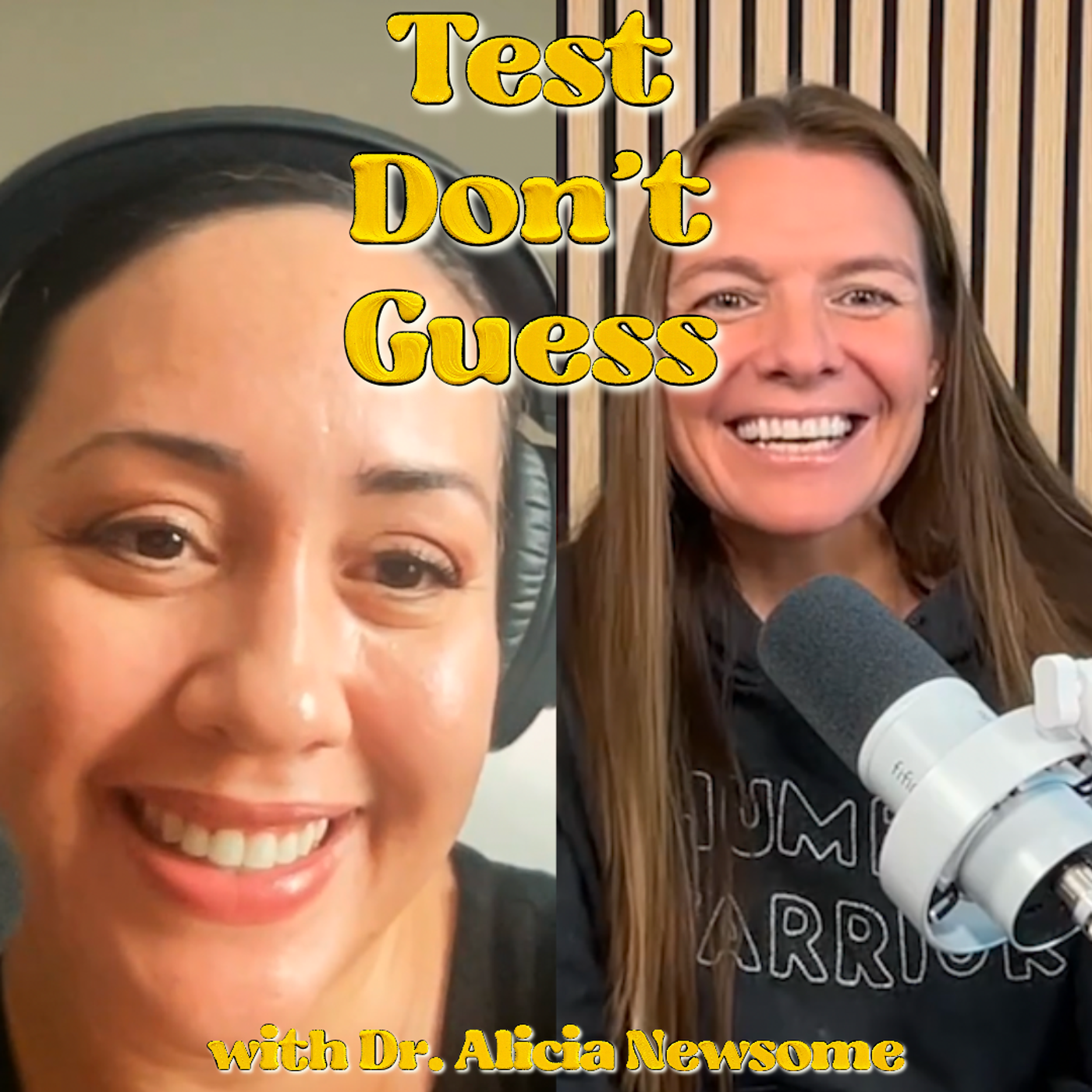
Episode 27: Test Don't Guess with Dr. Alicia Newsome
Tonight's Episode
Your fertility journey starts way before you start trying. The same body that carries you through all the other moments of your life will be the one you rely on to do what you want it to do while TTC...so why not learn what's under the hood as soon as you can?
Dr. Alicia Newsome is a functional doctor who specializes in women's health (fertility, hormones, fibroids, endometriosis, overall health). Her motto is all about finding out exactly what's under the hood, not just putting a bandaid on a symptom for short term relief.
Listen (or watch) this conversation if you want really good information about how you can approach your health from the inside out AND if you want some laughs. They giggle a lot for people who have one had one short conversation before this taping :)
To get in touch with Dr. Newsome:
https://www.dralicianewsome.com
Worthy of Rest book:https://go.dralicianewsome.com/checkout-worthy-of-rest
To get in touch with Ashlyne:
Instagram: https://www.instagram.com/ashlynehuffblue/
https://www.instagram.com/confessionsofaslowcooker/
Website: https://www.confessionsofaslowcooker.com
This audio and video podcast was produced, edited, and distributed by Small Batch Sound. https://www.smallbactchsound.com
Email: [email protected]
Small Batch Sound: Hey everyone, and welcome back to Confessions of a Slow Cooker. I'm Ashlyn Blue, and today we are joined by Dr. Alicia Newsome for some expertise. And we love us some expertise. Dr. Newsome is an international speaker, best selling author, trainer, and esteemed doctor working in functional medicine. Welcome to the show, Dr. Newsome. It is so good to see you again. So good to be here today. Thank you for having me. Of course. And With practitioners, I usually like to start with like an origin story. What brought you to this work, especially the functional part? Because it I was thinking like career day, elementary school, functional doctor is not necessarily like in the ⁓ standard selection, like teacher, policeman, firefighter, vet, right. So I wanted to know like what what got you here? I'm always fascinated, especially with these, you know, it's it's just not the traditional route. Yeah. So for those that are listening, first with functional medicine, a lot of times people are like, okay, what's that? And good to start think about if you have a headache. You can take a Tylenol, you could take an ibuprofen, and most likely your headache will go away. But you did not have that headache because you had a Tylenol deficiency. Okay. It's not like your body's like, I'm lacking Tylenol over here. There's something else going on inside your body. And sorry, I've never heard it said like that, and that makes total sense. I need Tylenol. Right, right. But we're often trained to think like, okay, I'm gonna take a medication for this or even a supplement for this or an herb or different things. That's really just not what your body may necessarily need. Now there's definitely a time and a place for medication and all of those things. If I get into a car accident or I'm having a heart attack, I want take me to the ER, you know, I I need to get help, right? But in just general everyday life, when it comes to chronic illness, when it comes to issues with menstrual cycles, when it comes to issues around digestion and bloating, there's other routes that we can take. So in functional medicine, we look at the body holistically To really find out exactly what's going on inside the body and then everything we do do is without drugs or surgery. Hmm. I love that. I love that and I'm one of my favorite things about having talking to more functional med functional doctors about functional medicine is that it's like the duh approach, but it's it's like labeled as alternative. And it's like, well, ⁓ you know, maybe it's alternative to what we what we grew up thinking. ⁓ and I have family or ⁓ in laws. My family actually no, my mom is a nurse, so I take it back. Sorry, mom. but my my father-in-law is a retired retired general surgeon, my husband is a periodontist, and my uncle-in-law, my d my husband's uncle is a cardiologist. So, like there's a lot of family talk now in my life that I did ⁓ medical talk rather, fa in the family that I did not have necessarily ⁓ as much growing up. But And they I think they come about like come to it in the in a functional side without saying it. Like they're they're ⁓ a duh approach, but also with like the, you know, like doing I called him the other day because I was like, hey, so I have a colonoscopy tomorrow. I've never had one. Can you walk me through what you did as a surgeon? And he did. And none of it was like, take ⁓ take meds, take meds. It was it was very like practical. But there's something about Medicine that again, like, why is what you do alternative? It it shouldn't be. Or you're like, why is it considered alternative? 'Cause it's kind of like, well, that's like the whole ball game and like it should be the I would think the last resort to go the the other route. I don't know. I'm not a doctor in the medical in in the medical industry and in medical school in general, really what's taught is to diagnose disease and then pharmacology. So then what prescription goes with this disease. So nutrition isn't taught. Only 25% of ⁓ medical schools even have one nutrition class. So for any doctor to practice functional medicine, and there's lots of different types, you know, MDs practice functional medicine, ⁓ DCs, NPs, ⁓ you know, there's even orthodontists that practice functional medicine and pharma pharmacists, you know, but we have to go back to school and get additional training for this. ⁓ to to learn this 'cause it's not it's not taught in traditional school. Everything is and you have to also think a lot of the sponsorship funding, different things like that comes from the pharmaceutical industry. The United States is only one of two countries in the U in the world that allow pharmaceutical companies to advertise directly to their consumers. So our you know we turn on the TV. Yes. In other countries You actually if there's something going on with you, you go to the doctor and the doctor is a doctor and asks questions and finds out what's going on with you. They still may resort to drugs. A lot of other countries do do a lot of al alternative things. But in the United States, you know, we're watching T V and then we're, you know, the drug company's telling us, you know, which drugs we need and then we just go into the doctor and say, Well, can you put me on this? What do you think about that? You know, I heard about that. I did not. Okay. First of all, my son, he's two almost two and a half, and there is not a drug commercial he won't stop and like crane his neck for. And I'm like, what are they doing? That a two year old is like Huh. Like I don't it's so f well like it's a joke at our house how much he will stop and like go around the ⁓ the island and be like, huh. If you can't see me I look weird, but ⁓ if you're just listening, but he will crane his neck and stop what ever he is doing when there is any drug commercial, it's not just one, it's all of them. I know all of them now based on him. ⁓ yeah, so there's some sort of psychology there. And it's working on my child. So great. Yes. I mean there's definitely, I mean, there's lots and lots and lots of money that goes into advertising, you know, and ⁓ what was I reading the other day? It was either 18 or 20 times the amount of money that pharmaceuticals spend on advertisement versus research. And I have a long a big career in pharmaceutical research. And I know a lot of money goes into that. Millions and millions and billions of dollars, right? But to think, you know, 18 to 20 times the amount goes into advertising. And you never hear about that. You hear about Research, research, research, and like and and all that's good. And I and you do have to advertise. I get if you can, yes. If you're allowed to. I understand the marketing and the the the business side of things. But yeah, it does seem a little lopsided. ⁓ to put it with And do we need to advertise? Because really people should be going to their doctors, you know, to Like what you might want to do is go to the doctor. And I mean, not you, ⁓ not the patient, but like the pharmaceutical company, and being like, This is why This is why this is marketing. Yeah, right. ⁓ I know. A lot of ⁓ people come to my husband's office with stuff, but they're not on TV. You know, implants are not as sexy. But but yeah, okay. So this is interesting. I I I didn't plan to ask you about this, but as you're talking about it, I'm like, this seems like the most normal route to figuring out what's wrong with you. in terms of a not a I mean, diagnosis kind of sounds like it's streamlined and that there's an easy way. But I feel like with functional medicine, just like with anything else, you have to ask a lot of questions. You have to do a lot of testing at the right time and all the things to really figure out because your body's not a monolith. A lot of it works to I mean, a lot of it works together, but if it's not working together, you kind of have to ⁓ do some a control, right? Like where you're like, okay, let's try this, but let's not throw it all at once because we need something to be consistent to make these ⁓ to be able to see where the problem lies. You know, we can't do all the med all the testing, ⁓ or testing maybe, but specific testing, like ruling something out, ⁓ takes time. And it's just not a quick fix like a like a medication. Yes. And in functional medicine, I mean my biggest saying is test don't guess. There's a lot of advanced lab testing that we do that you're not going to find at the traditional doctor. You're all and oftentimes it's it's not covered by insurance either because insurance is all in bed with the pharmaceutical companies and that whole world. So it is something that you have to be willing to invest time and money into to get the answers that you need. But once we have those answers, we're able to put together a plan that actually works. We're no longer guessing. We're not like, well it could be this or it might be that. Like when we do comprehensive testing, we know exactly what's going on and we can move forward strategically from there. Right. Well and and if I know anything, I'm on it I've been on it since two thousand twelve. ⁓ medication for allergic asthma and it's three thousand dollars a shot and I get it every two weeks. And so I made my deductible before like March every year, and I've been on it for forever. And yeah. But but during all this time it was like in the meantime, you're not breathing. ⁓ and you're going to the ER. So at the time when I and I sh I'm th rethinking my whole situation right as we're as we're talking right here. ⁓ can I see you after this? I'm just kidding. I'm not kidding actually, but I'm joking for for purposes of this podcast. ⁓ you have like patience for the rest of the day. But ⁓ the alternative at the time sounded great because I was actually at the end of of ⁓ singing ⁓ professionally, so I was It was a band-aid situation after band-aid situation, a cortisone shot here. I got shots in my nose to open up my sinuses. I had two sinus surgeries. Like I was trying everything and there's no time to recover when you're on the road. And so finally, I mean, I ended up with the ER twice. my my ⁓ inhalers didn't do a thing, didn't matter. Like it was like like they checked me for cardiac arrest once. And I didn't, but it was but it still took forever and a day for me to come back to n the normal. it's really hard to dance and sing at the same time while you can't breathe. Yeah. ⁓ and that's scary. Yeah, it was scary. I was by myself ⁓ in LA and yeah, it was even my manager wasn't even nearby because it was like Yom Kippur. So he was in services and they couldn't get my phone. It was a whole mess. But ⁓ but they The so this pulmonologist, very nice man, ⁓ was like, there is this new shot out. And this was back in 2011, and ⁓ and I was about to move back to Tennessee. And so he was like, Let's just see what we can do. So it at the time, he saved my life with this medication because it kept me from having all these allergy issues and it I didn't have these massive attacks that it came out of nowhere. Like I could be sitting still. Or I could be in the middle, like the beginning of a workout or something. It's so there was no rhyme or reason and we could not figure it out. I was a mystery. And it really irritated me on so many levels because I just didn't know it was gonna happen again. ⁓ and it made me not want to push. ⁓ on stage in front of people. And so ⁓ this shot that I'm on ⁓ has saved my life in a lot of ways and it was safe for pregnancy. So like things were good there. But now I'm reevaluating in real time everyone. Yeah. I don't care to be on this shot if I don't have to, you know? ⁓ so I should probably I'm I'm self diagnosing that I should probably talk to you. Okay. I'm here for it. Yeah, it's so I mean, that's where I feel like medication is great in emergency situations, you know. No longer emergent. It's been since seven twelve now. Yes. And a lot of times and I know you said it's a allergic asthma, you know, so there's something going on that's like triggering it. But asthma, allergies. eczema, a lot of that's tied into the gut a lot of times too. So I'm so interested, like, ooh, let's let's dive in and see what's going on there. We all do this here. That's not why I have you on at all. ⁓ But no, now I'm rethinking my whole approach. Okay, so what made you get into this? I think I asked you, like you're obviously interested in it, and I can tell just by the way you're talking about it, but ⁓ w what was that? Like you had to start somewhere in medicine. So where was that? Yes. So I always I had ⁓ a private practice and this was over ten years ago, well over ten years ago. My oldest children, they were still in diapers. I was going through a divorce, leaving a very volatile marriage, and I was exhausted all the time. So I would work all day, see patients. sit in rush hour traffic, go pick up my kids from daycare, take them home, feed them, bathe them, get them in bed so mama could go to bed. Like I was tired all the time. Sunday afternoon, I could head to a friend's house and plan to hang out. I'd sit down on the couch and I'm knocked out. They're like, Okay, give her her blanket, give her her pillow, we got the kids and that was my life, you know, and it I had other like kind of weird things like neck pain and back pain and I had always had irregular periods. Didn't really think much of it. And I ended up meeting a functional medicine doctor who ran advanced lab testing on me and then found out like what was going on with me and it completely changed my life. ⁓ energy levels skyrocketed, all my other health like weird things cleared up and it allowed me to really become a better mother, a better business owner, a better friend. Like all of those different types of things. So for me, energy is one of those things that I see a lot in my practice. Big indicate I'm very passionate about. Yeah. And yeah, it's a big indicator of like your overall health as well. If you're having you're sleeping all day and then you wake up, you're still exhausted, or let's say you're fine throughout the day, but then you crash midday. That like those are signs that something's going on in the body. Oftentimes an example that I'll give is imagine that you're driving down the street. And your check engine light comes on in your car. Now you see it come on, you're like, Okay, I gotta go take this car into the mechanic. Imagine that. When you get to the mechanic, you tell him, My check engine light came on last week. I'm hearing this little rattling sound going on and he's sitting there, he's taking notes and he's like, All right, ma'am, okay, okay. And imagine if he stuck his hand in his pocket and then he pulled out a sticker. And then he put that sticker right over that check engine light, right? Yeah, yeah. Right. That would be crazy, right? You'd say, Hey, okay, I need you to open up the hood, run some diagnostic tests, find out why my check engine light is going off in my car, right? There's something going on. So that just really transformed like even that understanding with the check engine light. And we talked about with Tylenol, you know, all of those things that Energy is that indicator, right? Of like how your body's functioning. It's one of the check engine lights going off, or digestion issues, or menstrual cycle issues. A lot of times as women, we're we've never even been taught to even understand the phases of our menstrual cycle and our the different levels of energy that we may be having during that time, or you know, like what our cervical fluid should be when we're looking at fertility and all of those different types of things. So And when those things are off, that's like that check engine light going off. So that's how I got started in functional medicine. And then I love that my life has taken lots of turns and done lots of things. I have a consulting business for f in pharmaceutical research. So I don't I I've I've lived in both worlds, right? That's really that's I feel like that's really good for what you do 'cause it you're not like just anti. Yeah, no, no, no, no. If you understand I love people who will like have the approach of eastern and western medicine and like it's like I'm not saying everything you're doing here is is ⁓ just wrong. I'm saying let's mix the two. Let's see what like it's a it's a case by case in what we're talking about. Yes. Very individualized for people. It shouldn't just be that band-aid approach, like a sticker or, you know, one size fits all. It should really be customized to what people need. So that's what I love about functional medicine. And I ended up opening the practice that I have now. I had many years where I worked, I was doing heavy consultant work and endometriosis, fibroids, women's health issues, cancers, all ti different types of things. And I ended up having a miscarriage. And that miscarriage really shook me up. I ended up passing everything around 17 weeks. So I was pretty far along. I was not expecting it at all. And I had been working in this consulting role for like a really long time. And I picked it up when I was going through my divorce. It was very ⁓ stable in the sense of like when you run a business and have a practice or you it never stops, right? So I was going through a divorce and everything like that. And then I transitioned into consulting. But I had always told myself, Well, I'm gonna go back to, you know, open up a functional medicine practice once I, you know, get myself together and feel more established and all of those things and All that happened, but I never stopped. Like I kept doing consulting. I remarried, you know, all these things. I I would have so much work. I loved it though. And my husband was like, Why do you have all these contracts? And you know, but I was kinda still stuck in a survival mode during that time. Which and I can s I can totally speak to that. But I was gonna say something that has nothing to do with functional medicine or medicine at all. But in divorce, like when you're going through I didn't have any children. But my my lawyer was like you 'cause I was doing real estate. We were talking about it before. ⁓ and that wasn't a constant. That was like in stable. And so he was like, You need to like table that for right now. Like 'cause obviously it doesn't matter. It's not like you have to clock in for that. I need you during this time to find a regular job where you just show up, you do your thing and you leave. And so I ended up working in admissions to college I went to talking to people about music business, ⁓ in like the song like all this stuff. So I stuff I knew. I didn't have to learn anything new. I actually was speaking from experience, like ⁓ you know, do you want to do a production? Do you want to do a songwriting? Do you want to do film ⁓ or or music business or whatever? And so I would talk to somebody every and was it was the best advice ⁓ I could have gotten, I think during that time, because it was stabilizing, even though it wasn't like my calling for the rest of my life. It was what I needed at the time. It was kinda like this whole thing. Like it's it wasn't a prescription for everything. It was what I needed during the season so that I could not be in such survival mode and have a lot of time by myself, which is what you do when you're a s ⁓ you know, a a contractor that may or may not work this month because, you know, real estate is is just that n the nature of that. So anyway, I I love that you were like, I don't need to do this, I need to do that, because that's like the opposite, but the same. approach. Like you you knew what you needed at the time. So Yeah. And it was perfect for me in that sense too. Like you said, like I could come in, do what I'm good at, all all of those things. And I didn't have because that was another stressor on me too. Like going through the divorce and all of that. And, you know, running to practice, even though now I've gone back into it you know, with running to practice, it doesn't always turn off, you know? It's not the same as like going in, doing my work and then I can go home and live my life, right? Right. Right. Yeah, I love that. And and going through divorce, while like it's in my it's in my rear view for ten years now, ⁓ this year, it's it's ⁓ it is such a like your life is blowing apart as you know it. It is there is just shrapnel everywhere. Yes. And if y what you do can be a sense depending on what you do, ⁓ it can be a sense of an anchor. Or it can be the source of more confus depends. It it literally depends on where you are, what you have. I didn't again, I didn't have any children, so it I didn't have any tether and ⁓ my dog died during my ⁓ my divorce. and I was just like, Okay, now and so I've got this little chihuahua over here and we're celebrating ten years this month. I got him ⁓ on my thirty first birthday, ⁓ and it was after, a couple months after my other dog died during the divorce and He was a stabilizer, but he, you know, he also like say I think he saved my life 'cause I had to wake up to take him out to pee, you know. Like I was like, I have to get out of bed. Okay, fine. But ⁓ but yeah, like so i ⁓ what you do and how you work and how you come to where you where you are, ⁓ yeah, during that time. I know this is not a podcast about post divorce, but it's a part of Part of both of our stories. I I was trying to do math in my head too, which is scary. But I was like, it feels like around the same time. Yeah. Yeah. And I and I understand that too is like how you said with the dog being that was another anchor for you to be able to like, okay, I've got to get up and do that. I feel like, you know, I had my kids at that time. They were little, but that was my like I gotta get up. Like I gotta keep taking care of these people. You know, like I can't yeah. Yeah. And and then it's a not it's not an anchor in like the settling sense. Yeah. ⁓ it's but it's in the going. Like you also need the pull me forward in life. Yeah. Uh-huh. Yeah. Divorce is not like you you said, just your whole life is blown up, you know, like everything like blown apart. ⁓ So glad that's like you said in the rear view mirror there. And then we're before we married and we got little ones. I have a my son's three. So just yeah. So yeah. mean So you you came to this from a very real place and Yes. And I I think a lot of times the obviously, you know, a male doctor wouldn't be coming to it from a very real fertility place. Or anything like that. Because they won't fit but they might have some like a touch point in their lives or something. Or just seeing people ⁓ and caring. But so you went through sorry, I sort of stopped you, you went through your miscarriage at seventeen weeks and k and started. Sorry to bring it back yet, but you're fine. You're fine. That really gave me that pause. Like it it made me be like, Okay, I am working a lot. It was work I enjoyed, you know. ⁓ But it was also during COVID. I was flying every week to different sites and different things like that. And it also just reminded me of what I really wanted to do. You know, I wasn't passionate about what I did. I was good at it. But what I really wanted to do, yes, yes, was open up my functional medicine practice. So I took some time to heal my body and, you know, all of those things. And then shortly after ⁓ maybe not shortly after, maybe about six months later. ⁓ I launched I launched this practice. And ⁓ my practice is virtual. So we work with women all over the country, all over the world. So even people in the UK, we ship them the labs that they need. They get shipped back. You know, we're able to work with women all over. And, you know, the area that I chose to focus on is women's health and hormones and fertility and menstrual cycles and you know even in my career in the on the pharmaceutical side I have all this on fibroids and endometriosis. Even with that, the drugs that were being researched and ⁓ two of them even got FDA approval. What we were doing were was we were giving women for endometriosis and fibroids, basically giving them like estrogen blockers. So we would block their estrogen. And of course, then the fibroids go away, the estrogen or the endometriosis goes away, all of those things, because those are estrogen dominant diseases. But then we'd have to give them adback because now they're having issues with their bones. And then also they couldn't get pregnant on the drug either, right? ⁓ Their their menstrual cycles would stop. So for me You said right, like I know. No, I don't. All good. Right? Okay. Yeah, yes, yes. So for me, with knowing all of that, it's like, well, why not from a root cause approach deal with why women are estrogen dominant when it comes to a lot of these menstrual cycle issues? And a lot of that has to do with HPA access. So that's ⁓ dealing with the hypothalamus, pituitary adrenal glands, which is your stress hormones. ⁓ which think about very comfortable with my stress. Yeah. We go way back, me and my adrenals. But it's imp it's I think we all have. You know, but in testing it's so it's so cool to see what's going on, you know. And a lot of times I can even with the data see almost like, ⁓ you know, this is sad. You know, like I can tell that you've been under a lot of stress for a really long time. And think about if there was a bear coming after you. Okay. Our bodies were created for short term stress. So bear comes after you and then You're going to eliminate that bear by either running away or fighting. Okay. So that's where we get fight or flight. By the way, don't fight a bear. Yes, don't fight a bear. Colorado, do not fight a bear. Do not fight a bear. No bear fighting. So you're probably gonna run away. Okay. But either way, the stressor is gone. And from there, your body goes back into what's called parasympathetic. Activity. So rest, digest, that's where your hormones are made, your sex hormones for a good menstrual cycle, fertility, all of that's made in that state. Okay. And think about it this way: if there was a bear coming after you, the last thing your body would think is now's a good time to make a baby, right? Nope. Your body is thinking about safety, right? It's thinking about I've got to run away. I didn't know I was so funny. So funny. So I'm just like picturing it. Okay. ⁓ Gotta go get pregnant. Yeah. Yes. The last thing you would think. Yes, yes. I'm turning red for anyone who's not watching. I should not have worn this shirt. Yes. so we've we've got to get our bodies weren't designed to be in this constant state of stress. They were designed for short term stress. But a lot of times as women we're staying in this constant state of stress. Mental emotional stress is a very real thing, like we talked about with divorce, relationships, work, all of those are can be stressors, financial stressors that that stresses out our body physiologically, just as if that bear was coming. But then there's other stressors. There's toxins. Toxins come in two forms there's biotoxins, and then there's external toxins. So biotoxins are living things like mold, fungus, parasites, bacteria, viruses, all of those things live inside the body. They pull on different nutrients that we need. They disrupt our gut microbiome. And then there's external toxins. So those are going to be things in the environment. Also a lot of those are endocrine disruptors because they mimic estrogen inside the body. So cleaning products, makeup products, things we put on our skin, things that we're breathing in in the air or water, different things have toxins in them. And the thing is we don't we can't avoid all toxins, right? I'm I'm pretty moderate with with things. I I remove what I can because it's a stressor to my body, but also I want to make sure that my body is getting rid of these things. And then there's a last bucket that I call deficiencies that is a stressor to the body, just like that bear, physiological stressor, and ⁓ nutrients is one. So we need a certain amount of protein, good fats, vitamins, minerals, amino acids, antioxidants in our body. Sleep is very important as well too. It's the most underrated free thing that we can give our body. But sometimes women have hormonal issues that's stopping them from being able to sleep. So we gotta address the root cause of that. And then also like a trauma. I used to have a a lot of trauma to get over and that was it was like a my body would wake me up at a certain time almost every night, not like a biologic not like a body clock. It was like This is your time to stress out about things you can't control. And of course that could be something else too, but I ⁓ did deal with a lot of that in my psychiatry appointments this past year, ⁓ doing like a post traumatic thing. E DMR and that. ⁓ no, not it it was just it was a s C P T. Okay. cognitive post ⁓ something like that. Yeah. Okay. Yeah. And it really did do a lot of good because there were a lot of things that were stuck in my brain that were re ⁓ purposed from a trauma twenty years ago that were like coming up and and so it was like that was bothering my gut because that's where my stress manifests. So I really do need to talk to you. But ⁓ yes, so d not only like you're saying the hormones, and I'm sure that my hormones are jacked up. But most women, yeah. Yeah. Yeah. ⁓ anyway, so continue. But sorry. But it's true what you say about the trauma. You know, big T trauma, little T trauma, it does get stored in I don't know if you've seen all the recent things out about the body keep score. That was all the whole thing. Like Yeah, the body keep score. And then they're like, no, the brain keeps score. And it's like, okay, it's it's really both, you know, the brain keep screen. Yeah, can we we don't have to fight about it? Yeah. Trauma doesn't care. Yes. But it gets stuck within us and That impacts our nervous system, right? So I can imagine you're like waking up in the middle of the night, right? And it's like that's your sympathetic nervous system that's being activated. And we do have to retrain our bodies to be able to relax and to feel safe. One thing that I tell my clients is I cannot get rid of all the you know, all the stressors in your life. But what we want to do is increase that zone of stress resiliency. So for those of you that are listening, like I'm white I'm opening my hands nice and wide. Think about it as if you were white water rafting and you're going down in your raft, but your your ⁓ raft is hitting the sides of the bank, right? It's just like ⁓ hitting it. That's like life happening. ⁓ toxins or this relationship or divorce or work or trauma, right? Different things. Your your raft is just hitting the sides as you're going down. What we want to do is Help your body increase that zone of stress resiliency. So widen that river. So as life is still lifing, right? It's still gonna do its thing, you're able to go down that river without hitting the banks the entire time that's going on. And your body can handle the stress better. I like that I'm a I love a good metaphor. I do all assimile's metaphor. I love it. I love it. So okay, when someone comes to first see you, asking for a friend. Point to me. ⁓ what do you do? What's 'cause it's all virtual, which is really nice to know because I know that my listeners and watchers are literally from everywhere. ⁓ it I some of them are like local here and I talk to some like at my my acupuncturist, like she's on here, but not everyone can see her. You know, and that's not only something you can do virtually, ⁓ actually. But ⁓ so yeah, what what what's the first thing that happens? Well The first thing everything starts with an initial consultation. My consultations are 90 minutes because we're gonna talk about everything. Okay. We're gonna leave no stone unturned. And even before that consultation, you fill out all of my intake forms. And that is over 300 questions. So take, you know, set aside some time. But with that information, I'm really able to get a good look into what's going on. In your body. I have root cause assessments, and you'll have a health score that populates from all of those things. And it gives us a really good bird's eye view of the underlying areas of what's going on inside your body. And then typically from there, we do labs. big advocate, test don't guess. We've got all this advanced lab work out there. Let's find out what's going on inside your body. So that could be anywhere from doing stool testing where we're looking like we don't look at your poop. The lab looks like a poop. But we we find out, you know, what's going on inside. Yeah, I'm not doing that. We find out what's going on with your gut. ⁓ we could find out like nutrient levels, like all your vitamins, minerals, amino acids, antioxidants. We do hormone testing. We look at stress hormones as well. We don't look at them in the blood as the primary place. We look at them in the urine and saliva. Where doing multiple collections throughout the day and then also throughout the month, because think about if you go in and you're having your hormones tested, they're just looking at it that day. And that is a very small just a snapshot. Yeah, just a snapshot where throughout the month your estrogen goes up and then it comes down and then progesterone goes up and it comes down. And we want to see what those levels are doing throughout the month. So I do something called psycho mapping. We're looking at all of that. We may test for toxins. There's all different types of testing. It depends on what you see in that with the intake and then the yeah. Exactly. And then from there, once we get your results back, that's where we're able to really put together a plan for you based off what's going on with your labs that will work because now we're working with data so that we're doing the right thing at the right time in the right way. And that's how we and we continue to work together one on one after that. That's awesome. Well, I I I It makes sen again, it's like a a very like duh approach. In the most like not n not dumbing down what you do, but like in like well well yeah. Well yeah. ⁓ yeah, I like it. I like it. Not giving any any patient information away, 'cause hippah. ⁓ is there anything like case wise that you're like this was an interesting one or ⁓ this is when I I thought I knew what was going on and then we found something else or Any anything interesting in your in your I'm sure there's a lot interesting, sorry. But anything that comes to mind that you want to share that you think would be ⁓ it's you know, either entertaining or just like ⁓ a ha because I think both are both both b I mean both are valid in my ⁓ opinion. ⁓ I had someone on yesterday, she's not gonna be I don't know what order, ⁓ it hasn't come out yet, it's my point. And sh her she ended up working with a ⁓ a functional a doctor and she actually worked with a couple because she needed to find the right match ⁓ with like the personality, the vibe and everything. And ⁓ and needed someone who'd really like get creative because she had a ton of stuff going on from Lyme and all these things that were imp impeding her stuff. And I feel like she was saying that most people mo the someone else like that she spoke to kind of hit like they hit a wall. You know, and it was kind of like, okay, like she she realized like she needed to move on. But hers was like twists and turns and ⁓ and then like ⁓ a parasite actually came into the from a Mexico trip and things like that. And so ⁓ she had to have someone kind of there for the long haul. And so anyway, I was just kind of mem remembering our talk yesterday and thinking, is there anything that you'd wanna share? Yeah, yeah, yeah, yeah. I mean I have all kinds of stories. ⁓ but I do think even with the other guests that you had, I do find that sometimes people will hit walls with other practitioners and also where I the state that I live in, there's also ⁓ naturopaths as well too. ⁓ which is a great profession. I find She may have started there and then ended up with all. Okay. So what can happen there sometimes? And I've had plenty of friends who are naturopaths and they still practice functional medicine. But what can happen sometimes with some naturopaths is that they will do the approach of you've got a symptom, now I'm gonna give you something natural for it versus root cause. So that's always something very important that you wanna find out. Yeah, that's a distinction. Now even yes. And Also, root cause is now like a word that's just thrown around everyone's using it, you know? But you really want to think about the major systems within the body, you know, like gut. That's very important. That's foundational. I recently had a client come to me and she's been to she's been everywhere, right? And she has neuropathy, she has lipidemia lip edema, and she has she has just a bunch of things going on. And we started working together. She brought me some labs that the previous practitioner had done, but she didn't even like bother having that practitioner read them. And I went over her labs. We also did hormone testing on her. And then even in the discovery, it was like no one's ever looked at your gut. Like all this work that you've done and no one's addressed what's going on here. So For me, really big areas are gut and then also stress hormones. Like you've you've got to address what's going on there. There there and then also the liver is a really important thing. So making sure that you have what we call drainage pathways. I I can't figure out a better word for it. I it sounds gross to me, but drainage pathways are gonna be like your gut. ⁓ you gotta be pooping well. So you don't wanna be constipated. You also don't wanna have diarrhea, you want everything moving. Think about your hormones go up and they go down, they've got to be able to leave the body. The liver is where your hormones are processed. The liver's gotta be functioning well. It's also right part of detoxification and ⁓ how the ⁓ your hormones ⁓ are metabolized in the body as well. Kidneys. So bile. Bile is very important for detoxifying ⁓ toxic. Estrogen, all of those are like foundational places that have to be addressed before you start jumping doing all types of things. So that's a way that also Q in like root cause. Are we addressing gut, liver? ⁓ all the things that are literally like sitting next to each other. Yes. Well, okay. So that kind of makes me think of ⁓ how ⁓ you know, ⁓ and I think I saw ⁓ or heard a commercial and it wasn't it wasn't For a drug, actually. It was for ⁓ life insurance. The other thing. And it's like my my dad I I don't know who it was, but my dad was the picture of health and he had a stroke. And I was like, those two things don't seem like they do to go but like you hear that kind of thing. Like they they were y he was so healthy. She was so healthy. What like and and it's The more and more I talk to people about stuff and it's probably because my podcast guest was on my mind and like she looks fine from the outside. I look fine from the outside. ⁓ I can't really breathe very well, you know. And I found out I have a f like a little bit of a fatty liver based on some labs I did. And so like I'm learning more about all these and I'm not science-y at all. So like but on the outside, I might look like I'm in good shape. ⁓ which I am finally for the first time since having my kid at f ⁓ 38. And ⁓ and but what is picture of health is the question. You like it my the pi is it a picture of me or is it on the inside? And if you don't know all these things and aren't educated on how the functions of the b I do like drainage pathways because it makes it it's like you can I do because like right outside where I am right now, you can see pipes, you can or drain drain pipes. You know, outside a house, like and if like how many gutter commercials have you seen in your in your life where they're like, You don't want this stuff to get stuck. Let's put something over it so the leaves don't get stuck. So that makes sense. Like you your body isn't you exc excrete excrement. Yes. That's cut yeah. So why w everything else has to go somewhere too? And we don't have just one organ. We have so many. So they all have functions that it makes sense that things are getting processed here and getting out, you know, this way or whatever. I I don't know anything about this, obviously, talking about like personally, but I'm going through, you know, forty doing colonoscopy, mammogram, things like that. And so I'm starting to have to give a shit about it. And ⁓ I wanna stay alive for my child. So Yeah. I did do I will drainage pathways is good. It's okay. It's okay. Just say like, think of a drainage pipe. You know, maybe don't think of like all the bodily parts, but I do I do not use traditional makeup. I did learn about that years and years ago since my my job was to put makeup all over my face every day for my job. And so I have been doing that. I did no but beyond that, like I again, I'm not sciencey. So like it it you know, whatever is under the skin layer is like I I just kind of I think maybe I just have like a phob not a phobia, but like I was never good at science in school, so I'm like not drawn to finding out until now. ⁓ I probably should. And it's like me. Don't be like me. Yeah. Well, just like you said with the commercial, fifty percent of the time the first sign of a heart attack is the heart attack. When you're having the other fifty percent of the time, there's it's called beginnings. That's like the literal ⁓ medical term, beginning sign and s and signs and symptoms. So think about that check engine light going off. Yeah. And I'm also Not too much of the belief that actually 50% of the time like there was no signs going on. I think that we're just tired to ignore them. I was recently looking up CDC statistics because I've I have a book coming out called Worthy of Rest for the woman who's tired of being the strong one. And I wanted to make sure that I had the most up to date ⁓ statistics talking about this topic as well as ⁓ pre diabet pre diabetes. So right now a hundred and ten million American adults are pre diabetic. That's forty four percent of American adults are pre diabetic. And over eighty percent of them don't even know that they are. These are C D C statistics. So they know that eighty percent of these people, which is almost one in two American adults, yeah, are pre diabetic, but they don't know it. Like but But they know, you know. Right. And it's just because a lot of times we're not really educated on the signs and the symptoms of things that are going on and the way that basic lab work is done, like if you go in for your woman well visit or your yearly physical, it's it's designed to wait until now we have a diagnosis of these things. Versus we could be looking at things like fasting insulin, which, you know, every time glucose goes up, insulin's gotta come out and it's gotta lower it. Mm-hmm. Glucose goes up, insulin's got to come out. So glucose goes up from stress, it goes up from ⁓ carbohydrates, pasta, chips, like different things like that. So it's blood sugar. It goes up, insulin's got to come out. But when someone becomes insulin resistant, it's when you're needing a whole lot of insulin in order to lower that number, but they don't even look at that number with typical blood work. That's one quick and easy way to let someone know like, ⁓ your pancreas is working. really, really hard in order to keep this number normal. Like your regular blood work will say, ⁓ it was at 85. It looks good. But then you need it four times the amount of insulin needed than what's, you know, optimal, like your pancreas is working really hard, but they don't look at that number. There's not a drug for that. You know, all the right all the blood work that's done is based on like, okay, we're running this to see if they need a specific drug, not do they need a specific lifestyle adjustment or anything like that. So that's really interesting because my sister is five foot and she has four children. So the stress is there. But she eats really well because she's very aware. She got gestational diabetes, I think of all of them, maybe maybe three out of four. But she just found out she's pre pre diabetic. They had her on metformin because she has PCOS and like she has all these like whatever, but like you would never look at her and say she has PCOS or that she'd be pre diabeted. Like she doesn't look like the type. She's a small little like ⁓ gymnast looking girl. And ⁓ and so yeah, it's like she when they told her that, she was like, What? You know, ⁓ but but she and so in the in the process, she's been learning all about the science of it. We're just these little Nashville girls are getting educated. ⁓ You know, my family's from Tennessee too, so ⁓ that's right, Chattanooga. Yeah. Well ⁓ Knoxville outside. I went to school in Chattanooga though. I went to undergrad in Chattanooga. But no, my my family's from Knoxville. So Yeah. Okay. Well well I'll maybe I should take yeah, I can I can stay with us little Nashville girls. Like Knoxville girls know. Yeah. It you're hilarious. I told you I had a lot of caffeine today. Y'all, she has had me cracking up since the beginning of this. When we got on before this podcast, we were chat chatting and she was cracking me up. It's been a good morning. It's been a good morning. I'm still very warm though. I should not have worn this sweatshirt. In the middle of summer. I know. But I was wearing to be honest with you, I was wearing it this morning 'cause it was chilly here in Colorado this morning. It was I'm like in the fifties and I was like, this looks good. Yeah. It's cute. I know I'm I I care so much about my wardrobe. No, it ⁓ I don't. And but I I mean like I thought if it was dirty, I would have changed it. I put it on though this morning. ⁓ okay. This has been so fun. ⁓ my I do this a lot. My cheeks will hurt after a while. My cheeks are hurting too. Yeah, they hurt. ⁓ Is there anything we haven't talked about that you want to make sure people know? Obviously, we'll put all the information of your upcoming book. And even if the book comes out, like maybe we have this new thing. I haven't even put it out yet, but it's called ⁓ slow cooker instant takes. So it's like a little you know, slow cooker takes forever. Instant takes are like a microwave and ⁓ you know, instant rice or something. And ⁓ so it's like people coming back to talk about something, either an update in their personal lives or like a book that comes out or something that is like more apricot. So I'll Yeah. I'll always update show notes and everything. So even if you're hearing this way later than we put it out, everything will be up to date in the show notes. But if you once your book comes out, maybe we can talk again. But is there anything else that we have not mentioned that you like everyone needs to know this? That's okay if it's no. Yeah, no, I think we covered a lot. I think we covered we did cover quite a bit. Yeah ⁓ well I so appreciate you coming on today and you you I I remember when I we first talked like you're like let's just see if we're a good fit and right away I was like Yeah we're good. We're gonna move this. Yeah and it it bore it bore out. So ⁓ everyone who is listening or watching, thank you so much for taking the time out of your day. thank you, Dr. Newsom, for taking the time out of your day. And I hope that you have ⁓ a good rest of your day. We talked about you she's had a morning, okay. Everyone, she's had a morning. but there's still time left. And if you have questions for Dr. Newsome, like I said before, and I say every time, I'll put all the information as as to how to get in touch with her in her show notes because sh remember she does service everyone, everywhere, because she does it virtually. So you don't have to be ⁓ you're in Arizona, right? Arizona, yes. ⁓ Arizona, yeah. So she's in Arizona, but it doesn't matter. where where you are. You can still talk to her. ⁓ if you have a question for me, ⁓ you know where to find me. And ⁓ if you know somebody who could use this information, use what Dr. Newsom said today, please share it with them. it doesn't have to be just about fertility. This is a fertility podcast, but we're I want to grow it outside of fertility because I think like your fertility window, it it starts well before you start trying. And a lot of these things could be ⁓ You don't want to find out like a lot of us do and have f ⁓ have found out that there are things we could have been doing a l a long time ago that maybe wouldn't lead to infertility issues. ⁓ and maybe it would, but but whatever. Like however you come to your body's health is is only going to help you through every phase of your life, including the fertility part. So ⁓ please ⁓ reach out to those around you if you notice that like they're always having trouble, they're always on meds. ⁓ but don't seem to be any better. 'cause I I truly am going to use Dr. Newsom after this. And so like I I I'm saying it not only to like tell her, like, don't get off the line, but also ⁓ like I accountability. Cause I I would like to see what else is under the hood because I just my colonoscopy came back okay. ⁓ I had a polyp, but like it was ⁓ benign and everything. ⁓ but I still have gut issues and I like I said at the at the very beginning, I have allergic asthma. And if there's another way to go about that, like you said, the gut, like I've always had gut issues. So like in my head, the reason I'm even saying any of this and not waiting till we're off the the air, so to speak, is that you said something in here that resonated with me because I know I am otherwise pretty healthy. Like I like I don't I don't make like crap decisions about my life all the time. I have stuff, I've lived a life from 40. So I've like I've got stuff going on. And yet I still have these issues. So why not take a different approach? Something I've never done before. So ⁓ anyway, I'm putting it out there. I'm doing it. I'm doing it. and ⁓ so if you if you are heard anything that Dr. Newsom said or even something that I said that made you think, well, yeah, I kind of could probably use a little bit of a different approach just to see because you you said ⁓ test don't guess. Or is that is that the way you said it? Mm-hmm. Test don't guess. Yes. ⁓ and so I I highly recommend, especially if you're out there thinking like I like you're like I'm I'm ha my my breathing is handled, but that's handled isn't necessarily what I want for the rest of my life. I don't really want to be on this shop. If I don't have to be. If I have to be, I have to be. Fine. But ⁓ alternatives are alternative for a reason. ⁓ and if you can make it your primary. Maybe let's do that. Yeah. ⁓ anyway, everyone, thank you so much for listening. Thank you so much for watching. I'll be back next week with somebody else who is awesome. And until then, I hope everybody takes care.
 Apple Podcasts
 Spotify
 YouTube
 Castbox
 Castro
 Goodpods
 Podcast Addict
 Moon FM
 Overcast
 Pocket Casts
 Podbean
 Podcast Republic