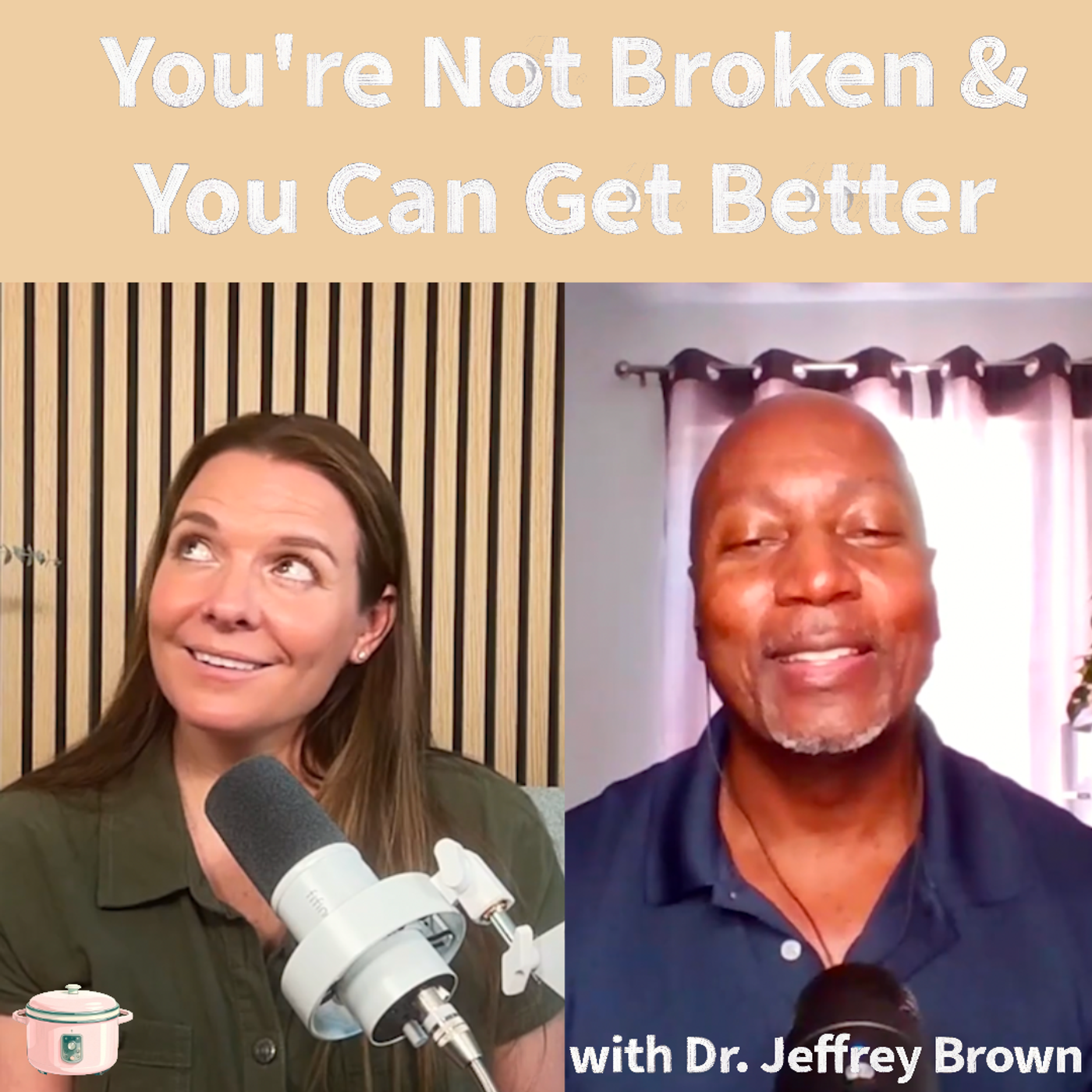
Episode 18: You're Not Broken & You Can Get Better with Dr. Jeffrey Brown
Tonight's Episode
If you've been on the hamster wheel of trying to get pregnant only to hit dead end after dead end with your own health? It can be so defeating and can cause you to stop believing 1. you'll ever be a parent and/or 2. you'll ever get any better.
Dr. Jeffrey Brown hopes you jump off of that spinning wheel and schedule an appointment with someone like him: a doctor of osteopathy specializing in fertility (specifically PCOS, endometriosis, hormones, etc.).
Our bodies are one unit, and even though every organ and system might have a different function, they all affect each other and throw the whole thing out of whack. So instead of zooming it, he zooms out in search of the root cause (which could also be trauma from a long time ago) and ways to bring everything back to a flow state.
For more from Dr. Jeffrey Brown:
- Webinar: https://hormonehealthwithdrbrown.com/webinar
- Free E-book (for listeners dealing with chronic pelvic pain): https://hormonehealthwithdrbrown.com/free-ebook
- Website: https://hormonehealthwithdrbrown.com
To get in touch with Ashlyne:
Instagram: https://www.instagram.com/ashlynehuffblue/
Email: [email protected]
Website: https//confessionsofaslowcooker.com
This audio and video podcast was produced, edited, and distributed by Small Batch Sound. https://www.smallbactchsound.com
Small Batch Sound: Hey everyone, and welcome back to Confessions of a Slow Cooker. I'm Ashlyn Blue, and today's guest is Dr. Jeffrey Brown. Dr. Brown is an osteopathic functional medicine physician, which is hard for me to say and I practice it all morning. He specializes in treating women with endometriosis, adenomiosis, also said that right, PCOS, and other conditions. And the key is he uses a holistic, whole body, big picture approach in his work. I'm really excited to talk to him today because I feel like I've heard the same stories my whole life, whether it be with family members or friends in more of an anecdotal way, or right here on this podcast. The story might be I first found out about my fill in the blank when I got off birth control and was starting to try to have a family. Or it may be something like I dealt with debilitating period pain, and I was just told that some people just have that. So Dr. Brown. Thank you for coming. Thanks for being on the show. Thank you for having me, Ashlyn. Looking forward to your talk. I'm excited to talk to you and hear ⁓ about what you do because obviously it is ⁓ crucial to find out what's going on under the proverbial hood when you are trying to start a family. ⁓ so let's start with, if you're okay with it, let's start with how you got what drew you to medicine and ultimately what prompted you to want to get more into the specialty that you have. Well, according to my parents, I said from the time that I was seven or eight years old I was gonna be a doctor. So I can't really recall, you know, why back then. But I do remember always having an interest in health and fitness. I just always was, you know, enjoyed sports. I didn't know what kind of doctor I wanted to be. I maybe I'd be a sports medicine, orthopedic surgeon. ⁓ I I didn't know. I just knew that I just love helping people. I love the human body. And when I was in college, I learned about osteopathic medicine. You know, 'cause most people don't even know what an osteopath is. Right. I I'd I had never heard of it. But I was Go ahead and tell us what So and so there's two forms of medicine ⁓ in the United States. It's the allopathic medicine, which is focused on disease, right? Those are the MDs. Everybody knows who they are. But then there's a branch of us that are osteopaths where we focus on the muscoskeletal system because everything derives, you know, neuromuscular from the spine. And so the philosophy of an osteopath is that the body has its own intrinsic ability to heal, but it just may need some help to, you know, move it along. And so osteopaths are in every field of medicine, you pediatric, orthopedic surgeon, neurosurgeon, you know, just like, you know, MDs, we take the same exams except that we also are trained to use our hands. ⁓ similar to chiropractic, just the manual therapy piece of it. So I wanted to have as many tools in my belt as I could. And so I only applied to osteopathic schools ⁓ so I can learn that skill because I've always had a a passion for pain as well. You know, anything that can really impact our lives. I wanted to be able to have as many tools as possible to help people to navigate that, which is why I went to osteopathic school. And so that's what brought me to to that. But and then I went into family medicine. I figured, ⁓ I can treat the whole family. Right. Just didn't I didn't again, I didn't know if I would be bored just seeing the same thing, you know, all the time. So I went to family medicine. you know, you're treating the whole family. So then when I finished residency, you know, and got out into the real world, ⁓ very disheartened, you know, at the beginning. I I didn't know, you know, that's how medicine w was it was gonna be. You know, I just felt like it was just, you know, a mill. You know, people came in, you know, you treat your symptoms, ⁓ maybe you're refilling your scripts. And some people were on so many scripts, you know, I spent the whole time just filling out the scripts. I was like, ⁓ my gosh, ten, fifteen plus, you know, more prescriptions. And unfortunately that is an epidemic where, you know most of the, you know, older population is on I think at least four medications, something like that. You know, which is just kind of ridiculous. But and so I kinda you know, I I just said I can't I'm not gonna do this the rest of my life. Like there's no way this type of medicine it just didn't feel right, you know, for me, where it's just kinda like a a band aid, you know, type of approach. ⁓ or you just referring to different specialists that, you know, nobody's really talking with each other. And so they're just each of them are adding you know, their own pills or were doing different tests, et cetera. And so kinda it was frustrating. I said, I know there's gotta be a you know a better way than than this. And so I just I searched. I, you know, eventually had my own practice and, you know, took some courses on some of the alternative treatments. And then I came across functional medicine. Actually it was the women in my practice that introduced me or asked me about bio identical hormones. Now of course I had never heard of biodegradic hormones. Now this is back in this is back in two thousand and eight give or so. When Suzanne Summers, you know, had written a book and you know, she was on biodental hormones and she was on Oprah Wyn3 and and Dr. Phil talking about biodental hormones. And ⁓ so I said, Okay. And I happened to have a relationship with the compound pharmacy. They sponsored me to go to one of their conferences learning about biodental hormones and it just blew my mind. I was like, ⁓ my gosh, this is kind of what I've been looking for. learn so much. Cause again, we didn't learn this in residency or, you know, in medical school. ⁓ and then from there, because I lived in Vegas at the time and that's where the biggest conference for A4M, which is the American Academy of Anti-Aging and Regenerative Medicine, ⁓ their conference is located in Las Vegas every December. So I went to that conference and again, blew my mind. Blew my mind. And so from that ⁓ moment on, I said, okay, now I know what I'm called to do. Like this was it. So implemented because they taught you how to address the the whole body, looking at the whole body, every system, everything's connected. We're one unit. But unfortunately we specialize in everything. So everything is, you know, differentiated where we're all one unit. Which is a osteopathic philosophy. It's like the body's one. It can heal itself. We just gotta figure out what it is that either is missing or if it's toxicity somewhere or whatever the disconnect is, figure that out and get out the way and let the body do what it's designed to do. You know, so right and To add to well t so my father in law is a retired general surgeon. ⁓ and I feel like I'm wondering I mean, not the osteopathic sort of thing, but like he used to do everything. Like he he would s you know, he'd come in, he would do the hysterectomy, then he would do the gallbladder, then he would do you know, and so I feel like specialties just weren't a thing back in the day and then they became a thing. It's like Like the pendulum seems to have swung a little like you said, no one's talking. Everyone's got a specialty and they're zoned in on one thing. And it's kinda like I feel like, yeah, like this osteo I know it's not new, but it it it's n it was new to you at the time. And I love how excited you got about it. Like I can tell, by the way, if you're not watching him, he got really animated. ⁓ you can hear it in his voice, but like that is such a fun thing to watch somebody like find themselves in something. Like you knew you wanted to be in this area. But now I know exactly what I wanna do and yeah, I got chills. And it's funny when you mentioned ⁓ your you said your grandfather. My ⁓ my father in law. Your father in law. And so when the specialization started happening and occurring, the one thing that never was created, unfortunately, was a specialty for women's health as far as the biodental hormone piece of it in the in the hormone dysregulation. You know, OBGYNs They deliver babies. They do gynecological surgeries, but they don't specialize in in hormones, which unfortunately most women think they do, ⁓ but they do not. I would have thought so. Yes, but they don't balance hormones. And that's why you see so many so many women struggle struggle with either the perimenopause, menopausal phase, you know, and unfortunately if they have, you know, the PCOS, endometriosis, adenomy, you know, all these things, you know, the really the treatment in the conventional world is well, birth control. antidepressants, you know, because women are so emotional, right? That okay, we gotta be antidepressants because what else are we gonna do, right? So then maybe that will help with you. And if that doesn't work, then it's like surgery. So really you've been given three options and like those aren't the best options because they're not really addressing the underlying cause. And so millions of women across the world suffer because really there's no specialty, you know, that's recognized by the AMA anyway, ⁓ that you go through residential training for to address those issues. So we have to learn that. I learned all that you know, afterwards going through my training and then with clinical experience to learn how to address, you know, those issues. And because it's been so underserved and I've seen so many people just, you know, in tears, you know, because they've gone from different specialists, you know, trying to figure out what's going on with them and they've been told that, you know, everything is normal. And so of course they're thinking they're crazy and then eventually they just give up and they just just suffer. And, you know, there you go. You know, so like I said, I always have a passion for pain. And so, you know, I had a mission to try to figure this out and navigate this 'cause I know the body can heal. You just have to figure out what that is. And so that's what I've been doing for over fifteen years is, you know, identifying the problems and, you know, helping women to navigate that, you know, restore their life. So that's wonderful. And I'm still surprised I know that you're doing this, but like I'm still surprised in this day and age that there's not something that and maybe there is and I just don't know about it, that there's not like a connector there in like the medical school anyway, whatever. So when someone comes to see you, w kind of give us a little bit of like what what what would you ⁓ first do? What questions might you ask to a patient? And, you know, maybe based on some of your past ⁓ patients, obviously, and we said that I said this before, we're not talking about specific people because of HIPAA, but like ⁓ some a type of person who would come in, what would you notice that might say, ⁓ this might go into this direction or let's look under this ⁓ you know, ⁓ let's look behind this door. yeah, what what would a typical initial and then follow up ⁓ session with you be like? Well the first thing is, you know, of course they're filling out a questionnaire and that questionnaire is very detailed. So I get a sense of, you know, what issues are going on. You know, what's are the more severe symptoms? 'Cause you know that you rate it on a scale, so I can see, okay, these are the areas that are most troublesome. And and then the question always is, okay, then what's most important to her? Right? So okay, so we can say, all right, 'cause even though I may think something else is more important to address, but I still want to know, okay, what is their main concern because that's why they came. You want to get their main things, you know, ⁓ addressed. And what you taking, I'm sure. Say again. What what medic medications are you on? Yeah, I can pretty much guess what those are. Are you getting I kinda like I told you already, like depending upon what they're coming in for, a lot of times it's either going to be antidepressants, you know, birth control, ⁓ maybe a different type of pain medication, you know, if they have endometriosis or fibromyalgia, you they're gonna be on pain meds, antidepressants, so a lot of stuff. And then once they hit perimenopause, you maybe a doctor wants to put ⁓ on a a statin drug, or maybe their blood pressure's starting to come up and and so the medication's totally. You're saying women aren't really that much of a mystery. Is that a good point. I'm gonna say You know, it's funny 'cause from a male perspective, I was like, you what? I've been working with women for so long and I got a maybe a mm more insight than most men do, but they're still a mystery. So that's kind of ⁓ trick question. Yes, yeah. Continue, sorry. No, so what was gonna say is, you know, a lot of these changes that happen, ⁓ you know, with women, it's not just like one area that you look at. Because like I said, again, i the body is systemic and and so there's multiple things that interact with each other that you wanna look at so that they can see you what the problem is and then they understand why, you know, I'm addressing this area. And then so we can so the body can do what it needs to do to, you know, work together. You know, so y yes, you wanna look at the hormones, right? And it's gotta be done in a certain time of the cycle. Now, I know I've met I'm met a lot of women, they say, Yeah, I asked my doctor to run hormones. Maybe they did, maybe they didn't, right? ⁓ but again, they're not trained to one to know what to order, first of all, as far as making sure everything is there and then when to order them, 'cause depending on when you order take it in your cycle is very important 'cause it gives you different information. So you can't just go at any any time. And then you have to work with someone that knows, okay, what's the you know, how are they balanced? You know, it's not about just looking at the reference range. What's the relationship between estrogen and progesterone? What does testosterone look like? What is the complete thyroid panel you know looking at? Because in a conventional world they're not ordering a complete thyroid panel. And you need to to get a bigger understanding as far what what's happening. And so that's why it's not really done. And so when people are asking for those tests, they don't understand the person that they're asking really truly isn't trained. So you're not going to get the answers that you're you know, that you're hoping for. Yeah and so that's I've actually heard a put like some pushback from ⁓ I know my sister had pushback because I suggested after they found a thyroid issue with me when I went to ⁓ I went to a fertility clinic to start IVF and that was one of the things they obviously did a huge comprehensive thing and they were like actually so use your hypo you have hypo hypothyroidism but just enough to where it's it's not gonna bother your whole system on a regular basis but as you're trying to get pregnant as a geriatric patient ⁓ you know, this is something we want to put you on. Is it levathyroxine, leva thyroxy? So they put me on that. Yeah. The ⁓ they put me on that. And so I told my sister, I was like, hey, you should ask for blah. And I and she was just with an obese. She didn't have she had three kids by that point. She was having some miscarriages after three. And so she didn't have a specialist and she they were kind of reticent. And she was like, But I'm asking you to and so this makes so much more sense to me. Because it's like it's not necessarily like, no, we don't wanna check your hormones. It might just be like, we just aren't trained for this and how do we say that? You know? Exac you hit the nail on the head because you're asking for something. If they don't know what they're gonna do with it to address it, then while I I'm not gonna order a test that don't know what to do with the answers. Like when the results come back, if it's not my area, you know, I would send you to somewhere else that, you know, would know how to deal with that. But people under assumption that, you know, every doctor knows. The same thing. Yeah, it's like, no, that's that's that not how it works. So yes, yeah, that's correct. Which is good information to know as somebody who's first of all, I know my sister was really frustrated because she 'cause the response was not, I'm not trained in that area. Right. It was more like no, from the nurse. It wasn't even from the doctor. And so she never quite understood why I'm asking for this blood test. I don't care if it's covered or not. It's not about that. But that's kind of where they left it. Like, well, it won't be covered because of whatever. And they just kind of let it die off. And she insisted because she's very ⁓ she's spicy. ⁓ and and she was like, No, I wanna know. And I told her what to to do because I had all my labs with me. And so they were able to do that and she was able to see something and it was the same as mine. And ⁓ I'm not saying that's what got her her fourth child. I have no idea technically, but she fought for herself. But I feel like most people don't have that advocate nature because they feel like I'm the patient, the doctor must know more. And so this information is I feel like is so good because it's not about saying, Doctor, you aren't qualified. ⁓ please check your ego at the door. It's more like just knowing who to ask the right questions so you can get. More comprehensive answers. Exact. Like you. Yes. Exactly. No, and it's very well said. I mean that's really you know, I encourage people to ask questions, you know, find the right source, you know, where you can get in depth ⁓ testing done. ⁓ there's a I forget the name of the program now, but I've had some patients do it where they can pay money online to get functional tests done. So I think it's called functional lab, something like that. And so they can get a comprehensive, you know, test. We'll figure it out before the end of this and we'll put it in the show notes. Yes, exactly. Yeah. So they can order it themselves. They just have to have a physician that can h you know help them navigate it. But they can order functional tests on their own, you know, if they're willing to pay the membership fee, you know, for it. So you know that's a great thing that they they put out there for patients who are looking, you know, for some answers. But they still gonna have to find someone that can help them with the results they get. Right, right. But but just sometimes I feel like if you're afraid to have if you're not a spicy person like my sister, sweet Maddie, Maybe you don't wanna be that person who's pushy on the phone. Yep. ⁓ or seemingly pushy. You're not pushy, you're being an advocate. You should be able to do that. But if that's not your jam, then this this sounds like a good avenue to be like, all right, I already got this stuff. Here it is, here are my results. ⁓ you know, and maybe even asking who, you know, who can who can dissect this code or not dissect, who can crack this code of my body? 'Cause I feel like that's kind of how it feels. When you aren't a textbook person, and who is really, but I'm 40, almost 41. ⁓ I look 12, but I'm 40. And I you know, and I don't know if you know anything about my besides you obviously know I went through IVF, but there were so many things that I didn't know until I got into it. And I don't have PCOS, I don't have endo, I don't have any of these things. But it was still difficult. And I felt like I was just getting older, which was creating that ⁓ that that what is it on my cousin Vinny? She's like, My biological clock is, you know, just ticking. And so it just put pressure on the whole process. ⁓ my husband actually ended up having something as well. He had an obstruction. So he had to get his sperm manually extracted. That was something that we didn't find out ⁓ until after two IUIs, which were fine. Like they looked at everything and it was like motility was a little lower, but he was older too and whatever. And then we went up for our workup and the ⁓ our IBF workup and they were like, There's nothing. Literally nothing, no count. There had been a count two months ago, no count now. And so we still don't know why that is, or when the obstruction in two months happened and whatnot. But it w just took a lot of digging. And the longer that takes, the more crazy you feel. And the more helpless you feel and the more defective you feel. And so ⁓ I just that's where in in all those things put together. it will bother y how you feel like in terms of depression or anxiety. And so like it I feel like it almost adds to it. You may need an antidepressant for that, you know, for the process, but maybe you didn't need it for the first part. And so yeah, it's it we're a jumble bundle and jumble of nerves and fear and inadequacies will make probably come to you. and so w like you where do you besides okay so we started with testing. Once you get some tests back. Maybe like let's go into a test case of something, you know, it doesn't have to be specific, but say it's somebody that you're like, I feel like this is gonna be an Endometrius. Endometrius. That sounds like something from Harry Potter. Endometriosis. Endometrius. like a case of endometriosis ⁓ or PCOS. You get to choose, obviously. But what would you what would your conversation be like? with someone who you're kind of like, are I'm seeing what I'm seeing, and this is what I'm thinking. Okay. So yeah, that's that's a lot. So Yeah, cause in my cause right My mind just was like, wow, there's a lot there as far as something so okay. Think where you want to go with it. Yeah. Cause there's a lot of d different avenues, you know, to go. So I'm gonna first start with ⁓ endometriosis species. So these are all kind of blend together because I can talk about certain things that will impact all these things anyway, that impact all of us actually. Mm-hmm. So one of the theories behind endometriosis is the endocrine disrupting chemicals that are impacting the health of the fetus while it's developing. You know, because we're exposed to so many chemicals. And especially those endocrine disrupting chemicals. And so when they're in utero ⁓ that will impact their genetics, the genetic expression, as well as their hormones. And we know that these chemicals, these endocin disrupting chemicals, they will impact how hormones are expressed, ⁓ how they are, you know, received, the messengers, because that's what hormones are. And so chemicals are a huge, you know, huge player in I think our sickness, you know, today, and especially hormone dysregulation. And so gotta look at that. So you say, okay, you these toxins, these plastics, these microplastics, these nanoplastics that are basically everywhere probably on the earth, you know, right now. Right. You know, and so if this impacted our system, ⁓ and creating havoc and increasing inflammation, 'cause a lot of these things are inflammatory conditions, you know, what can you do at home, you know, to at least slow down or decrease your exposure? You know, so that's on them. But then we talk about it because some people are not aware, you know, of that. You know, I still, you know, when you go to the stores you see shopping carts full of bottled water. You know, so I'm looking at women, I was like, Mm, I hope you're not drinking that. That's not helping you, right? You know, when you look at your cabinet, do you are you storing your food in plastic? Are you heating things up in a microwave in plastic? Are you using all that saran wrap? Are you buying yourself with all these plastics? You gotta stay away from those things. 'Cause those things can impact your your hormone health. And and so toxins are really important. important, you know, staying away from fish, staying away from, you know, ⁓ charred, you know, meats. Yeah, I know we love the barbecue, but how much of that are you eating? Because that can impact, you know, your hormone health. So if you're having a hard time getting pregnant, you gotta look at your toxic exposure. You know, and that's that's a big thing. 'Cause yes, I'm gonna help you to help the detox, I'm gonna help your body to facilitate ⁓ releasing some of those chemicals and helping that, but you also gotta stop the you know continued exposure. You know, so the education piece is is really important. Help me help you. Yeah. Right. So then you once you give them that information, then they can start, you know, Googling it, watching YouTube's, you know, different podcast and people talking about it. So they ⁓ I didn't know. Okay, so then they can start making those changes to, you know, d decrease the amount of exposure that they're having and before you know it, maybe things will start to, you know, they get get better. Because we know a lot things are just choices. Like you you put your ⁓ your stuff in the microwave somehow, like put it in a glass bowl. Like you know, like it's one A or B. And so it's not really like it doesn't have to be a huge lifestyle change. It's more of a t like a a choice, especially during this time of your life. And can I go back to you were saying just to make sure I'm hearing you correctly, that when the the the patient was in utero, that's when those disruptions happened? Okay, okay. Yes. Because you know, as a as a female Well not just a female, mi men and women, we have a lot of chemicals in us. They've done studies and they've shown that, you know, breast milk, ⁓ urine, ⁓ you know, pretty much any fluid, you know, is coming out, looking at the placenta, you know, they've seen over a hundred different types of chemicals, you know, in that ⁓ that liquid. And so that fetus is exposed to those chemicals, right? There's no getting, you know, around that. But so if you can slow that down or significantly decrease that, you know, that goes a long way to helping them. Now obviously that that fetus and utero there's some genetic predisposition to developing endometriosis because not everybody develops that or a DNA or PCOS. But we know those microplastics, we know the mechanism and how it can end up turning into PCOS when they hit puberty, right? Or endometriosis, right? Because they're affecting our hormones, glutenizing hormones, folcostimulating hormones, testosterone production, you know, ovarian disruption. We know those plastics can get into your thyroid and cause problems in your ovaries, etcetera. Right. So that's they do. They get in and cause havoc. So we know those chemicals are doing that, you know, to our systems. And so all of a sudden, you know, you you get your first period and you're debilitated. And it's like, wow, from the very beginning. And then of course they just throw you on birth control and it 'cause you and then hoping that helps to regulate and decrease your pain. And then when you decide to have kids, well they never addressed the underlying problem in the first place. So now you're having problems and now you've just found out that you have endometriosis or maybe PCOS, etcetera. Because Soon as you have pain and, you know, as a as a child, maybe you have depression, anxiety, the period is really bad. Well, you know, what are they trained to do? Put you on a pill. And, you know, you may have to try different pills to find one that maybe you tolerate, you know, but ⁓ so that's what the problem is. So that's what I say. The chemicals, the toxin exposure is really important to make those lifestyle changes. You know, like you said, w from the kitchen, you know, to what you're putting on your body, the lotions, your cosmetics, you know, buy green products. That's really important. Not just to buy the regular stuff, you know, over the counters. You don't understand how many chemicals are on these things that you're putting on your body. Because your skin is the biggest organ in your body. So now you're putting all these chemicals, you know, on you on a regular basis. Even the clothing that you wear. You know, the polyesters and, you know, the other thick stuff that's that's there that's not allowing your skin to breathe. A lot of the sportswear contains all these chemicals in it that people are not aware of. You need to be aware of that. You know, you need to really start educating yourself on these things that could be impacting. ⁓ your ability to you know have a child and just g be healthier overall. Just Right. This is this is for people who are wanting and not wanting. Like I'm not planning on having another. ⁓ Archer was our he's two, but he ⁓ he was our last embryo. So unless something happens, which again we're not we're not trying for it, but like I would I'm taking this information as well, ⁓ and and ⁓ want to apply it 'cause I would like to be healthy for my child who is here already. ⁓ for as long as I possibly can. And I remember hearing that ⁓ phrase, which is a fact, that your your skin is the biggest organ, back after I was probably thirty. So I I grew up dancing pr competitively and which is a lot of stage makeup, ⁓ since I was seven. And then after ⁓ in college I got a record deal and so a collective s six hours a day in hair and makeup. And Yuck. And for by the way, like I don't love wearing it anyway because it is not fun to have it on. But at the same time, that was my job. And so I found out at like thirty I think I'd just gotten divorced ⁓ from my first husband and I talked to somebody who was also in music before. She was a little older than I was, and she was like You need to start doing clean makeup. And I was like, I don't want to wear makeup. She was like, Well, you to eventually again. You're like sad pants right now, but you will have to eventually again and again and go back into the world. ⁓ and she said, And so you need to think about like what's on your eyelids, what's on whatever. And I it changed my entire world back then. I was like, ⁓ okay. So I need to like not only I can't reverse whatever, but I at least need to be mindful. And ever since then, everything I have chosen, not only do I First of all, I don't and I don't know how you feel about this, but I don't ex I don't ⁓ trust just the word organic or just the word clean. I do more research because the regulations around, especially in the US, are s are really antiquated and in terms of healthcare or or health like, you know, like lotions and definitely makeup. ⁓ and I learned a lot about the law there, which was a deep dive for me. But so I would say Definitely do your research there. It's with what we've got today, it's not a long process to do the research, but it may be clean in one part of the the supply chain. But if I think what did they what did I read once? But if like the the coconut oil sits in a tub that's made of plastic for like three weeks, that can change. You know, and so ⁓ and glass bottles versus ⁓ plastic bottles and you know, what what they're what they're packaged in. So Yeah, it it seems like a lot, but the reason I even bring it up is that the if you get into a mode, it's a lot easier. You know, it's it's not like, ⁓ they're telling me to do all these other things. Life is hard enough. It is hard enough, but it is ⁓ it's a worthwhile choice, not just for I feel like getting ⁓ pregnant and staying pregnant and having a baby, but also staying alive for said baby. Yeah, I had a professor once to tell me, you're either gonna pay in the front end or you're gonna pay in the back end. It's just a matter of depending about when when do you want to pay? And if you pay in the front end, you're gonna be paying so much less. You know, it it just that's what it is. And and you went through it. Yeah, I tell patients all the time, you just once you start educating yourself and like you said, you start making these small little tweaks because you're not changing what you're already doing. It's the same habits, but now you're just making different choices. Then, you know, it's this on autopad. pilot. And you you don't not even gonna think about it. Once you've done the done the work and the education, your due diligence, you'll understand, you know, where you need to ⁓ you know, shop, purchase, use, you know, whatever. Yeah. And and I think the the company that I started to buy makeup from at the time, I don't really do makeup as much anymore is more skincare, but ⁓ their philosophy was once you're done with what you got, like it wasn't up like throw everything away, you know, start from scratch. It was like once you're done with what you've got, which you're going to, then try us. And then it becomes like then you can replenish that and that and that. And so I know that resources are scarce, sometimes scarce, sometimes less scarce for some people. And so this is not I'm I'm I'm not putting words in your mouth. I but I'm assuming you're you're not saying you have to quit everything you've ever been doing. It's just like be more mindful and when you have the opportunity, it can only help you go in the direction you're looking to go. That's it. That's a you know, yeah, certain things may cost a little bit more. Weigh them, I guess. Yeah. But like when it comes to buying meat, you know, you definitely gotta stay away from the hormone fed products. Like to me, some there's certain things that there's there's there's no ⁓ I I would say there's there's no room for that. I just like there's no there's no reason to be ingesting that. Like I don't does it have to be organic? No. But sometimes they have other forms like Costco has organic and they have ones that say yes, not ⁓ no antibiotics, no hormones, no, right? So it's like, okay, so it's a bit cheaper, but it's a little bit more expensive than a regular one. But I say that's definitely worth it for your health. Like that's you know, if you have choices and you can make a healthier choice and spend a little bit more now, I said that would help you save on the back end. And maybe an easier way to think about it if you're like I feel like a lot of people, especially women, are like, I don't want to spend that on myself, or like they they start to like find ways to say you know, a like a deserving thing as if that's a that's part of this the decision, but it is, it is. And so instead of pretending like it's not, maybe like saying, All right, what what would I give my baby? You know, like if you have one, like you give your baby the best you can possibly find because you want them to have the brain development and all those things. All right, so if I wanna have a baby, what do I want to go ahead and start doing for that baby? Or what do I already give my actual baby that I want to keep giving to my body? as well. ⁓ if you want to take it out of your own headspace. Hell yeah. No. Especially if you have loved ones that you care about. And one thing about women, and I you know this, is that ⁓ you know one of the problems that I have with women is like you guys are too selfless. And I need you guys to be something to be more selfish. Right? We know men, we can be selfish. We don't have any hard time with that. Women always w women are always giving, giving I'll go without I'll go with that. Yeah, you'll go without it's like, hey, no problem. And then I would say, Well, if your cup is empty, what are you gonna give to anybody else? Like, think about that. You know, when you're in a planet, okay, you gotta put your auction mask on first before you go to somebody else. But I'm like, you y if you don't have a cup that's full or even half full, then you're not gonna have anything left over, you know, for somebody else. So I also put it in those terms. And the other thing I tell my patients as well, I say, look, one of the biggest stressors and and that's a topic of conversation as well, is stress as far as impacting fertility, but we'll come back to that later. Yeah. But one of the biggest stressors that I've seen in my patients is that they're taking care of their parents. And so if you're not taking care of yourself now, you're gonna be adding an unfair burden to your children when they're adults because you didn't take care of yourself. And I was like, That's not something you really want to pass on. Like for me, that's one of the reasons why I I I take care of myself 'cause I told my kids you're not gonna have to worry about me when I'm older. I'm not putting that stress on you. And so I make you know, that's why I'm working out, eating healthy, you know, for my own you know, well being but also I think about my kids 'cause I've seen that stressor on so many of my patients of having taken care of their parents when they're old because they didn't take care of themselves when they were younger. So I was like it's not, you know y you keep that in mind. People don't think about the future. And so that's something else I tell my patients. And if you if it's easier for you to say my own cup like like I'll I'll help everyone else, then you know, phrase it that way in your brain and say, I'm helping my kid later. I'm helping my kid later down the line That brings me to something that what you were saying like kind of brought it up in my head. This podcast is called Confessions of a Slow Cooker. So like a literal slow cooker, ⁓ is my little emblem and the s emphasis excuse me, but the emphasis was on slow, because it took me so freaking long to get cooking. But it's also just a long process in general. And that literal thought to me came up when you were talking about All the things you're putting in your body, ⁓ don't let it ingest or whatever. But like, so say, and I'm not much of a cook, my husband does this for us, thank God. But a slow cooker, an actual, you know, pressure cooker is a bowl, so to speak. And you put all these things into it, but what if you put everything into it and there was a chemical or a poison lining the bowl? What you come out with is something that is inedible or bad for you. And so if we are the slow cooker, if we are the oven, if we're you know, we're the bowl, our body needs to have it needs to be clean for it to cook right, you know, and for the baby to cook right. And so it's it's so duh, but it is I feel like like you what you said, like selfless is just I feel like the way re women tend to run. And we need to unrun that way. Yep. Yep. I I say it all all the time. ⁓ it's like I wish you guys could just become more selfish sometimes. ⁓ it's you you you go go go, you you know, you're you're pouring out and you know, you don't slow down. ⁓ but that leads, you know, to other issues. You know, one of the biggest things maybe this is good time to start. If you're trying to get start a having a baby or start a family, this is the time to start. Being selfish if you haven't already. Yep. Being selfish. You need to take more spa days, you know. You need more self care days. One of the things that I find ⁓ because a lot of my women are high performing women. You know, they're business owners, they're professionals, they're, you know, you're just you're wired, you're you're going, ⁓ you push through. And one of the things that well because you're wired that way, I said, That's a gift, it's a talent. And it's allowed you to succeed in certain areas of your life. But that same skill set, that same talent is hindering your health. And I give the analogy as like when your body it feels like it's in fight or flight, you know, it's in defense mechanism, right? It it it's going into, you know, that defense. And and so when that happens, there's a lot of things because you only have so many, you know, resources, right? And those resources kinda get get diverted. And and so If you don't need, if the body doesn't need certain things, it's gonna take resources from there. Just like, you know, running the country, right? You gotta put the resources where you feel is most valuable. ⁓ and the reproductive system is not necessary to run or fight. If your body feels like it's in danger, ⁓ that reproductive system is not important. It's not a priority. So your body's gonna take resources from there and put it towards areas that are very important so your body can defend itself. You know, so if you're always going and fighting, your body's always in this fight or flight state. it's not surprising when I see a lot of reproductive issues, you know, whether it's irregular cycles, the heavy periods, the dysregulation. ⁓ i it's you're in fight or flight. Your your body's not going to be happy, you know, in that. Cortisol is going to be high, you know, in a fight or flight situation. So if cortisol is high, that means progesterone's low. And if you don't have progesterone, you're not getting pregnant. You're not maintaining, you know, a pregnancy. You're gonna have ovulation, you know, issues. So you can't have be operating with cortisol being you know, high all the time. A and and so the other thing you may find too is I have women that because of high stress, they're gonna have gastrointestinal issues, you know, the bloating, constipation. I can't tell you how many women I've seen that don't have a bowel movement for maybe, you know, three, four or five days. And unfortunately they've been told sometimes that's normal to go a few days without, you know, having a bowel movement. But I'm like, no, that means you're keeping those toxins inside of you. You gotta go regularly, ultimately two times a a day. But anytime I see a lot of gastrointestinal discomfort, I know it's probably because of that fight or flight response that they're still in that that go mode. And so it's really important, you know, that they work on the rest and digest. And that that's like one of my three pillars as far as what are we addressing to help with some of these issues is the toxins. And then the other one is is stress. But that's the hardest one to get people to do because it's so wired to always go. But I tell them I said, Are you listening to your body? All these symptoms, your body's giving you clues. But you're ignoring the clues. You're you're ignoring the body's ability to communicate with you because you're not listening. And if you don't listen, then things are just going to get worse because it's trying to get your attention. But I think sometimes because of how you're wired, you just push through the pain, you push through the discomfort, you push through the signals that your body is trying to get your attention. And so That is something we always have a conversation about. Every single day, all day long. I'm talking about what are doing? What do what are we doing here to to help bring cortisol down? Because then if cortisol is high, that means thyroid is affected. And we know the thyro is really important as far as helping you to get pregnant. I've seen that over and over again. When the thyroid is not working right, you you're not gonna be able to get pregnant or maintain a But I don't think you said we've seen and I'm sure you're thinking like in your practice, like and and and your medical background, but we didn't know that had anything to do with it, as in me or anyone I know. And I am a big advocate for people, like I said with my sister, I've told other people, get your thyroid checked. ⁓ I didn't know to the extent like you were saying all the things, but I definitely definitely knew from experience. And then when it came to progesterone, ⁓ I've said this on the podcast, but since you've not been on the podcast until today, I'll say it again, but my lab accidentally between my second transfer, my first transfer did not work, my second transfer ultimately did, but my estrogen was low the day of the transfer. And so they said, All right, go let's up your dosage and then get a test for the estrogen in two days back at in Aspen. ⁓ 'cause I was a down in Denver. So they were gonna check me back here locally. And because it's such a small lab and they already had my like ⁓ you know, pregnancy test stuff, the the lab ⁓ order in for both of them, they accidentally ran the wrong test. They ran the one about my HS H C, my ⁓ my progesterone and my estrogen. So because they accidentally ran a full panel versus just the estrogen, they caught that two days after the transfer, my progesterone plummeted. And so they were able to adjust that. And my husband and I are kind of curious because progesterone's kind of key in the transfer stage, right? So we wonder ⁓ could that have happened the first time? And we didn't know because there was no test between day of and nine days later, which I think is insane. And so my suggestion is for everyone to ask for an extra ⁓ test for both. ⁓ even if you didn't have any issues come up on the day of transfer, because I'm pretty sure that's how my son got here, you know? Back to and so this is not me asking for medical advice ⁓ via podcast. It's more me telling you, I have I'm the high achiever. Yep. ⁓ And I would say, you know, most women would probably say, Well, my success in life it has worked. I have been successful because I have pushed through some of the less fun emotions or whatever, and it's worked for me. ⁓ I don't get stuck on those things. So, you know, if you've got it in your head that you're successful because I do X, Y, or Z, that may be true in one part of your life, but if you've learned anything from your relationships, you cannot push past certain things on that front either. So why would you think your body would be any different? I run fight or flight mode. I don't know if that's a a a switch, but I have ⁓ I have run that way for the longest time. And I do know the the reason I'm less so today because of a lot of therapy, a trauma back in my teens. ⁓ but I definitely run that way and ha did through all my fertility stuff. ⁓ got a divorce at 30. That gave me some anxiety that I had to deal with as well. And then all of my stress manifests, including panic attacks in my gut. Always has. And so ⁓ that I'm like I'm like your I'm your patients. Yep. You are. You're the typical one. Yes. I should have come to you. ⁓ but yeah, all this resonates with me, and I'm sure I'm not the only one. No. You know, and unfortunately, you know, too many women have suffered traumas, whether it's, you know, emotional abuse, sexual abuse, physical abuse, just the verbal abuse, you know, when they were younger. And and that then that gets stored internally. So now you you you even push through and try to suppress that that trauma. But that trauma, you know, that stress is it it's gonna go somewhere and it's gonna have to come out, you know, at some point. And at some point it's gonna manifest, you know, and that's why, you know, therapy is important. ⁓ working on, you know, stress reduction i is so important. ⁓ 'cause people try to bury that or throw it in a closet, but no, it's it's not it's gonna rear its ugly head unfortunately and and that really disrupts hormones. You know, like I said, my issue was ⁓ I was afraid to tell someone. And so I didn't tell anyone for a year and then I didn't tell my parents about it was a it was a sexual assault when I was nineteen and ⁓ so all that time it known was challenging. any of my assumptions about this particular thing. And ⁓ including myself, my assumptions were my assumptions and they just took off. And what I learned in this past year of doing ⁓ some PTSD or cognitive ⁓ whatever p CPD CPT excuse me therapy for like months and months on end was that it grew legs and arms and it went elsewhere and it had a new personality and it, you know, like and so it just traveled around and it's and it found new ways. to come about and had nothing to do, I thought, with what ha what happened when I was 19. ⁓ but it did. Yeah, I have several stories of that. ⁓ from I I'm thinking a couple of different patients run into my head. And like I told you before, the stress is a sympathetic response. And it it's going to manifest in the parasympathetic areas that are not important for fight or flight. And so Very commonly GI issues, gastrointestinal issues will come up. And one of my first questions, of course, is gonna be, when did it start? You know, depending upon this the the degree of it. And so then they'll tell me when it started. And then I'll say, Okay, what stressor, ⁓ trauma or anything that happened, you know, leading up to that? Mm-hmm. Thirty seconds within, tears come. And Ca and a lot of them never made the connection. You know, until I asked the question, it they never made the connection before. But whatever that was, that was a stressful time in their life and then all of a sudden those gastrointestinal problems started coming up, you know, or you know, some other things that may have started because of I thought mine was food poisoning. Yeah. Yeah. And I was like, I don't know why this would give me food poisoning or not, or but it was always something different and a different time. So like I couldn't find the link in my head. ⁓ I'll tell you about the link later because it's not podcast helpful. But fibromyalgia. You know, you know fibromyalgia. Mostly, you know, women. Again, every single one. 100% of patients that I see with fibromyalgia, they've all had different stressors and and trauma. So you just ask the question. I have not met one that didn't have any. Or at you know, if they're gonna be honest, they all have had you know something. Because when you're in fight or flight mode, you know, your muscles are tense. They're ready to go. They're ready to fight, they're ready to run around and pounce. And long term tension of that's gonna lead to the headaches. It's gonna lead to that pain, that lactic acid ⁓ buildup, you know, that's there. So next thing you know, now you, you know, you get diagnosed with fibromyalgia. So a lot of these symptoms, you know, give me clues. Like that's what I'm saying. Just to ask the right questions, it will tell you, you know, what w what's going on. And then now you just need to, you know, work, you know, through that, you know, depending upon what it is, either with the different specialists, you know, 'cause I'm not in the mental health world. I don't do that. But once I identify it, now they know okay, they need to work on that. And then I can help the body to, you know, heal. But they gotta work on the emotional, spiritual, you know, piece of that. My gastroenterologist back when I I lived in Nashville for the most of my entire life and ⁓ I went with my my grandmother and I used to have coffees on Mondays 'cause she lived near me. And so we would have coffee and just hang out together and some of the best times of my life. And she's still around. But ⁓ were when I was literally living so close to her that we would do that. And in lieu of one of them I was like, Can we go to my you will we go with me to my gastro appointment? 'Cause ⁓ I had had that a lot recently. I'd just had b gotten home from a trip where I'd thrown up like for two days straight and I hate throwing up. ⁓ and I was like, God, I've had five bouts of food poisoning in in like the last few months and like this is bad. And she had had, ⁓ in her s fifties, late late fifties maybe, ⁓ ⁓ colon cancer and they found it and they got it and it was all in the biopsy when they when they took out it was like that was it. So she got really lucky that that that's all that it happened and they just like poked in the right spot. But I was thinking, what's wrong with my colon? Like probably something's going on. My dad has diverticulitis, I have I have gut issues, like I must have something wrong. And the doctor was like listening to all my s all my stories of all the times and he was like, No This does not sound like that. and we penned it down to he was like, Some people, you know, they it manifests in like a migraine. Other people it manifests in the gut and you are that person. And I was like, Holy moly, that's possible. You know, and that did it did help me, but it also made me aware of how my stress could manifest. And that sort of stressed me out. So it didn't totally help all the time. Cause then I was like, Am I nervous? ⁓ my God, I'm nervous. ⁓ my God, am I nauseous? ⁓ my gosh, I'm gonna throw up. You know. So it it sort of led to a little bit of a a bad thing for a while there as well. But ⁓ but that was so interesting to me. I am getting a colonospie next month at 40 because I do have gut issues of running in my family and I just want to make sure that the pipes are clean. But ⁓ but it is so I love what I love about all of this is listening to what you're saying about just the the approach. And I mentioned it at the top, like it's a f whole big picture. Like you said, you're not in the mental health space. But that doesn't mean that you can't see the connections and the origins and the root causes. Because if we know anything about our medical system, as you've touched on, it is that it is treating symptoms. And that is great for short term like pain or whatever. ⁓ when my husband gives surgery, he definitely sends ⁓ some pain medication if it's it's you know, if it's specific thing that's going to be hard. He doesn't want it to be hard. That doesn't mean that he's not trying to find the infection and get that infection out. ⁓ because otherwise you'll just have to come back. Or we might lose that tooth because of it, you know. So that is I feel like better medicine is to say, I don't want you to have to come back. I would like for you to be a graduate. as opposed to a chronic patient. ⁓ and finding ways to get to the root cause is the only way to do that. I feel like the mental health space does ⁓ the good ones do a good like my psychiatrist is phenomenal and he's so good about that. He's not looking, I know, just based on the way that he talks to me, he wants me to get better, which means we're gonna have the heart conversations. And I feel like that's the kind of the whole health, the whole body, because they are connected. ⁓ someone said to me yesterday, why aren't or no, a couple days ago, why aren't the eyes and the teeth part of your ⁓ you know, what they would consider your whole body for medical insurance? Like why are those selected as separate? They are so part of the body, you know, and and yet it's like, no, but do you have to have vision insurance? You know as if they're not part of the whole thing. So I love that you look at the whole thing because I think a lot of people tend to specialize in their own heads too. Not as like medical doctors or anything of that nature. But they sort of think that all the organs are in silos and that they're they're so next to each other. They're literally touching each other in there. And so if one thing's happening, maybe something else somewhere is happening too. So I mean it makes so much sense when you think about it. I just don't think we think about it all that well. No, no, 'cause we're not trained to because we've been so everything's so specialized and we just segment everything. So they're training people to go to different specialists. So we end up thinking the same way and not understanding that, yeah, your knee pain could be because of, you know, a shoulder issue or a gallbladder issue. Like we we don't make the connections. Right. Right. And we're not trained to, but like you said, we're also going to people who specialize in that one thing and they're like ⁓ like is it myopic? Is that the right word? Like you know, you're you're kind of looking through some binoculars as opposed to ⁓ or or a magnifying glass as opposed to like looking at the whole body. And that makes me want to be a little bit more aware of anatomy. I'm not a science girl or a math girl. ⁓ don't ask me to do math in public. ⁓ but it make it's more interesting to me thinking about it in terms of all the things working together, not so much having like a quiz. ⁓ so I'm gonna try to do that this afternoon. All right. Very nice. I'm gonna be a science girl. Okay. You've seen all these, not you, but ⁓ say a listener has she's seen so many medical doctors. She's seen so many specialists. She feels just like at the end of her rope. She doesn't want to invest anymore because she doesn't have that ⁓ just laying lying around somewhere. La laying around, lying around, laying around. And what would you say to to somebody who's like, Do I really need another doctor? Is it gonna make any difference in terms of functional medicine? You said, well when I say Yeah, or what would what would your what would your pitch for lack of a better term? Because that sounds like y you want business. But like what would you say to someone who's like Re like what's real like obviously if you've been listening to this conversation, you know there's a lot more to be learned about your body than treating the symptoms or or whatnot. But how would you talk to somebody and say, like, this is worth your time and and money to take that extra step? ⁓ most definitely, because I I I already know where they've been. So a lot of my patients have already been, you know, they may have been to the the gynecologist, they've been to the neurologist. They've been to the endocrinologist, they've seen their own primary doctor and they you know, just kind of the same thing. And I told them 'cause you they don't specialize, you know, in the areas that you're, you know, having issues with. Even if you go to gastroenterologists, they're gonna scope you, you know, from you know, top to bottom, and they may say everything's fine, or maybe they see one little polyp, but it's not the functional testing. And that's the issue there is the functional testing. So, like for us, you know, we're doing comprehensive stool analysis. Where I can look at you know, look at the microbiome and see what's going on with it, the different organisms, are they balanced? You're looking at the inflammatory markers, we're looking at ⁓ certain enzymes that are important that influence how your hormones are being ⁓ metabolized. You know, we're we're looking at all those things, the the gut lining, you know, we're looking at food allergies and sensitivities, you know, we're looking at your stress markers, we're looking at your hormones, we're doing specialty tests to kind of get a sense of, you know, what's going on, you know, inside of your body. But also too, you know. Because of how we approach it, we're gonna spend time with you to figure out what's going inside your head. You know, where where are those emotions at? Where does some of this stuff you know start? It's important to know were you breastfed? Did were you a C section baby or were you a regular vaginal deliverer? Because that gives me, you know, information. What was your childhood like? You know, was there trauma or not? You know, was it happy? Where did you live? Where did you grow up? You know, do you have some under water were drinking? Yeah. Exactly. Underlying infections maybe based on the information that you are are sharing with me. Because then the more information that we get, then we're able to paint a picture to have a better understanding of what you, and then we know, okay, these are the tests we need to run with these things in mind that I'm I'm, you know, double checking to see, okay, yep, you know, that is that is it. You know, sometimes these patients, they've been suffering for years. And then once you ask the right questions, like, ⁓ I think this is where we're at. Run the test, just had someone, you know, two weeks ago. Sure enough. You know, Lyme disease, ⁓ the different ticks co infections came back and she'd been struggling with fatigue and skin issues and stuff, and no one ever thought to run it. You know, because people didn't think about asking the questions. Where did you go on vacation? Where did you hang out? Like all those different things because, you know, with a functional doc typically we're asking a lot of questions, we're spending a lot of time so we get to know you, and then that can help me to decide what tests that we need to run besides just you know your basic ones. I mean, our stuff are usually more in depth anyway. than your traditional testing. But we're also when we do our tests, we're also looking more at optimal ranges. Like people want their thyroid tested, but they may get a T S H in in T four, but they're not going deeper. You know, what about the antibodies? You know, what about, you know, free T three, which is the active component? Because that tells me, you know, your stress level as well. If you're not converting from T four to T three, well that tells me there's some other things that's going on there if you're not in the optimal range. 'Cause too often the conventional world is looking at the reference range, which is so huge, and as long as you fit in there, they tell you everything is fine. I was like, No, that's not y you need to be here, right, to make sure that your body's operating optimally. Not to mention too, this reference range, you know, who's the average population? Well, people are overweight, everybody's inflamed, they're toxic, they're depressed. Y you wanna be the same as them? And that's like, no, I don't think so. But that's the reference range based on the average population. So We wanna be in the optimal ranges, right? Or your height and weight, I'm assuming too. You know, like blood work, right? So ⁓ right, right, right. But all those things, you know, when you're looking at the reference range, you can't just and I see it too often where they're in the reference range, so the doctor says, Yep, everything's fine. It's like, No, you're not. You know, this is the range you need to be in. You're not even close to being in that range. ⁓ and we need to help you get there. And so that's what I tell people is like, look, if you more behol a comprehensive approach. And it's not so even I won't e use the word holistic because it is. We're looking at the whole mind, body, spirit, because I truly believe in that. But it's also more comprehensive, you know, looking at all the different things. Right? We're testing your blood and we're looking at your stool. We're looking at your spit. Like we're looking at your urine. We're looking at all these things 'cause it gives me different information to help you. You know, so that that's the difference. I love that. I love that I sh I so would have I feel like I would have so benefited from this well before ⁓ even the the family, you know, d building phase of everything because so much of my life I feel like has been more of like a reactive thing, you know. Being on tour does is not good for the body, mind, or spirit. no matter how much you love it. And I my body was breaking down without anything other. I think it was just over over the top stress because I wasn't drinking. I've never smoked. I've never done a drug. Like I had nothing to like add to it. And yet my body would not function well. And I'm sure it was what happened in my trauma that was like just compounding it and finding different ways. I think one of the biggest eye openers, the only good thing about that gastroenterologist appointment that I had, but by the way, he didn't touch my body at all. He literally sent me home saying, There's nothing wrong with your body. Cause I can tell based on everything you said to me, this is actually somebody. ⁓ that is stressing you the hell out. ⁓ that's a good guy. That was a good guy. I think most of them would go and test and scope you and do all those things. Yeah. He didn't touch he literally did not touch my skin. Not once. And sent me home ⁓ with a lot to think about. But what it did tell me was that the mind and the body are so connected. And I was like, okay, so if somebody tells you that it's all in your head, it may start there. It may end there, you know, in your gut, or it may end somewhere else in your body. Phantom pain. What whatever the case is, it does not mean that it is you're crazy. That might mean that it there's a mental component that is tweaking the system enough to where it is coming ⁓ alive inside your body. And that is ⁓ not again, I don't think that's dismissive. I think the words, the phrase is bad, but I do think that it is ⁓ it's true. It can be true. And like and so I love that your approach is with that component as well. Not just what's going on physically, but also like where did you get that idea or why are you in fight or flight mode? ⁓ because the why is usually the answer, you know. Amen. You said it can't see any better. I am so good about that. No, I am not. This is not my realm. I just happen to have a lot of personal, ⁓ unfortunate personal experience being on the other side of it. Is there anything that you want everyone to know that we haven't talked about today before we wrap up? I mean, the floor is yours either way. Like if there's ⁓ just anything that you would say, obviously we've talked about everything you would do with the patient and I will put all of your information in the ⁓ show notes. ⁓ if if somebody you're on the east coast, right? Yep, we're in Florida. Mm-hmm. Florida. Okay, great. What part of Florida? We're down in Palm Bee's Gardens. Okay, that's awesome. Yeah, so I'll put all your information, especially if someone's nearby, because it sounds like you'd be somebody I I'm in Colorado, so ⁓ I'm not necessarily very close. But if someone is, like I would I would love for them to get in touch with you. And so I'll make that abundantly clear in the show notes. But is there anything ⁓ besides like the functional panel that you talked about, is there anything else that you would leave listeners with that we have not spoken about today? Well, one of the things I want well, there's there's a number of things, but one is that ⁓ you're not broken. And you can be better. That that is 'cause I think too too many women have given up and they don't think that they can get better. And I would say, no, y y you truly can. You know, you just gotta believe, you know, that you can. that's that's really important, the the power of belief, you know, when it comes to healing. You know, so I'll I'll go to my grave with that. ⁓ as long as you believe, because I've met patients who didn't believe they can get better. And guess what? They didn't get better. And I would say that on the on the initial consult. I'm like, you come in here, I can see that you don't believe you can get better. And so if you have that in you, you can't fight like I can't do anything with that. Like I said, the power of belief, you know, in in different religions, you know, as a Christian, it's like, yeah, you know, you are as you believe. And so if you don't believe you can heal, don't be surprised when it does, 'cause that's your magic. Don't waste your money. Yeah. Yeah. It's yeah, don't don't waste your money with it if you don't think it's it it's gonna happen. ⁓ you know, I do have a ⁓ virtual program, you know, so my goal and mission is to help women, you know, really across the world, you know, that suffer from chronic pelvic pain, endometriosis, adenomyosis. Like that's like I said, I want to help people get rid of that pain and let them know that they can they can heal. I do a monthly webinar, you know, free webinar every month. And so we'll give you that information. So if you want to join, you know, every month, you know, we're doing it so they can learn more about our approach and, you know, how we ⁓ address that. And, you know That's it. Just believe, have faith, be more selfless. You know, take more like I said, self-care days is really important. And I truly believe that, you know, your body can heal. That that's it. I love what you said. And this is where I wanna end on because I think it's a great way to end. ⁓ you're not broken, but you can get better, which another way to say that, you're not broken, so you don't need to be fixed. Yeah. There you go. Not something that needs to be fixed, but you can get better. with help, education, investment, ⁓ choices, and belief. Love it. Ugh. This has been so great. Thank you so much for coming on today. I have learned a lot about myself, even though I like knew some of it. I'm still like, do I want to start this monthly thing just to learn more? Probably so. I so appreciate your time and I know that So many women, whether that wherever they are in the journey of wanting to either get pregnant, not maybe they're listening for a friend, ⁓ because they're going through that, but they're getting something I feel like I'd be getting something out of this and even if I wasn't on a fertility journey at all or having had been already. So this has been so great. Thank you, thank you, thank you. ⁓ and thank you for everybody who is listening right now. If you have questions for me, you know how to find me because you know my stuff is in the the show notes. If you have questions for Dr. Brown, by the way, I'm unfortunately not Dr. Blue Boo. So if you have a question for him, I will, like we have said this whole time, we will put all the information that you need in the show notes. Please do reach out to him. If you can't tell, he is a wealth of knowledge and he gives a lot of shits about this. So ⁓ if this episode is something that would you feel like would help someone in your life, please share it with them. I don't do the subscribe, ⁓ you know, give me five stars. That's that's great for an algorithm, but this podcast is really, really meant to help those who are in it right now or want to know that they are absolutely normal in going through it and find ways to make their life just a little bit more healthy, a little bit easier, and a little bit more fun because you know, we're living. ⁓ thank you so much for everybody here, Dr. Brown. And until we meet again, I hope everyone takes care.
 Apple Podcasts
 Spotify
 YouTube
 Castbox
 Castro
 Goodpods
 Podcast Addict
 Moon FM
 Overcast
 Pocket Casts
 Podbean
 Podcast Republic