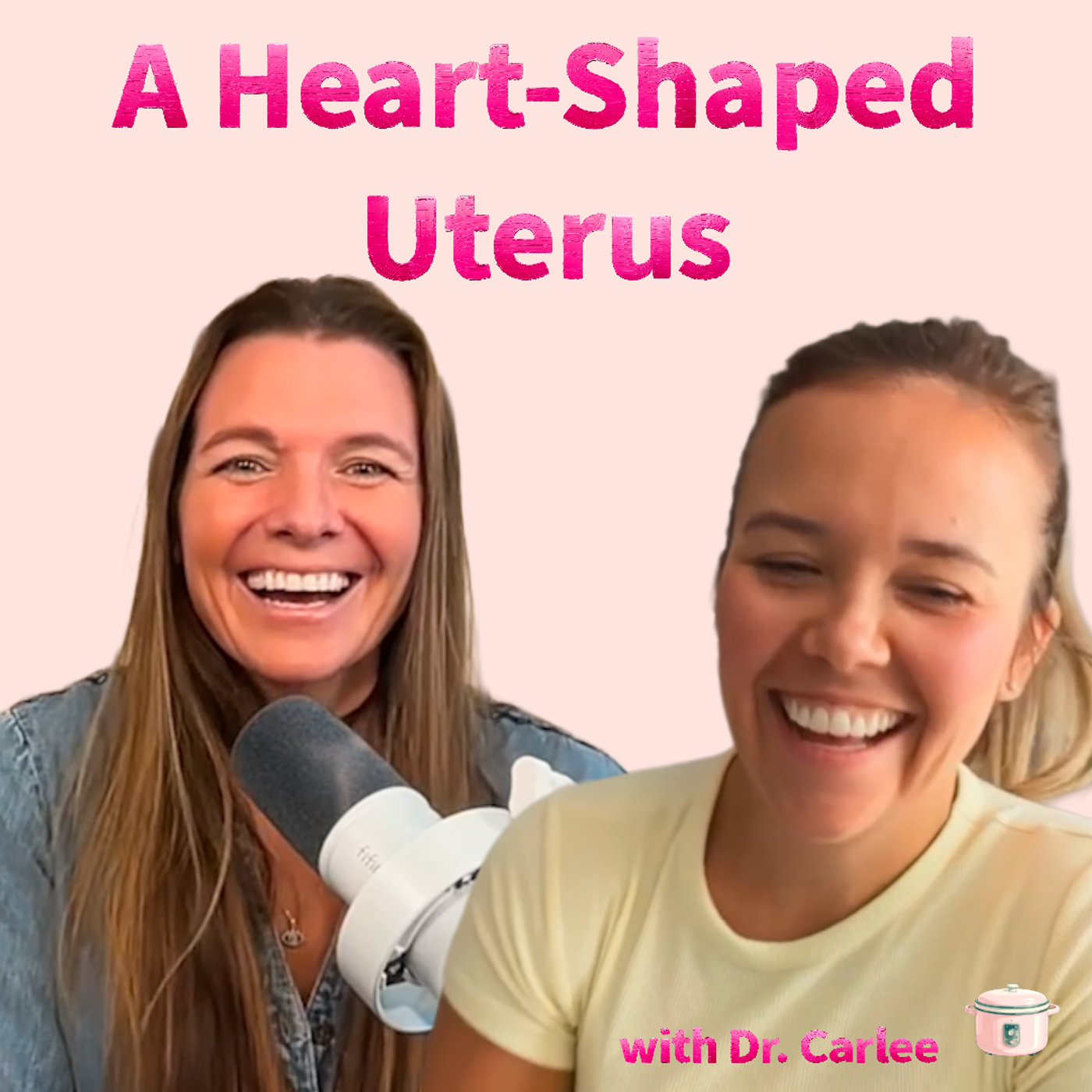
Episode 35: A Heart-Shaped Uterus with Dr. Carlee
Tonight's Episode
Dr. Carlee Wetzel and her husband (also a chiropractor) are the picture of health. They know all the tests to run, the healthy decisions to make, and they are good to their bodies inside and out. So why have they experienced so many miscarriages? Well, the answer came in the shape of a heart...well, sort of. Carlee has what is known as a bicornuate uterus (boomerang or heart-shaped). The reduction in size and change in shape (usually more like a pear) can have an impact on not only staying pregnant but also affect delivery.
Carlee is still in her journey today. Unlike a lot of other guests, she is not on the other side yet, which takes so much courage. Listen to her talk about all the information she's learned along the way so far. And cheer her on!
To get in touch with Dr. Carlee:
https://www.instagram.com/doccarleeb/
https://www.eastnashvillechiro.com/
To get in touch with Ashlyne:
Instagram: https://www.instagram.com/ashlynehuffblue/
https://www.instagram.com/confessionsofaslowcooker/
Website: https://www.confessionsofaslowcooker.com
Email: [email protected]
This audio and video podcast was produced, edited, and distributed by Small Batch Sound. https://www.smallbatchsound.com
Carlee Video: Hey everyone, welcome back to Confessions of a Slow Cooker. I'm Ashlyne Blue, and today I am delighted to see an old friend from my yoga teacher training days. Dr. Carly, she was Brockman back then, but Dr. Carly was in my core power yoga orbit when I was at the Tennessee location, Brettwood, Tennessee, back in like what, 2017, 18? Yeah. and then I also learned that she was a chiropractor, so I became one of her patients. And then I moved to Colorado. And so since then, I'll be honest, we haven't really kept up with each other as our worlds just naturally diverged and that happens. But when I posted about anyone wanting to come on the show to talk about their journey, she answered, Hi, Carly. I have missed you. Thank you for coming on. Hello. Yeah, social media is the the tiny way that we get to all stay connected. And so yeah, when I saw you post, I was like, I knew that sharing my story is going to be something that I want to do. and it kind of just felt like the right person, the right time to at least start sharing what my husband and I are going through. So as you said, like so my background is in chiropractic. I've been a chiropractor for 10 years. my husband and I specialize in functional medicine. So we do a lot of nutrition. we use something called muscle testing, applied kinesiology. And so it's all about listening to the body and what the body's going through, how the nervous system can handle it, and then supplementing, detoxing, supporting. All based off of that. So we do a lot of work with our patients on stress management, but also digestive health, hormone health, fertility, and everything and beyond. So that's a huge part of like when we talk about fertility, that I'm like, okay, let's go. And you guys got married. You you were together, I know this whole time, but you guys got married after. I I moved to Colorado. So congratulations. Thank you. Thank you. Yeah. We we just got married two about two years ago, maybe two and a half years ago. and we pretty much started on our trying, right after we got married. and so yeah, it's been a it's been a journey this whole time. Tell us about okay, so y something that you mentioned to me is that people have this this Misconception, misconception, I don't like it c they had this idea that if you are the health like you and your husband are super super healthy, it should not be a problem. Right? And yet you are not pregnant yet, correct? Correct. Correct. So that's that's something. That's a that's an that's an interesting thing 'cause everyone would assume like if your if your whole body's wor technically on the outside or even on the inside you think that everything's working, it should be no problem. So I know that that's one of the things that you had mentioned to me and I'd love now or later in the in the talk talk about that. But yeah, when when I say, right, so my husband and I would get put into that crunchy category, so to speak, if you're talking about granola. Granola, yes, whatever you want to say, local organic produce from a local farmer that we know the name of that we watch them plant, right? grass fed, beef, organic chicken, We are, scouting out where we're getting all of our groceries from eating global organic to the best of our knowledge, no seed oils. we have air filters all throughout our house. we're very conscious of something called EMS, which is electromagnetic frequency. we I mean, no chemicals, no fragrance, no aluminum in my deodorant, you know, like we not only did this in the last two years. As we're on our pregnancy journey, but we've been doing this for the last 10 to 15 years on our journey to just like our beliefs in what we believe as being healthy, right? And so, prepping for pregnancy, we you know, we were very adamant about managing stress, optimizing sleep, cutting alcohol, cutting eating out, doing all the things that sounded like the right thing to do. not that we did a lot of that anyways. But yeah, we were very healthy. And so when we before we even started conceiving or trying to conceive, we ran extensive blood work on our bodies to make sure that every number was exactly where it was supposed to. and yeah, and so then we started trying. And so we tried for six months. And I'd say for the first three months, we were just optimizing, you know, the typical signs of ovulation. Right. Cervical mucus, desire, all those things. And you were just enjoying the experience as you do as you're trying to make a baby. And then I would say after those first initial three months, we got a little bit more serious with using ovulation strips, test kits, and those things to make sure we were dead on the window. And we got our first positive test six months after we started trying. And I did what every First time healthy person maybe does. And I told everybody immediately after I took the pregnancy test that we were so excited that we were pregnant. And because as two very healthy individuals, the stars finally aligned for us and we thought that it was gonna work out. Here it is, yeah, yeah. And I'll be straight up and honest with you, I miscarriage wasn't even a thought on my mind. It was not even a glimmer of anything because, like I said, we do everything right for our health. We prep everything. We've done the blood work. We've done everything. and so shortly after, about six and a half weeks, we ended up having spotting that fell into a full miscarriage of our first pregnancy. So that would have been April of 2025. Okay. And I think that was the beginning of me kind of like taking that step back or holding my breath and being like, this might not look the way I thought it was gonna look. And I definitely How old are you now, Carly? I can't tell how old anyone is, so I'm thirty-three. Thirty-three, okay. Yep. And my husband's thirty-eight. so in in the scheme of things, I'm not young, but I'm not old, right? There is plenty of geriatric, yeah. Good. But yeah, so we we had our first miscarriage and I I remember having to reach back out to the people who I told and being like, Hey, it didn't work out. And in our community, you know, I am somebody that is looked at for health support, health advice. And that was the first like time where I was like I I don't know you wanna call it imposter syndrome. If you wanna call it just like I was like, my goodness, like, what's going on? Right. And it just brought on the first sense of fear that I had never felt when it came to making babies, having babies, conception, delivery, anything. I had never had fear. And I am a spiritual person. And so I remember praying to God and being like, Why would you put this fear in my heart? It wasn't there. Like, why did you put it there? And so being in holistic health, I knew that it was gonna take a little bit of time for my body to heal. And so went went back to what we were doing. And that was April. in July we reached out to a friend to just do even more extensive blood work and be like, what are we missing? And he gave us a little bit more tips and tricks. But again, there was nothing that was screening like, you have low progesterone. Yeah. You have this, you have that. And so we ended up, would have been fall, would have been September of twenty twenty five. We got the next pregnancy test. And I was like, Okay, this is it. The last one was a fluke. Everything is good. And yeah, so we ended up getting pregnant. This time I was like, not telling anyone because I don't wanna have to text them back to learn that work out. Right. I'm like and we ended up getting Closer to eight weeks. We went for the eight week ultrasound. And the baby that we were carrying was only at six and a half weeks. And so that was the beginning of the pit in my stomach. And even going to that ultrasound, and I don't know if any of the interviews, I've listened to a couple of your interviews, but like your gut is never wrong. I mean, I feel like you being a mom now, like you know that, right? Like having a son, like your gut's not wrong. Right. Yeah, you can you can you can not listen to it, but you feel the things. Yeah. And so, I remember going to that ultrasound and telling my husband, like, something's not right. Yeah. And so we went to that ultrasound, baby was measuring six and a half weeks, and we were closer to eight weeks. And they did as they do, which is come back in two weeks. And we didn't Which is so long. So long. So long. And they're just like, no big deal. come back in two weeks and we'll check it again. And I'm like, check one again. and we miscarried that baby shortly after, within a few days after we found out that it was not measuring to where we went. Right. Right. so now you feel like, okay, this is n becoming more trendy than it was. It's not a one off, it's a Two off. Yes. Sorry. I don't know the word the words to reuse. Well, you look at statistically speaking, it says, you know, a miscarriage is one in four. And I'm sitting here and I'm like, I'm two for two. Like, what what kind of stat is that? You know? And so that was like kind of the first like thing where I was like, okay. And then I felt like, well, first off, the only thing I wanted to also talk about that has been super like big on my heart is that yeah. When you miscarry a baby, if you choose to not go into a hospital for a DNC, you labor that baby. Yeah. And my first loss at six and a half weeks, more like a chemical pregnancy, was more of what you would say is just a heavy period. But this pregnancy, my body fully thought I was at that time almost nine. weeks pregnant. Yeah. And so, my husband and I chose to birth the baby at home. my gosh. And I mean it was full labor. And I think that's something that people don't always know. That's another thing I get passionate about of being an employer who has employees is what does bereavement periods look like? What does healing from miscarriage look like? And I I mean I just it needs to give be given more energy than what we're giving it. I agree. I agree. Yeah. I l almost almost said I love that, but I don't love that for you or for anyone else going through it. But I do love that you're bringing it up because I feel like that w from from all the people I've talked to who have had miscarriages, usually it is in really funky spots. Like they're finding out they're doing it when they're in a cabin out in the middle of nowhere and they're having to drive to basically a like a like a podunk hospital, with people they, you know, know where they know, and not to shame any hospital or anything like that, but like healthcare when you're going through something like that, you want it to be t Top notch, hopefully. and someone not looking at them and not being not telling them what's going on. And like it's if so, and not letting the husband come back, like as if there's something else going on, other than like losing a baby or whatever. And there's just like a sterile environment. And then I've had well, one person had like four or five in a row, and they were all different. One of them was kind of like yours. One of them was more chemical, one of them was was. physically very painful. another one she like was by herself, I think out of or you know, another person I talked to, she was by herself because she her husband was out of town. And it's just like these are these are traumatic experiences. I never had a positive pregnancy test before my son. And that was with IBF. and I actually I get back. I did. I did have a miscarriage. My first embryo did not take, but I did not have to go through the birthing part. like you're saying, or the DNC or the or the the ex excessive bleeding. I just got the bad news that we lost that embryo. It did not it did not stick. So I did have that, but I didn't have the physical ramifications besides coming down of all the hormones that they put me on. but it it It's a trauma's hard no matter what kind, but I feel like what what you're saying is so true. It's it's done in in silence, even if it's not silent for you. it's it a lot of it is experienced in silence. And I can imagine I can't imagine, excuse me, how physically painful, but also lonely that moment is, even if you have your partner with you. Because it's happening in your own body. And I don't know if you felt like, okay, like kind of betrayed by your own body or like I don't trust my body all of a sudden because it's been doing all the things I've wanted to it to do for so long. And now look at this two for two, like you said. And also just the physical labor of having a baby you will never get to meet. yeah, that's that's unreal. That's so it and it's so common. It's so sadly common. Yeah, and you're bringing it up. You made a comment about feeling the hormones coming off of the embryo transfer that didn't stick, right? And that that is something that I have realized through every miscarriage we've had. it's a true 90 days for me to feel 100% myself again. And that's with me doing acupuncture, Epsom cell baths, working out, therapy, supplements, eating like Really to get everything about things you're already doing. Yeah, to get to that, like what I would call an exhale is 90 days. And meanwhile, we feels like a lifetime when you're trying. Yes. But also, I have women in my clinic who because we're in fear of timelines, because we're in fear of inadequacy, because we're in fear of whatever it is. And then I say this with so much kindness, but then there's this big influx of social media people being like, You're super fertile after a miscarriage. And I'm like, yeah, but your body is so depleted. And I'll tell you a little bit more about that in my story later on. But really giving the body the time to heal before we immediately jump on and try. And I'll be honest with you, my husband and I, we did try again, and my body just said no. Right. Yeah. And I still ovulated. It just wasn't the timing for us. And but what you said is I was feeling all this confusion and really the thing was is I was questioning my gut because I was like, My gut's always been right when I listened to it and I'm like, Am I missing something? I will have yeah, like literally, literally, I'm like and so to be honest, I actually did a gut test 'cause I was like, Okay, am I missing something? Like and just kept digging deeper and to be honest, to be honest, Carly, that does not surprise me in the slightest. I was to be honest, I did a gut test. You no. Yeah, of course, of course. Just to dig deeper and be like, is there something else we're missing? the with that, so now we're on, you know, we are over a year into trying. We've had two losses. no direction on why. And I'm like, okay. And this is, I think, when the emotional toll hit my business. It hit my soul. It hit my marriage. because you start to get into these situations where, you know, I I remember going to Christmas last year with my family and showing up and being like all of my cousins, and I have a very large family and we're very close, and all my cousins are either pregnant. Had their kids, et cetera. And I remember the Christmas before being like, that's gonna be me next year. Yeah. Right. I'm gonna bring a baby to Christmas. And now I'm here. Or or a belly. One of those. Or a belly. Yes. Yeah. Some progress in this situation. And I remember showing up to that Christmas and having neither. Yeah. And being like, wow, this is not fair. But excuse me, but also at the same time convincing myself that like. but by our family get together this summer, I will. just I'm I'm I'm if you're watching me, I'm smiling because I did the same thing. The mind games are psychotic of just what you tell yourself to remain hopeful. Yeah. Because that's the only thing you can hold on to is the faith that God has it and the hope that like either the right person is gonna cross your path with the right answer or the right time is gonna happen. And so you just create stories in your head of, by this time next year, by this time, by that, by whatever. And then don't even throw a birthday in there. If you throw a birthday in there, then the spirals in your head start going even crazier. Because now freaking old. Yeah. And you're like, okay, by the time I get pregnant, I'm gonna be 34, I'm gonna be 35, whatever the story is. but It was at that time about Christmas of this past year that I started having the thought that was like, Hey, maybe we need more help. Maybe we should talk to a fertility clinic. Maybe we should talk to somebody else. traditionally that was not going to be part of our story. I was adamant being in holistic health that that was not gonna be part of our story. my husband was also someone who was like, Hey, for for him, like as of now, IVF is off the table. So I was like, Why would we talk to a fertility clinic? If our blood release is perfect and we're not gonna do IBF. But because I was in a season of wanting to force a child into our lives, we did end up booking an appointment at a local fertility clinic from a referral from someone we know knew like and trusted. And I will tell you that appointment, it was a virtual appointment and it was terrible. yikes, I'm so sorry. And as being another provider. Right. And being someone that's now in this situation of needing a provider to be there for them, I was just rattled. And what made it what made it bad if I can add you c you can be like you don't have to be specific, but like what Yeah, and I'm I'm not disciples or was it Yeah, I mean there's you know, when when you have someone and again, maybe I hold myself to a higher standard being a provider myself is like you have someone that walks into your clinic, right? They write on their paperwork, they've been through two losses. They have all this blood work, they have all these things, they come into your clinic. I think they should be met with empathy and grace. and because the fact that you weren't is what? Sorry. Correct. Yeah. So like I guess for me it was bedside manner, right? It was the ability for someone to just stop for one second and be like, Wow, you've had a hard year. But this is what our clinic is here for is to help you find answers. Right. Literally, that's why we exist. Right. And so there was none of I did get that on mine. My virtual appointment. I did get that. My doctor down in Denver, she had had all of her kids through IVF. She understood the thing and and she wasn't like she was Bedside Manor, maybe like and I knew this going a into it 'cause my friend had had her as a doctor, I knew that she wasn't like touchy feely, that she was very matter of fact, but that that it that could actually be in my favor in terms of someone not being not not sugarcoating things. So I knew that going into it. But I did feel empathy and I did feel like she wanted to help us find a solution if this was the right road for us. So like I felt h held maybe, you know, like stabilized. I didn't feel yeah. So it it it doesn't have to be that way. That's what that's what pisses me off right now. Yeah. And I think because we are in whole like you said, my husband and I do we are very granola, very crunchy, right? So And so I think that caught her off guard, or maybe she wasn't ready to hear some of the things we had been doing. even down to the point of accusing my husband of being on testosterone. Yeah. Be because his testosterone levels were so high. She couldn't believe that he had a high testosterone naturally at 38 years old. Okay. And we had like been going going to acupuncture and she was like, Well, that doesn't work. And I was like, Okay. It was just A very in my clinic for the acupuncture said well after I got some testing done around the blood flow around my uterus, they were like, We want if you're willing, please do acupuncture where you come from because this will help. And it's so interesting. okay, I am in Colorado to be fair. But Ugh Sorry. Yeah I'm mad. I'm very mad right now. So it was just like, again, I'm like sitting here and I'm like, okay, you know, I I don't really go to traditional doctors. That is not my normal way of taking care of my health. So now I'm like, I finally get the balls, excuse my language, to go to a fertility clinic. And then I have a really poor experience. And I was like again, I'm like trying to listen to God and trying to listen to my gut. And I'm like, what are we doing? what is supposed to happen here? And then two weeks later I got another positive pregnancy test. And I was like, okay. Okay, this is yeah. This is a hundred percent it. I wasn't supposed to go there because our time was coming. And this pregnancy, so this was April, March of this past year, 2028, okay, six. We're in now. and this pregnancy felt the most real of them all. I had terrible morning sickness. The exhaustion, everything. in our previous pregnancies, the the first two, we did the HCG and the progesterone testing. And that just caused me a bunch of anxiety. because I was like, what if it's not doubling? It's only one and a half in. Is that the problem? All of that. So this pregnancy we chose not to do any of the blood testing. I don't want all the data. Yeah. Yeah. Cause it doesn't in our circumstance, I was like, it's not gonna change the outcome of what we're doing. So I we didn't do anything. we just I was so sick that we were like, this is working. This is great. Yeah. Yeah. And so we kept going. and we got to, I think it ended up being closer to like nine weeks. or excuse me, it was it was eight weeks. It was an eight week ultrasound. and we went in and for the second time, she goes, Are you sure you're eight weeks? And I was like, Yes, I've been so sick. Give me a good answer. And she said, Your baby's measuring six weeks and six days. And I was like, Are you kidding me? Like, how can that be? This would be like the third time at six weeks, really. Like, even though you were like it stops at six, six and a half weeks. Yeah. And then she's sitting there, and we our ultrasound tech, she's a retired OB and she is Italian. It's a vibe. It's a vibe. But she she is looking at my uterus and she just looks at me and she goes, Do you know you have a bicoronate uterus? And I said, Is that what? Excuse me? I'm literally asking myself too, but yes, you probably were as well. Say that again. Bicoronate? Bicoronate I hope I'm saying it right. I don't even know if I'm saying it right. Bicoronate, septate, uterus. And I said, Okay. And so basically what she did is she showed me that my uterus is in a shape of a heart. how cute. And so basically, if you look at the video, it looks kind of like this. And so with with our previous pregnancies, with our previous ultrasound, when they saw the baby, they basically zoomed in and they said, This is your baby. And they didn't look that there was a whole nother cavity of my uterus on this other side. And she said. She asked me, she was like, hey, who's your midwife? I told her the answer. And she said, okay, well, I'm gonna reach out to her. And anyone that's in the fertility world knows that when the ultrasound text says, I'm gonna get your doctor, that's usually not a great sign. Right. And so over the next two hours, we basically had Google, Chat GBT, I mean, calling friends. talking to our midwife, talking to doctors and basically getting the lowdown of what is a bicoronate uterus. And so it is a developmental abnormality that happens when I was in utero in my mom's belly, that when my when my uterus was developing, your uterus starts as two tubes that unfold into a circle and mine just only unfolded into a heart instead of all the way into that circle. And so is there like a clamp kind of I don't know. did it it needed to go like I don't know. Can I try to show a picture on here for anyone that's watching the video? Yeah, yeah. it kind of looks like a boomerang, to be honest with you. okay. Okay, so disregard the circle because that's just part of the ultrasound. But see how it looks like a boomerang? Okay. Yeah. Okay. So this thing right there that's going down, that's the septum. Okay. So see how the outside is a big circle? Yeah. So my uterus is actually what we ended up finding out, I'll tell the rest of the story here in a second, is that my uterus is actually not bicoronate. It's just my endometrium is septate. And so that little septum that goes down, basically when we got on the phone with our midwife, she described it as very fibrous dense tissue with very low blood flow. And so for it to s yeah. Okay. For it to grow, for it to stick. And so she said that she goes. I just want to be transparent with you. And I said, Yes, shoot me straight. And she said, the baby you're carrying is not going to make it. And I was like thankful, but shot to the heart. Correct. However, for the next four weeks, I proceeded to continue to have morning sickness. And was sicker than a dog, tired, all of the things that you would expect in your first trimester. And so for For four, well, it wasn't four weeks. It ended up being two weeks because I couldn't handle it anymore. I every day woke up and I had to hold hope. Yeah. And also release the loss at the exact same time. And I had so many people praying over me, speaking over me, like, Carly, like, God creates miracles. Like, you could be part of the 1%. Like that this works. And I remember it was a Friday morning and I looked at my husband and I was like, I can't do it anymore. I cannot hold hope anymore. it's exhausting. It's tearing me apart. Not to mention I'm going to work, helping women with their fertility, helping people, I'm adjusting newborn babies, working on pregnant women. And I was like, I'm like, I'm going to lose it. We're living two different lives, one internally, and then one that you have to, yeah, you have to show up for your patients. So That Friday, that was two weeks after we found out about the bicoronic uterus, we went in for another ultrasound because I was like, I need to know if this baby's growing. Like I am so sick. I need to know like, is this going or is it not? And so that would have been at ten weeks and the baby was still measuring six weeks, six days. And at this point the baby no longer had any heart flutters. Mm. And Again, my gut was already talking to me before we went into that ultrasound and it said, Hey, I don't I don't think it's gonna happen. And so then we were stuck with the decision of what do we do? Right. Do I let my body just release this baby or do I go into a hospital setting and do a DNC? Do I take a medicated pill to be able to help release the baby? And from all of my knowledge in holistic healing, my knowledge in how the body works, how the body recovers, hormones, I really wanted to be able to pass this naturally. Mm-hmm. And so I actually carried that baby for an additional two weeks. my gosh. knowing that it wasn't gonna make it, that it didn't have a heartbeat. Just waiting every day, waking up every day going, is today the day? and yeah, I mean, it was so hard. It was so heavy. And like you said, it's it's an invisible, I don't want to call it an illness, but an invisible burden to carry. Right. Unless you unless you choose to speak about it. And so you look around and it's not easy to do in real time. some people are like you tell the certain people in your life, but even th even then, even people do know it doesn't it does not lessen how it makes you feel. Like the burden is still just as heavy, even if other people know that your burden is heavy. You know? And pe people want to show up for you with hope, right? They want to sh Yeah. And there's moments where I'm like, I don't I don't need that. Yeah. Yeah. We don't need to show up with hope. let's just sit here and be like, This sucks. So Well, and sometimes the hope Reality is reality. If something is literally not working, you can't change that with hope. And and sometimes if you like I'm like envisioning getting a paintbrush and just big glob of paint and this covering over it, like that does not change anything. Literally does not change anything other than you've got paint on you now. Yeah. Like, thanks. But like maybe it looks prettier to you, but it feels shitty to me. And I just have to like some things like post divorce, I had to go through it. All my fertility stuff, I just had to go through it. And someone saying something, not only did it not change the facts on the ground, it sometimes made me feel like, what? What's wrong with me that I can't rally? You know? And that almost just set the burden a little bit deeper into my bones. and it wasn't because people were trying to, they were trying to offer some good things, but Some stuff just sucks until it doesn't. And really, so our our philosophy at our clinic, and I know you and I have had history of that together, is that you know, we are holistic beings, meaning we're structural, biochemical, and emotional beings. And right. The philosophy behind applied kinesiology is that it's this triad of health. It's a triangle. And so you have a structural and a biochemical that are the two sides, but the emotional part of that triangle is the base. And emotions are meant to be felt. When they are not felt, when they are pushed under a rug, they will show up again in some sort of form. Whether that's knots in your stomach, whether that's hives on your skin, whether that's just anxiety every time you walk into that room, whatever it is. Mm-hmm. And so I can I can attest to that. Holy moly. Yeah. And so it's like emotions are meant to be felt. And so I think sometimes when you want to just continue to put hope on things, you're you're burying the grief. You're burying the loss. You're burying the what ifs, the whatever other emotions that you're feeling. You're also kind of denying your gut a little bit. Which I have so many gut issues and I know where they started. They started with a with a sexual assault, when I was nineteen and I didn't do anything about it and it's come out in so many different ways and I'm I'm dealing with it now. I've been dealing with it this whole time, but like I'm really dealing with it now. And yeah. Yeah, I didn't I denied myself how I f not how I felt about it, 'cause I I knew how I felt about it, but I denied myself thinking that that there was any other way to deal with it other than not tell anybody because I was afraid of being judged for something that happened to me. But it's it's come out in really funky ways. And it's grown and it's changed and morphed into other things to where enough to where I didn't realize that I was dealing with something from twenty plus years ago now, 'cause I'm forty one. so long ago that's still coming out in different and I'm like, I thought I dealt with that. No, you did not. You did not deal with all of it because by the time you got there, it looked like something else. And anyway, not to get on that soapbox, but like I I get and that was something that it was one incident, or actually two, but one incident, one event really. And and it it has grown legs and arms and appendages for twenty years still even after dealing with it. So I can I mean fertility is it's just it's kind of a lonely road anyway, but like yeah, if you don't if you don't feel the things that will come back up in another part of your body. and you and recap and you as a mother, like and I I call myself a mother. I have fur babies, I have employees and I have babies in heaven. You know? So Yeah. The The goal, right, is we want to show up as the best mother, right? We want to show up as the best wife. We want to show up as the best spouse, child, whatever we are. And, you know, I think being a mom actually shows you where you have some of these areas that you need to feel, that you need to experience, and that you need to bring just massive amounts of healing to so that you can show up that way for your child, the way you want to, and also just. give them the opportunity to not have to carry as many burdens as maybe we had to carry. Yeah. Well, and and the idea of feeling idea of feeling it like you can feel it internally but not release it. Mm-hmm. And I was really good at feeling everything, but not finding a way to release it in a good way. You know, it would come out in other ways. And and and that's because I was not I g I I would say a lot of my stuff a lot of my issues came from not knowing how to release it because I didn't actually understand what was going on in the first place, how I felt about it. I was confused by it. I was I was embarrassed by it and I was really ashamed of the the thing and and so therefore I felt all these things but nothing r l left my body. It just moved this way or that way or whatever. And then it became something un untenable A, but also unrecognizable. And so yeah, I I'm I'm now on my soapbox about this. Sorry. but yeah putting putt putting hope on it for the sake of making the moment feel better, just in that moment, for anyone, for yourself or whatever. Like, but I it's it's not helpful first. But secondly, I feel like I feel like ha I feel like our ha our society makes us think like if you are be more positive and and there you go, like that will help. And what I've learned over teen years now from all the things I've gone through in one way or another, and they're all so different but yet so similar, is that you don't have to be so positive and you don't have to have hope all the time. Sometimes you can just let it be because you know that. something felt really, really hard back then and it actually did get better. But feeling the hope and not act or wanting to feel hope but not feeling like that's a that feels like another it's another burden and it's another failure. And so I think we should take ourselves off the hook for that kind of thing. if you don't if you feel bad right now, feel bad right now. Feel it and let it go. And and and hope that tomorrow sorry use the word hope, but like think believe that maybe tomorrow or the next day will be good. and I think that's why we we you you said and I did the same thing. I did the same thing post divorce. I did the same which is when you knew me. for the first time. And then I did it during fertility stuff. Like, yeah, maybe by next year. I never did birthdays either, which is so interesting. But I always thought of Christmas. So it must be that's like in the water. like next time I see my my family, the next time I I'll have some news, like I met somebody. During the divorce, or I, maybe I'll be I'll be pregnant by then, or we'll have started our IVF by then or whatever. And I just wanted good news. And so I would put it off like a whole year thinking this gives me an amount of time. And that felt more possible or more like tenable because it was like there's a lot of time between now and then. Surely something will work out. You know, it'll pan out by then. But then when it didn't, a couple of those years, you know, for for those respective time periods, it was like, okay, maybe I should stop doing that. Because it it's I feel like a failure on top of failing, you know, myself. so I don't know. I just went up on a tangent as as I do. no, I mean it it it just and it it shines light on the emotions that come in any sort of grief and trial. Right. Yeah. But I did want to circle back to yeah, my crazy bicoronate uterus slash septate uterus. Your boomerang. Boomerang, heart shaped. because so my husband and I chose to wait until the my body was ready to release the baby we were carrying, of which I had to go through another labor. again, bringing light into that miscarriages, if you choose to bird them, are full labor. This was a four hour labor with contractions, vomiting, and eventually passing what was in your home. Yep. and I will say, you know, being on this journey the last two years, it has been, and you can probably bring light to this, and I know you have other interviews on your podcast about this, of like it is hard on your relationship to be in an infertility season. It is so hard. And I will say The middle part, that second miscarriage was really hard on our marriage. But how my husband has been able to show up for me in the last eight to nine months in this season, like it truly is that thing of like pick the person you're going to marry, like your life depends on it. Because in sickness and in health is reality, right? It's real, yeah. It's so real. And so I mean, he was there through Every one of the laborers, he was the most supportive husband. And in that two week wait while we are waiting to pass the baby, I'm a little bit of a control freak. I think maybe you know a little bit about that. and so I was like, Okay, I'm gonna find whoever knows about a bi like I'm still carrying this tissue, whatever you wanna call it at this point, no longer has a heartbeat baby. and I'm like, I'm gonna find the best doctor that does that knows about bicoronates. I'm gonna find somebody, like we're gonna I need help with this. I need a plan. Yeah. I need a plan. because when we were doing research on it, basically everything about what I wanted in a birth was going to go out the window. People with a bicoronate uterus have a 98% chance of having a preterm baby, meaning anytime before 36 weeks. So there's an increased chance of nicotine. 98% of people who have bicoronate uteruses end up in C sections, which was definitely something that I did not want for my birth story. somebody who never goes to a traditional doctor other than her midwife. I was like, wait, I'm gonna have to have a hospital birth. Our plan was to have a home birth. And so my brain was spiraling of what the hell? Everything I thought was gonna be our story is now out the window. And I was like, I need to find help. I need someone to help me with figuring this out. And so while we were still carrying before we had passed the baby, I made an appointment with a traditional OBGYN that was in network with my insurance. I also found out that there's whether you want to call her influencer, she, Hannah Brown from The Bachelorette. Okay. she had posted on her stories on Instagram. This is why I like love that you and I, that's the only reason I saw this podcast. Is she had posted on her stories that she actually had just had the surgery to remove her septum. The day I found out that I had one. Wow. And she was bold enough to talk about it on her Instagram stories. Good for me. And I know enough to know that she lives in Nashville. and I was like, I need to figure out who she knows, right? And so we actually have some mutual friends. And so I was able to get some information. And so that's when I made my second appointment at a or my first appointment, but my second in my life at a different fertility clinic. And this woman was supposed to not, I mean she had no openings for six months, and I was able to get an appointment four weeks after we passed the baby. Which feels like something. Feels wonderful. It was like I can't wait for July 3rd. Let's go. and so she was able and she She met me with Grace. wow, this is so hard. our team, she's like, I'm I know so much about this. I'm here to support you. Like looking at our blood work. You guys have checked everything. Your blood work, like, it was exactly what I was looking for in the bedside manner of somebody that was going to help me on what feel like the hardest journey of my life. Mm hmm. and so she was like, We need to do a very specific scan and we need to measure the severity of your septum. that had to be lined up with my cycle. So it took us about another four weeks to get the scan. we found out that my septum was measuring on the scan at thirteen millimeters and to have millimeters. Well, like it's like this. Maybe not. If you're looking at the video. but anything above a nine would be warrant for surgery. Okay. And so she called us and she was like, Hey, I think I think we should do the surgery. I think we should remove the septum. Of which then I had to give my crunchy spiel of, I'm sorry, but I really don't want to take birth control. And I also am really scared of anesthesia. So could we do this unmedicated? And she was like, Shark. Let's go. Okay. And so that was September eleventh. So today you and I are talking October 2nd. So that was about two and a half weeks ago. I think. Surgery was great. so confident in my doctor, so confident in the nurses. When she did get in there, which is fun when you're awake because you get to like kind of hear the play by play. I know I'm I'm in medicine, so like this is cool for me. she was like, it's definitely worse than what she thought, worse than what the ultrasound had showed. So she was really grateful that we had di decided to do the surgery. she was able to go in. So the way that they describe the septum is similar to like the callus on your heel. So it's very dense fibrous tissue, but underneath that tissue, there is good, healthy tissue. And statistically speaking, that's a really good metaphor. Okay. Yeah. Great. It's great. And so she said that like they've never in history seen where it's grown back. And so once it's removed, it's good. The only question is is did we remove enough to get under nine millimeters? Okay. So right now my husband and I are waiting until I have a cycle. To be able to go in on day six, seven. Do the same kind of thing. You said it was thirteen, which was more than thirteen, but yeah. Compare the ultrasounds. and if we do the ultra or the scan in the next week or two and we see that it's under nine millimeters and there's no scar tissue, my husband and I will go back to trying to conceive a baby. Which you know you can do, which is so great. I have the chills now, by the way. like whole body. It's like the whole body. It's weird. So it's like we won't stop. That is answers are so great. Answers in one way or another, you felt like a mystery until you realized, I have a heart shaped uterus, which sounds, like I said, very cute, but not helpful for this situation. And no blood test was gonna tell you that. No amount of eating was gonna tell you that. Like, I mean, and this is where I say thank goodness for you know, Western medicine too. Like, not necessarily for every single thing. But as someone who did I didn't have a birth plan other than get him out safely and keep me alive as well, whatever. and I think that's partially because I had gone through the gaunt gauntlet and I was like I don't for a planner not to have a plan besides like, you know, making it, I I just didn't have it in me to to try to micromanage it. But but the I did have a C-section because his head was too big and it wouldn't come out. And so they were I was like, whatever. But this is after thirty-six hours of pushing. I mean, not of pushing, of of labor. And it was brutal. But so I have I feel like I went through every experience in one, but you know, I'm so thankful that that had they had that option. My husband said to me, he was like, This is like who dial dies in childbirth. say so thank goodness it is there. But the fact that you don't have to you get to pick and choose when you do it until it's necessary. so it's like I'm so grateful that both exist. I think I'm I'm I'm erring on so much more of the holistic side now. I'm working with a functional doctor. Actually she was on the pod a couple of weeks ago and we're in the middle of me getting some testing done. my cycle's off because I had a panic attack last month. So the Dutch test we did didn't take because my period came early. So fun. so I have another one of those. But yeah, we're doing like the whole the whole thing because I think like there are so many things that are just n misaligned in my body that can probably be aligned again with the right tools and and whatnot. But she and this particular person, one one of the reasons I really like her is that she said she used to work for pharmaceuticals. So like she's been in both sides and she was like, you need it when you need it. But if you can find a way to balance it out and do like what you're doing, be crunchy as hell, whatever. and and then but that in that moment being like, do I do I want to be strict on this to the detriment of not ha or do I want do I want a baby and maybe there's something here too? Like I feel like there's a there's a way to do both, but sticking and you can also still stick to your convictions because it's not like I'm giving everything up. It's like, no, there is something really wonderful about this this opportunity and you would never have found that out otherwise, besides like being like, Okay, surrender. I'm gonna go see. See what we can find out. And so, and here you are. And I I'm so hopeful for you. Yes. well, I literally am having hope. Yes. We are having hope now. We are back in a season of hope. I mean, it's it's I'll be honest, it's a season of hope and and a little bit of fear. you know, our th our third pregnancy, it took me a good six days after my miss period to even take the pregnancy test because the thought of being pregnant felt a little scary. and so I do feel a little bit of that creeping in of like. wow. Yeah. Not only am I gonna have to get pregnant, but I'm gonna have to get beyond twelve weeks. I'm gonna have to get to an ultrasound and see a baby greater than six and a half weeks. Right, right. And that stuff I will say, I'm only speaking for myself. after all the negative stuff that happened during our fertility, you know, roller coaster, it wasn't even a journey. It was like like I don't know. The worst roller coaster ride ever, it felt like for me. And, we all have different stories, but everybody's feels pretty shitty. And and with that, I by the time I got pregnant, I was just I was a mess because I was like, I've seen every f every shoe drop known to man thus thus far. Like, who am I to think that this is actually gonna work? And I ended up having to give myself like room for that and not I didn't ch chastise myself for feeling that way. I was like, just keep going, keep going. The the positive t for positive sake is not going to help you either. So stop like don't rake yourself over the coals here. Be honest about how you're feeling. Tell certain people who are not going to be like, come on, you're fine. You're making it worse. Like cause that will actually double burden you. Yep. I wrote about it a lot in my journal. A lot, a lot. I told my parents, I told my sister, who was actually, you know, Maddie, but she was going through two miscarriages around the time that I was starting to do all my stuff. And so then then she got pregnant like 30 days after I did. and we have w call I call them cousin twins. but yeah, I think like this is not advice. It's more just like I this is how I felt. But Give yourself a break for not feeling for feeling like you're white knuckling it. Cause you just do. If you've had some if you've had some tragic moments, I got through it, but I was not I never really let off the the break or the gas. I don't know where this metaphor would work, but I I I always had a little bit both at the same time. Yeah. Yeah. I was like I until it came out, literally. I felt A little bit of trepidation always because I thought I don't want to get too complacent, as if that would have made a difference. But so it's like find that that period or that or that that threshold where you can be like, it's okay that I feel this way, but there's no guarantee that it's not gonna work either. You know, like I can live it in the in between, but yeah, I don't know. I don't know if that made any sense. No, for sure. And I mean, I think Unfortunately, but fortunately, and part of why I wanted to start sharing our story, even though the story isn't done, is like there's so many people out here that are dealing with this. And you never know, like I mean, I'll be honest, like, you know, when in my search of like what is a bicoronate uterus, like I checked Instagram, I checked TikTok, I checked podcasts, like I was like, I just was seeking information and it's like there's so many people going through infertility, fertility struggles, secondary infertility. Now finding out hormonal issues, structural issues, whatever else, that anytime we get the opportunity to share even parts of our story, you never know when that's going to open the door for someone else to feel peace, hope, contentment, lack of alumeness, whatever it is. And so that is also part of my goal in continuing to move forward in this is sharing, right? Sharing when we have our next pregnancy test and not having the fear of having to text someone and say, Hey, it might not work, but instead being like, Hey, who wants to be in my army with me? Because as with having a kid, you need you need a team, you need a family, you need people who are there for you. And so sharing it. Sharing it to the people you trust with the information, also knowing that, you know, and I've said this on the podcast before, I don't even know when, but I said it at some point that There's something really good about telling certain people, keeping them aware of what's going on in your life because those same people who can celebrate the heck out of what you're going what you what you achieved or got or whatever, they also are the ones who are gonna hold on to you when when it's going low. So only telling people the wins is not helpful for you. obviously finding out who you need to tell, in those in those hard, dark moments. I did the same thing well I Everybody knew I was having ambio transfer. Not everybody, but like my my circle. And and then I had to text them and be like, it didn't work this time. you know, and it that was hard. But those same people found out it did work this time when it did. And so they were so much more excited because they had been down there with me, that they could be up here with me and and e experience that that feeling that I was feeling almost to the same degree. because they were rooting for me so hard the whole time. And because I had let them in, And so yeah, I I think it it is good. it's no fun to find out that you have to give bad news. but but there is light at the end of the tunnel when it does actually work out for you. I personally am so grateful that you are willing to talk about it right now in w in real time while it's still happening. Because, like you said, you look for information wherever you can find it. A lot of times you can't find it. And so you're left to your own devices. You're left to think, I'm probably the only one dealing with this. If it's not out there, then it must not be out there. And really it is. It's just a lot of people not talking. And not everyone's a talker. That's okay. But one person can make all the difference if you hear about it. I had someone else on in another taping and she has pots. Yep. and she now tr helps people through pots. But we were talking about her fertility side of it because she didn't she didn't realize it was getting worse during that time, but she did had not been fully diagnosed at that point. So she didn't know that her you she was like, it's probably has something to do with the fact that I did have I she had a concussion at one point and then she had she had PCOS. She also had she was on birth control for most of her life, that also that she had she was like crawling up the stairs, or just almost passing out. Every time she stood up, she would be dizzy and black out a little bit. And it was so scary for her, but she didn't she she was like, of course that probably had something to do with my fertility and how I and how I couldn't get pregnant. But you just don't know. And I said the same thing to her, like one person is gonna hear it anecdotally, one thing, and then they're gonna hear someone else say, I stood up really fast. And and it's starting to happen more and more often. And they're gonna be like, this might not be exactly what you're going through, but I just heard this thing on this thing that I listened to and whatever. It was shared by this person or that person. And it's like then you can at l if nothing else, rule it out. i in and I th I feel like you talking about what do you say bicornet? Mm-hmm. what's yeah, or you can say septate because that's a little easier, but septate. Septate, okay. But it but any of those words, like I think it's w it's worth it to say all of those because people use different terminology or whatever. And so you saying that may like all of a sudden be like, okay, she's had X amount of miscarriages. Wonder what our uterus looks like. that's not the first thing you think of. You think of blood work, you think of diet, you think of all the things you were talking about that you dealt with head on ahead ahead of time. This just gives one more thing to say, to ask, to advocate for when you're in the room with somebody being like, Can we look at the shape of my uterus? Do you mind? I mean, that's that's huge. Like in my practice, I'm as I'm helping these women get pregnant, stay pregnant, birth babies, et cetera. Because so one of the things with a bicoronate uterus is that baby does not go head down. And that's why 98% end up in C-section. Because if your uterus is a heart, baby doesn't have the room to flip. To move. Yeah, yeah, yeah. So now I'm having these women come into my clinic and their first baby was a C-section, their second baby is a C-section, and they're holistic women that are like, I'd love to have a vaginal birth or a V back. And I I am, I'm asking these questions, like, have they ever done an ultrasound of your uterus not pregnant? Specifically. The specific ultrasound that fills your uterus with water. to see what the shape looks like when it's not deflated. Like, and so that gets me into a whole nother topic of being able to communicate with providers and advocate for yourself. But yeah, just asking. Like, or I mean my husband and If you don't know what the questions to ask, then it's really hard to ask them. Correct. And if you don't have a doctor that you don't feel like you can talk to, like our first fertility doctor, like Yeah. it makes the journey just so much harder. And that's how that's where a lot of things you find out you find out stuff that you're going through could have maybe been avoided if you had n had had the right tools in your toolbox. But the way you can get those tools is by filling, you know, your inbox, your emotional inbox with things that, you know, like a people people let me say this again. The way that you can know what to ask is by I think a lot more listening to people, in their own lives, listening to little one off situations that they're talking about with about their health or whatever. And then you just hear something elsewhere and you're like, Wait, wait, wait, that sounded like something else I heard. And so like just a lot more listening in general, I feel like can help in like what you said. applying it to your practice. now you're you're giving them something else to ask when they're going because they're telling you all these symptoms. And and you wouldn't know if you didn't know. And I don't know. I I think I think the more conversations the better. And the more questions the better. Which means people have to get out of their own way and they have to, like you said, I mean I'm so proud I know that you the the crunchy in you did not want to go to a second fertility. But I'm so proud that you did because I mean it it it made all the difference, you know, and and and the they brought the midwife in too. Like so it wasn't just it wasn't just that, but like a team, a full-on team, having people look at it from literally different angles, but also figurative angles and and saying, Okay, like you can help me, you can help me. I heard this anecdotally here. And now we can just we can tackle this. And I wonder how many more things there are out there that people just don't know about. and they only find out the hard way. You know, they only find out after something's gone wrong. So if we can I mean, I I I'm so proud to be a part of this, to, to make this to, you know, whatever, do this podcast because I feel like it's bringing stuff out of what could be silos, either in terms of people's personal experience or coming up with things and saying, well, I dealt with this and maybe that's what you're dealing with too. whatever I come up with my functional doctor, we're gonna have a whole episode about it. I'm gonna talk about everything in real like all the things we did because that I feel like that's another thing people don't really talk about. They talk about what they found out, but not like the whole process, you know, not the the the inner workings. And I was like, can we like track this so that I can cause I'm okay. I don't mind talking about it. Like it's Who cares? But it goes back to the emotional side of things. If if we're only ever sharing at the top of the mountain, if you're if you're down in the valley, it is so hard to see yourself at the top of the mountain. But if you see the personality, that's for someone else. Yeah. But if you see the person at the top of the mountain, if you see their climb, if you see that they had to take the step, that they had to go the next day, they had to do it again and again and again, it does. It gives you the courage. It gives you the strength to say, if they could do it, so could I. Right. And I saw this meme the other day that said, if you knew that you were gonna be rejected a hundred times and the a hundred firsts you wouldn't be, like with with what your endeavor is, whatever. Think of how excited you'd be every time you failed. Yeah. How fast you would be. Moving on, moving around, let's fail again, let's fail again, because you know that you just gotta get past all these. And I think, yeah, that's not life. You don't get to know, but what you can do is use is do what you're saying and and use the overlay of like someone else could do it. And they probably felt like I did, especially when you hear that they did feel that way. That's so important that they felt like there was no way there was no path for them. I didn't feel like I was ever gonna meet anyone. I met Marcus. I didn't feel like I was ever gonna have a family because I was getting older, and we were we were struggling. I have I have my child and we have our family, and that's all we're gonna have because just the way things are, but I I was not thinking I'd be in this position ever, ever, ever. So and here I am. Yeah. And I think that's not to go on another tag, and this could be a whole nother podcast, but also unboxing the emotions that is what we thought our lives would be and then accepting the reality of what they actually are. Yeah. Well, and I I I did a solo, I haven't put it out yet, but I did a solo one about about sort of like that. Like if you feel like you're in good company, it's amazing what you will actually say probably sooner or or deal with sooner. and I feel like, you know, it takes some people like Doing what you're doing right now, saying like I'm I don't know how this is this is gonna end, but instead of holding it in till it till it's done and I can wrap it up in a little bow, why don't I go ahead and say it out loud now? Who could it help in the meantime? And also, you have that many more people rooting for you and celebrating with you and like it there what's what's the harm in that? I know it takes a lot of vulnerability, but sounds like Yeah, we're both type A. So we both had it we have a lot of ideas for how things should go. But if I can say anything, it's it's that everything that has not worked out for me has worked out for me some other way. it's it it does it was not how I wrote it in my head. but it it it's better. It's it's better because of because of all the things I appreciate now that I would not have appreciated. I appreciate my marriage so much more because of what we went through with fertility. because I know that we went through some stuff like like you, like I know you guys were together for longer than than Marcus and I were before before we got married and stuff, but you you like learn really quickly how to get through some hard stuff and that you can build from that. You know, that's like you don't have to wait for 10 years and then all of a sudden like you're like, something's hard. We just haven't had to deal with something really that hard yet. Now you know, like we can go through something hard and we've we've we have tools, more tools in our box to to deal with that, to deal with something else that may come up, you know. And and I will say it's really I feel like Marcus and I are are better off for having gone through what we did because he had issues, I had some issues, and we had you know, a f a failed transfer or whatever. So we've gone through ups and downs personally, like separately, together and whatnot. And I think it's made us better parents because we already have like have a little bit more of an understanding of how we deal with stress. And when I when he's having our a day, I can jump up. But we just have our we I don't know, the routine's a little bit better. And it is no joke postpartum. It is so hard. But he had already watched me go through a lot of hard things. So and I trusted him with my hard things. And so I feel like all of it just builds on itself and it it ends up being better than you expected, even if it's the shittiest story you've ever told. I know I was like, I was I was like the last two years, I was like. I keep like I keep walking into flames with the idea that on the other side of the flames there's not gonna be flames, but there's just more flames. More flames. And I just I just keep walking and I'm like, okay. and like I said, take your husband like your life depends on it. If you have faith, I have faith. Like God knows what he's doing in my story. And so yeah. This is a beautiful story. It already is. It already is a beautiful story. And it's not even over yet. And I can't wait to hear more about it. Please keep me I will set a breast, but it makes me think of boobs. Anyway, keep me telling me what's happening. you don't have to text me like your friends, but like tell me tell me later on. Carly, thank you so much for for being willing, for for having the vulnerability to to have the courage to talk about this right now because I know it it you're still in the in the question stage. And so I I know it will help someone out there, if not multiple someones. And I've personally enjoyed getting to get back together. We should I whenever come down to Lil, when I come to Nashville again, I wanna I wanna give you a hug. everyone else out there, thank you for watching. Hopefully you watched it 'cause she gave some visuals here. I'll I'll try to make sure that I post I we get a short out of that so that regardless of how someone consumes p podcasts, they get the the shape of your uterists. everyone else out there, thank you for listening or watching. if you know anyone who is struggling in this way, please share this because this is like huge. Something I've never heard of before. And so I'm that that probably not that I'm like the all knowing person, but it definitely means someone else hasn't heard of it either. And maybe this is the key, you know, maybe this is something that that could change the trajectory of their fertility journey and life, therefore. thank you, thank you again, Carly, for being here. And I wish you all the everything good coming up in this next season. I feel hope for you. I can I can carry both hope for both of us. I don't care of like whatever you need, but I feel it. I'm feeling great about this. And please keep us updated. I will. Thank you. You're welcome. Everyone else, I d I'm also gonna share if she's okay with it or not I'm gonna share Carly's information about her practice because if you are in Nashville, you should go see her. can confirm she's wonderful and tiny but mighty. And I will put all the information that you need. I'll get it from you, Carly. Everyone else have a great week. I'll see you next week with someone else wonderful. And until then, take care.
 Apple Podcasts
 Spotify
 YouTube
 Castbox
 Castro
 Goodpods
 Podcast Addict
 Moon FM
 Overcast
 Pocket Casts
 Podbean
 Podcast Republic