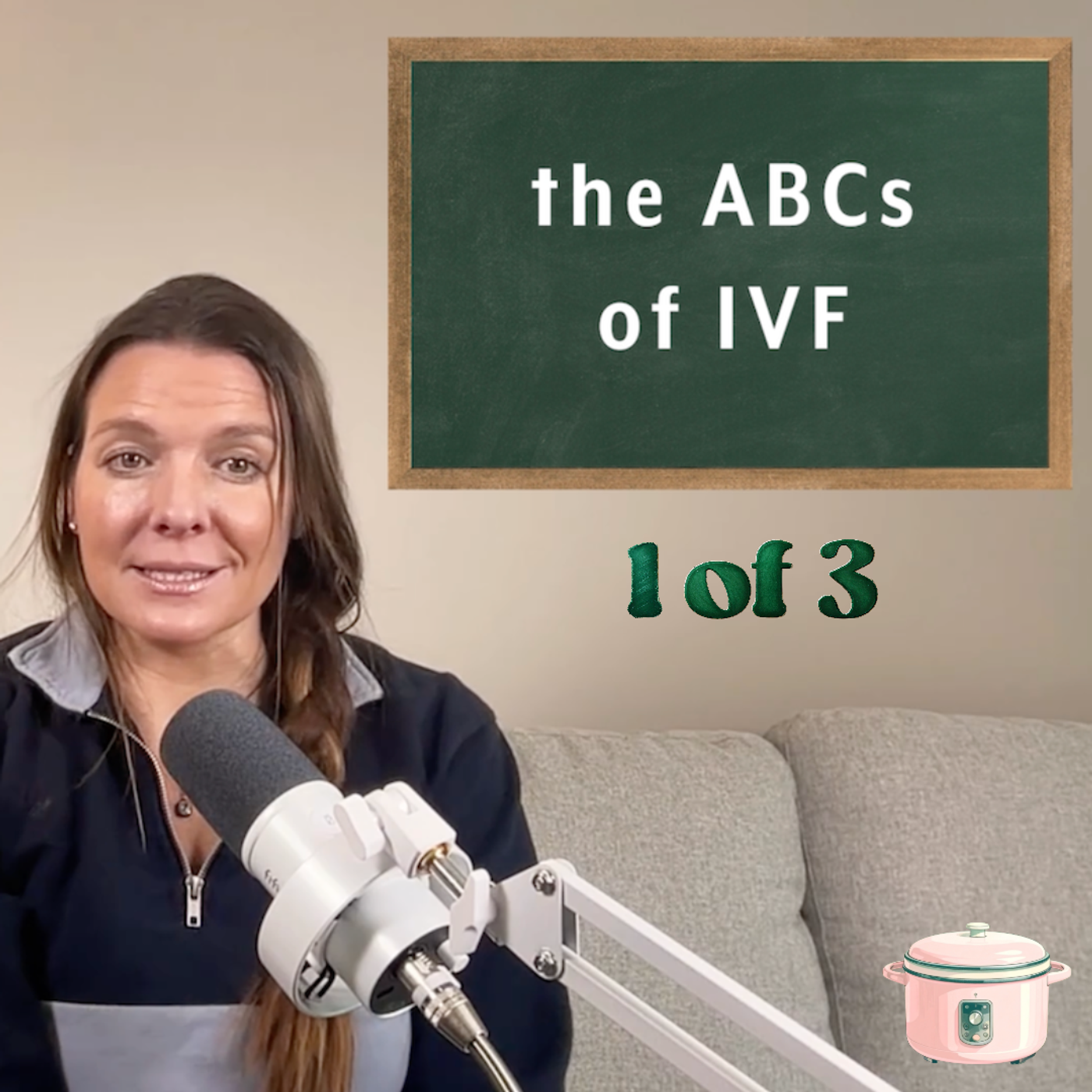
Episode 3: ABCs of IVF (Part 1) - The Initial Consultation & Work Up
Tonight's Episode
There are multiple ways to get to the point where you might consider in vitro fertilization (IVF). But no matter the reason, the process largely remains the same. That process, however, is quite complicated and sort of daunting.
In this three-part series, Ashlyne Blue breaks down the whole thing using her personal journey starting with the initial consultation and the work-up (part 1), the egg retrieval (part 2), and the embryo transfer (part 3).
Have a question or have a fertility story to share?
Email [email protected]
Instagram: @confessionsofaslowcooker | @ashlynehuffblue
This audio and video podcast was produced, edited, and distributed by Small Batch Sound. https://www.smallbactchsound.com
Small Batch Sound: Hey everyone and welcome back to Confessions of a Slow Cooker. I'm Ashlyn Blue and today is going to be the first in the series I call the ABCs of IVF. The basics, the possible timelines, the steps, the meds. There are plenty of online resources available from every clinic out there. But hearing about it is sometimes a little easier than reading about it on a webpage. Case in point, I went back to see what my clinic wrote and yeah, it was accurate, but. I was overwhelmed and I've already gone through it. IVF stories are all over this podcast, but I think it's smart to dedicate a whole episode or two or three to the process itself. Because until you go through IVF or walk alongside someone else who's gone through it, it's not really common knowledge. I find that people typically know that it's emotionally and physically taxing and that it's very expensive. And all that is very correct. But it's a lot more than that. I went to CCRM, which is Colorado Center for Reproductive Medicine in Lone Tree, just outside of Denver. And the reason I went there was simple, because I knew someone who had gone there and had been successful. Molly Dodge lives in Aspen, and she at the time had her first of two baby girls via IVF. So I called her when my husband and I were contemplating this very big step. She gave me every bit of information I could have ever asked for, and I took her lead. How you pick your clinic is up to you. But if you know someone who has gone through the process, I do suggest at the very least asking about their experience. My conversation with Molly, it really prepared me way more than just a Google search would have. Plus, then I had a resource. There are so many fertility clinics out there. However, I can only speak to my experience at my clinic. So please know that whatever I'm about to tell you might be different when and if you go through it. Every place has their own protocols. Every doctor has their own approach. Nothing I'm telling you is saying it's right or wrong. Again, it's just my personal experience at my clinic. In preparation for this episode, I went back and did some research. Yeah, it was seared in my brain while I was going through it because it was everything. I mean, I could have said it all in my sleep, but now, almost three years later, it's kind of hazy. So I went back through all the stuff I kept and I kept everything. My journal entries, I went and read back up on the procedures I had, the meds I took. Actually, that makes me think of something else. I went through IVF mostly in 23. It's 2026 at the time of this taping. So even the specifics at my clinic could have changed by now. Technology and science are always changing and getting better, which is good. Just keep that in mind. So I don't think the process itself has changed that much. So let's get started. After you've chosen a clinic, you need to schedule an initial consult with a doctor. Ours is online because we live three and a half hours away, but I remember them offering it to us in person. Our doctor gave us a background of her work, her qualifications, and then lots of questions. She wanted to know our entire backstory, including health histories, our ages, if I had ever gotten pregnant before, if he'd ever gotten anyone pregnant before. Basically, is there any knowledge that either of you can get successfully pregnant? No. Was our answer. When do we start trying? If we had tried Niiui, which we'll cover on another episode. Had Marcus gone to a urologist? Things like that. She was trying to see if we were candidates or if she would offer us an alternative suggestion. And by the end of our conversation, it was decided in her view that we were candidates. She told us we would need to schedule a quote, workup, one for him, one for me at the clinic. This conversation was the first step. And while she thought we would be good candidates, the workup would give us the real physical results of that theory. The workup takes pretty much a whole day, at least for the woman. I have my sheet right here. So looks like I started at 10.45 in the morning and my last appointment of nine began at 2.30. And then I had to drive over three hours through the Rockies in the winter back to Aspen. So fun. Something important to know right off the bat, everything during IVF is based around your cycle, everything. So this workup was scheduled based on what day of my cycle I was on, not an arbitrary date on my calendar. Go ahead and get a tracking app for your cycle, ladies. You're gonna be using it a lot. The first test of the day for me was a baseline 3D ultrasound and Doppler. So, pants off. I can't recall how many ultrasounds I ended up having during IVF, but this was the start of it. The 3D ultrasound and Doppler are used to assess uterine health, ovarian reserve, which is your follicle count, and blood flow in the uterus and ovaries. What they find out here can provide a crucial set of data to help predict ovarian response. and then tailor medication dosages for a more successful IVF cycle. My apoligal count was fine. My uterus' lining seemed fine, but they said there was a blood flow issue revealed by the Doppler around my uterus. So they suggested that I see an acupuncturist during certain parts of the process to aid in that blood flow. Of course, I said yes. And I remember you can't have caffeine for like 72 hours before this test and no thank you. Pants back on. Next, a nurse consult where I met my assigned nurse who would basically be my point person for the entire thing. Lots of paperwork in this one. I think it was during this one. And then there was the financial consult where we talked about the expense of it all. Quite the mood damper, if I recall. IVF is so expensive. After that, it was back to the probing. IVF, like an IUI, like a Pap smear, lots of probing. Get ready to be probed a lot. Okay, pants back off. The HISS test, which is short for a hisscaroscopy. It's kind of fun to say. It's a procedure done by your doctor to examine the inside of the uterus using a thin lighted tube. It is used for both diagnosis and treatment of issues like abnormal bleeding, uterine fibroids, or polyps. Mine did not take long and it didn't hurt, if I recall, but they did have me pre-treat with petylenol for like soreness later. Another test I think I would have done that day, but I had already gotten done before the workup, is the HSG. I can't pronounce it. I'm not going to try. It's also known as the blue dye test. And they inject this blue dye into your fallopian tubes and then take an x-ray to see if you have any blockages. This really hurt. But other people say it was no big deal. So it all depends on your body, I think. All right, pants back on. After that, I had a genetic counselor consultation. where they talk all about the testing they're going to do on both of you. And then the embryos, ⁓ you know, once the egg retrieval is complete, should you actually make it to that point. All right, now roll up your sleeves. Next was the first of many, many lab draws of this whole thing. Just like the probing, you have to get used to being poked by needles. Blood draws all the time. Shots in your belly for weeks on end. Lots of poking. This first lab draw was to test for communicable diseases, do genetic testing, and a panel to see levels on things like hormones and thyroid. Now, obviously, you don't get blood tests results in, real time, so it took a few weeks to learn this, but it turned out my thyroid levels were off just enough that they wanted to put me on levothyroxine right away. Apparently, that's a factor in getting pregnant, one you may know of but I was totally unaware of. I need to pause here. One of the hardest parts about IVF is the fact that you just don't know where in the process you may have a hiccup, if you do at all. There's no guarantee you'll get enough eggs, no guarantee they will successfully be fertilized and turn into embryos, no guarantee they will survive those crucial days or be deemed healthy and strong enough to be implanted. There are just so many unknowns in this process. And that brings me to the last step of the day, the so-called regroup with your doctor. Now, typically you and your partner go in for the workup together. He'll get his labs while you're doing your thing, and he'll provide a sperm sample that will be tested for motility, count, morphology, chromosome analysis. It's a lot less to do for the guy, but like I said, you would usually be there together and attend this regroup as a unit. Marcus and I had to do it on different days because of his schedule and my cycle. So I attended this part in person by myself, and he had gone like a couple of weeks earlier. I called Marcus in at some point and the reason I didn't call him right away was that I thought, ⁓ she'll just say something to the effect of, we'll wait for blood test results, but if all looks good, we'll get you going as soon as possible. I was wrong. We got bad news. Even though we had done two IUIs just a few months before and during the IUI, they like actually examined the sperm to see if it's good enough to move forward. And it had been. Well, something had happened in the meantime. His count wasn't just low, it was gone. Like, no count, nothing. I felt like I had been punched. And then I was gonna have to call my husband to tell him this news while I was still in this meeting. Obviously, you know how this ends, we have a son. But at the time, it was devastating. We didn't know what had happened, how long it would take to get the count back up, any of it. Long story short, we couldn't move forward with IVF until we got that under control. But Marcus was a trooper. He went to a fertility-focused urologist in Denver for the next year and tried everything under the sun to get his count back up to where we knew it could be. Ultimately, we found out it was an obstruction. Still not sure what caused it. And he got his sperm manually retrieved about a year after our workup. Or as he likes to call it, they ice-picked his balls. To recap, I went in for my workup in February of 2022. I didn't start IVF until March of 2023. We'd just experienced our first tick-up and it wouldn't be the last. I think that's a good place to stop for today. It's a lot of information and there's a lot more to talk about. If you have questions about anything I talked about today, please reach out, whether that be via social media or YouTube or email. There's a link in the show notes for all of it. Just starting IBF can be so overwhelming and you don't have to go it alone. And if you know of someone who's going through this and you think it would be of help, please share it. Next time we'll talk about the next step in IBF, the egg retrieval. Until then, take care.
 Apple Podcasts
 Spotify
 YouTube
 Castbox
 Castro
 Goodpods
 Podcast Addict
 Moon FM
 Overcast
 Pocket Casts
 Podbean
 Podcast Republic